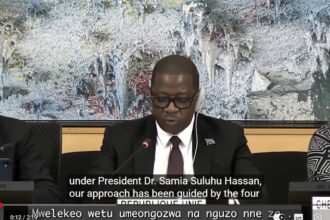
Meeting on Monday 29 June at the Palais des Nations, on the sidelines of the 62nd session of the United Nations Human Rights Council, the Independent Commission of Inquiry into violations committed in the provinces of North Kivu and South Kivu presented an initial assessment of its mission in the Democratic Republic of the Congo, while calling for international mobilisation to preserve evidence of the crimes and protect the victims.
Held under the theme “Documenting crimes, protecting civilians”, the meeting brought together commissioners, international organisations and representatives of Congolese civil society involved in documenting human rights violations.

Nearly a year and a half after the Human Rights Council resolution establishing the Commission of Inquiry, its members presented the initial findings of their recent mission to Kinshasa. Despite a particularly poor security situation that prevented them from deploying to the worst-affected areas in the east of the country, they reaffirmed their determination to conduct an independent, rigorous and impartial investigation.
“Our mandate is to establish the facts, document violations, identify alleged perpetrators where possible, preserve evidence and contribute to future justice mechanisms,” one of the commissioners said. He stressed three principles that will guide the Commission’s work: the independence of the investigation, the protection of victims and witnesses, and the preservation of the evidence essential to the fight against impunity.
The commissioners also paid tribute to Congolese organisations that continue their documentation work despite the risks. Human rights defenders, journalists, humanitarian workers and civil society representatives remain, in their view, essential partners in establishing accountability in a conflict in which violations of international humanitarian law continue to be reported daily.
The testimony of Évariste Iragi, a representative of the Goma-based organisation Haki Zangu, illustrated this reality. He described the system his organisation has set up to gather information from the very heart of the occupied areas: a network of local defenders, analysts tasked with verifying testimonies, a secure database and close cooperation with medical facilities in order to identify victims of torture or sexual violence. It is painstaking work, carried out in an environment where the risk of reprisals is ever-present.
Beyond their assessment of the situation, the speakers stressed a common message: without the methodical collection of evidence, without the protection of witnesses and without sustained support for local organisations, the prospects of justice risk receding.
The Commission of Inquiry now intends to continue its investigations and hopes to be able to travel soon to Goma and other localities in the eastern DRC. Its objective remains unchanged: to prevent the human rights violations committed in the region from becoming normalised, to preserve evidence before it disappears and to lay the groundwork for future accountability.
Translated from French. The French original prevails.