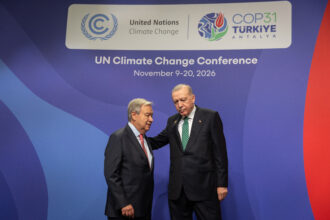
The accelerating retreat of Arctic sea ice, observed by scientists on the Tara Polar Station expedition, is a reminder of the urgency of the commitments made at COP21. Ten years after the adoption of the Paris Agreement, global warming continues to upset the planet’s natural balance. But behind the scientific warning lies a political paradox: the melting ice, which threatens ecosystems and global climate stability, is opening up new commercial and strategic opportunities for the major powers. We take stock as COP31 opens in Antalya, Turkey, on Monday and runs until 20 November.
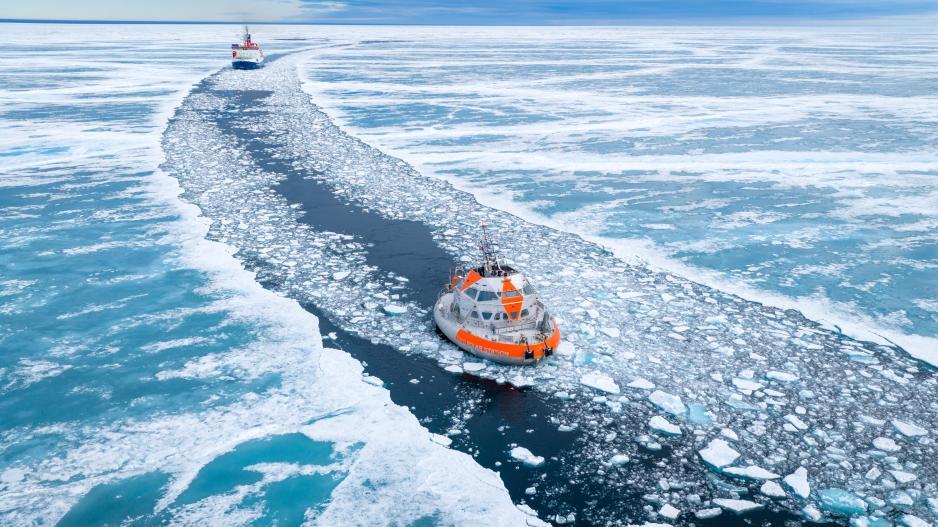
The Tara Polar Station, a drifting polar research station, in the heart of the Arctic Ocean. Researchers are studying the changes in the sea ice and their consequences for the global climate. The retreat of Arctic ice is one of the most worrying signs of global warming.
Some regions tell, by their transformation alone, the full scale of a planetary crisis. The Arctic is one of them. In the darkness of the polar night, twelve scientists and a dog named Örkki are currently drifting on weakened sea ice aboard the French research station Tara Polar Station. Their mission is to study the upheavals in an ocean whose balance is increasingly threatened by global warming. Their findings are unequivocal: the ice is becoming scarcer, open water is gaining ground and human activity is pushing into regions that were once difficult to reach.
As international climate negotiations approach, this expedition sheds a particularly worrying light on the state of the planet. Above all, it is a reminder that the scientific warnings issued before and during COP21, held in Paris in December 2015, are far from having lost their relevance.
The Paris Agreement meets the test of reality
COP21 marked a turning point in climate diplomacy. For the first time, states adopted a universal agreement aimed at holding global warming to well below 2°C above pre-industrial levels, while pursuing efforts to limit it to 1.5°C. This commitment rested on a collective recognition: climate change is a global threat that cannot be tackled through isolated initiatives.
Ten years on, however, the Tara Polar Station expedition is a reminder that adopting an international agreement is not enough to reverse the physical dynamics of the climate. The transformations in the Arctic bear witness to the persistent gap between diplomatic goals and the reality observed on the ground.
According to the United Nations statement, the Arctic is warming three to four times faster than the global average. This acceleration makes it one of the regions most vulnerable to the consequences of climate change. The UN Secretary-General, António Guterres, voiced his concern during an exchange with Maxime Geoffroy, the expedition’s chief scientist. He believes that world leaders have yet to fully grasp the gravity of the situation.
This concern raises a central question: what is the point of climate commitments if political and economic decisions continue to contribute to the degradation of ecosystems? COP21 opened a new chapter in the fight against global warming. The challenge now is to turn that ambition into tangible results.
The Arctic: a barometer of global climate disruption
The retreat of the sea ice is not merely a regional phenomenon. It affects a mechanism that is essential to regulating the global climate. Arctic ice acts as a vast natural mirror. Its white surface reflects part of the sun’s radiation back into space, thereby limiting the amount of heat absorbed by the ocean.
When the ice disappears, the dark waters absorb more solar energy. They warm up, which in turn accelerates the melting of the sea ice. This mechanism, known as the albedo feedback, helps to amplify global warming. The phenomenon is all the more worrying because the Arctic Ocean plays a major role in the circulation of water masses and the redistribution of heat across the planet.
Disruption to these mechanisms could have consequences for marine ecosystems and climate patterns far beyond the Arctic Circle. The scientists aboard Tara Polar Station fear, in particular, that an ice-free Arctic in summer could become a reality in the coming years. Such a development would represent a major upheaval of the natural balance.
But the researchers also acknowledge the limits of current knowledge. Climate models make it possible to anticipate certain developments, without determining precisely when they will occur or the full extent of their consequences. That is precisely what makes their mission indispensable: to observe, measure and understand the changes under way in order to improve the capacity to anticipate them.
When climate catastrophe becomes an economic opportunity
One of the most striking paradoxes of the Arctic’s transformation lies in the way it is perceived by economic players and the major powers. While scientists warn of the gradual disappearance of the sea ice, companies and states see the opening of new shipping routes as an opportunity for commercial and strategic development.
The researchers aboard Tara Polar Station thus came across several oil tankers using the Northern Sea Route along the Russian coast. The shrinking ice cover is making these routes more accessible. It could boost maritime transport and heighten the economic appeal of the region.
Yet this prospect carries considerable risks.
An oil spill in Arctic waters could have particularly serious consequences for marine wildlife. Oil could remain trapped in the ice for long periods, while the climatic conditions would make clean-up operations extremely difficult.
The opening of these new routes thus illustrates a fundamental contradiction: the consequences of global warming are liable to create economic opportunities which, in turn, may help to increase the pressure on the environment.
The problem extends far beyond the question of shipping. It also concerns natural resources, strategic interests and geopolitical rivalries.
António Guterres has, moreover, warned against an approach to the Arctic increasingly dominated by security considerations and the ambitions of the major powers, at the expense of protecting this fragile environment.
Science versus political and economic interests
Beyond its scientific observations, the Tara Polar Station expedition highlights another major issue: the place of science in political decision-making. The programme brings together some 80 scientists working on 220 research protocols. Their work focuses in particular on how marine life is responding to warming, deep-sea biodiversity and the role of the Arctic Ocean in carbon storage.
This international cooperation, which brings together researchers from twelve countries, shows that scientific knowledge can transcend geopolitical divisions. It is also a response to the pressure exerted on researchers and to attempts to sideline climate data in public debate.
António Guterres denounced economic interests, notably those linked to fossil fuels, that seek to discredit scientific evidence and weaken its influence on political decision-making.
The expedition’s chief scientist, Maxime Geoffroy, for his part describes a worrying shift: after climate denial, strategies to delay action are proliferating, sometimes compounded by “green silence”, or greenhushing, which consists of downplaying or concealing environmental commitments. This shift is particularly troubling in light of the ambitions proclaimed at COP21.
The Paris Agreement enshrined the central role of science in the fight against climate change. But recognising this need does not guarantee that governments will give it priority when weighing economic and political trade-offs.
From Paris to Antalya: the challenge of climate credibility
COP21 raised considerable hopes. It showed that states could overcome their differences to acknowledge a shared responsibility in the face of a planetary threat. But the experience of Tara Polar Station is a reminder that climate diplomacy cannot be judged solely by the declarations and agreements adopted.
The credibility of international commitments now depends on their being translated into concrete action: cutting greenhouse gas emissions, transforming energy systems, protecting ecosystems and curbing the most destructive human activities.
In this respect, the message to the leaders gathered in Antalya for COP31 is particularly clear. Scientific findings must be taken seriously, acted upon and supported.
The Arctic is a warning, but it also lays bare the contradictions running through climate policy. On the one hand, governments acknowledge the need to limit warming. On the other, economic and geopolitical interests continue to favour activities likely to worsen climate disruption. This gap is fuelling a crisis of confidence in the ability of international institutions to respond effectively to the emergency.
An existential fight for the future of the planet
Finally, the Tara Polar Station expedition is a reminder that the fight against climate change is not merely a matter of economic or diplomatic considerations. It concerns the preservation of the very conditions for life on Earth. The disappearance of the sea ice, disruption to ocean currents and the weakening of biodiversity are all signals that bear witness to the vulnerability of natural balances.
For António Guterres, the climate fight is also a fight for truth and for science. He expressed his concern, but also his anger, at the scale of the upheavals observed and at the persistence of political inaction. This anger reflects a sense of historic responsibility: present generations still have the means to change the course of the climate, but every delay narrows the options for action.
Ten years after COP21, the Arctic is a reminder that the time for declarations must give way to the time for decisions. The scientists aboard Tara Polar Station continue to drift at the mercy of the winds and currents. They control neither their course nor the changes to the sea ice on which they work. But the future of the planet they are observing is not entirely set in stone. It also depends on the choices world leaders make: whether to treat the climate crisis as a collective priority, or to allow short-term interests to keep prevailing over the preservation of the planet’s balance.
The warning from the Arctic is unambiguous: what happens at the North Pole does not stay at the North Pole. And failure in the fight against global warming would not be the failure of one region of the world, but that of humanity as a whole.
Translated from French. The French original prevails.