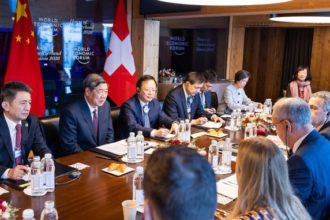
The World Economic Forum’s Davos 2025 meeting opened this week in an atmosphere tinged with uncertainty and international tension. As political leaders, business chiefs and influential thinkers gather in this small resort in the Swiss Alps, one question looms larger than ever: what purpose does this meeting serve at a time when the multilateral model embodied by the UN appears to be steadily eroding?

Since its creation in 1971, the Davos Forum has been hailed as a unique platform for bringing global decision-makers together around the major economic and social challenges. Yet this year’s meeting highlights a growing gap between stated ambitions and the reality of the geopolitical landscape. Armed conflicts, recurring economic crises and the fragmentation of international alliances have profoundly reshaped the dynamics of global power. The UN, once seen as a bulwark against such divisions, is today weakened by internal rivalries and institutional paralysis. In this context, can Davos, with its informal format and lack of coercive power, really contribute to effective global coordination?
Participants at this 2025 edition are highlighting crucial themes: the energy transition in the face of climate change, the regulation of artificial intelligence technologies and strategies to reduce economic inequality. But while the speeches are imbued with urgency and optimism, many criticise the forum’s tendency to favour spectacular announcements over concrete commitments. The lack of tangible follow-up after these meetings has become a source of frustration for a public disillusioned by inaction on critical issues.
Some argue that Davos’s importance lies elsewhere. More than an arena for formal decision-making, it is a space for dialogue where a wide range of actors – representatives of states, CEOs, NGOs and universities – can meet outside traditional diplomatic channels. Confidential discussions and informal agreements take shape away from the spotlight, sometimes helping to break deadlocks in complex situations. Yet this opacity also draws criticism: for some, Davos is more a closed club of the global elite than a genuine force for global change.
The end of the multilateral model as it was conceived in the 20th century does not necessarily mean an absence of international coordination. But the tools for achieving it are being redefined, and Davos finds itself in an ambivalent position. On the one hand, its inclusive and flexible approach could offer a model suited to new challenges. On the other, its lack of representativeness of the world’s populations and the limited accountability of its participants tarnish its legitimacy.
In 2025, the question “What is Davos for?” remains open. While it cannot replace the mechanisms of global governance, it can serve as a laboratory of ideas and a catalyst for innovative initiatives. But those ideas still need to resonate beyond the circles of power and to be matched by concrete action. For now, the Davos Forum remains a symbol of the state of the world: a place where the great challenges are identified but where solutions are often slow to materialise.
(article written with the help of AI)
Translated from French. The French original prevails.