© WHO/Pierre Albouy
The Director-General of the World Health Organization (WHO), Tedros Adhanom Ghebreyesus, at the opening of the 78th World Health Assembly in Geneva.
With the new Ebola outbreak and hantavirus “the latest crises in a world in turmoil”, the head of the World Health Organization (WHO) defended the record of the reforms undertaken by his organisation and called for an overhaul of global health governance.
At the opening of the 79th World Health Assembly in Geneva on Monday, the Director-General of WHO called for a far-reaching renovation of the global health architecture to make it fit for the future, saying it had over time become “increasingly crowded, complex and fragmented”.
“It is time to renovate it, in order to build. At this Assembly, Member States will consider a proposal to establish a joint process, led by Member States and hosted by WHO, to reform the global health architecture,” said Tedros Adhanom Ghebreyesus.
For WHO, the aim is not to launch a new initiative, but to bring together the many existing initiatives that have proposed reforms to the global health architecture, in part or in full.
Reform and modernisation
At the Palais des Nations, the WHO chief highlighted the transformation and modernisation efforts undertaken in recent years.
On health emergencies, he recalled the gains made since Covid-19, such as the creation in Berlin of a global health data hub backed by artificial intelligence, the launch of an mRNA technology transfer hub in Cape Town, South Africa, which now shares this technology with research centres in 15 countries, and the adoption of the first global Pandemic Agreement at the previous Assembly.
But these initiatives have been rolled out against a backdrop of budget cuts, economic crises and conflicts, “a difficult, dangerous and divisive time”.
As you all know, WHO itself has been through a difficult period because of sudden and drastic cuts to its funding.
Many people are wondering what impact these cuts will have on the future of WHO. They want to know what is happening.
Turning to the financial crisis hitting WHO, Dr Tedros acknowledged “a difficult period” following the abrupt withdrawal of US aid, which forced WHO to scale back its programmes and make significant job cuts.
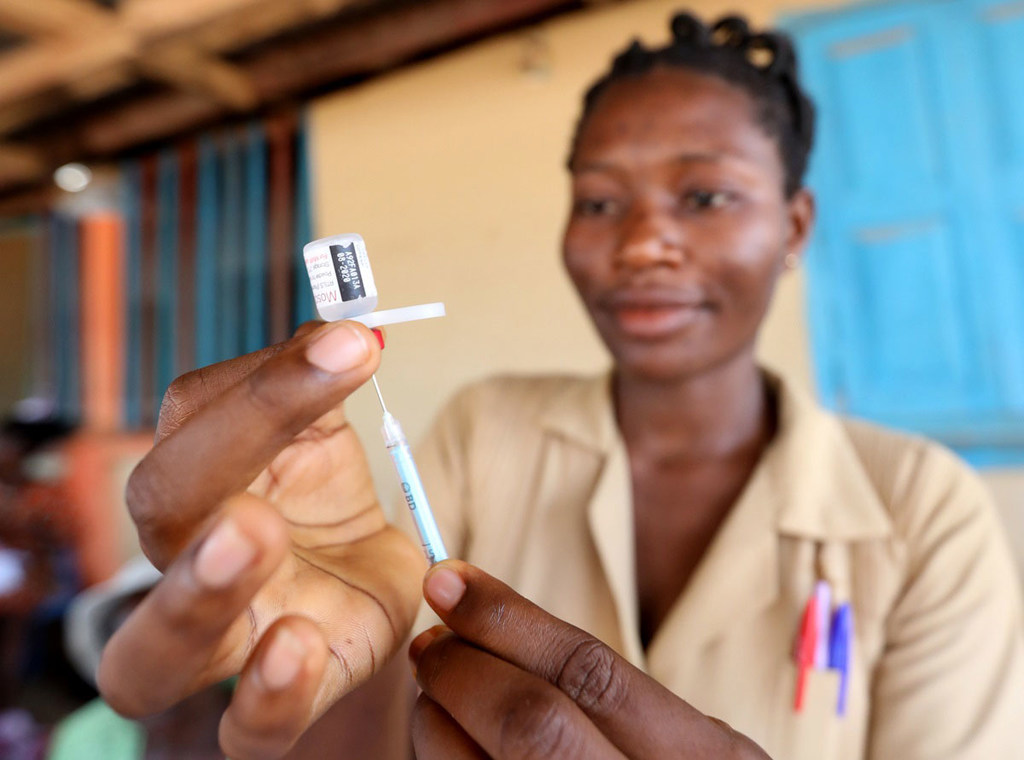
WHO A health worker holds a syringe of malaria vaccine in Ghana during a mass vaccination campaign. (file photo)
The call for a new health sovereignty
For the current budget period, the WHO chief said that 90% of the base budget was funded, while acknowledging that the remaining 10% would be difficult to raise in the current climate. “We have now completed the restructuring process. We have reached a position of stability and are moving forward with determination and confidence,” he argued.
But over the past year, many countries have experienced severe disruption as a result of sudden and drastic cuts in development aid. “These disruptions, and the damage they have done to the health of individuals, families and communities, were regrettable and could have been avoided,” Dr Tedros lamented.
The crisis has also prompted a political awakening in several countries, leading “many leaders to declare that the time had come to turn the page on the era of dependence on donors and to usher in a new era of health sovereignty”.
“That is the message of the ‘Accra Reset’, and the echoes of Accra are now resonating in Geneva and around the world,” Dr Tedros stressed, noting that every country should be able to count on others, out of friendship and solidarity.
“No country wants to be dependent. Every country aspires to equity. Every country aspires to sovereignty,” he concluded.
Less aid, greater health vulnerability
Echoing the WHO’s assessment, the UN Secretary-General also addressed the consequences of cuts to bilateral and multilateral aid, which have “disrupted health systems and deepened inequalities”.
Speaking in a video message, António Guterres painted a stark picture of the consequences of the cuts to international aid: clinics closed, health workers laid off, and prevention and health surveillance systems scaled back. These weaknesses, he warned, have cost lives and deepened the vulnerability of millions of people.
At the same time, WHO has redefined its priorities, turning its attention to the health challenges looming on the horizon. It was a way of reaffirming the central role of the UN agency in global health governance. The institution is regarded as indispensable in the face of recurring crises but, in their view, it will only be able to fulfil its mission in full if it preserves its independence and has stable, sufficient and sustainable financial resources.
It is against this backdrop of shifting priorities that a broader assessment of global preparedness for future health crises has emerged.

Unsplash/Gabriella Clare Marino Italians queue to be tested for COVID-19 after the Omicron wave of January 2022 in Rome, Italy (Archive)
Preparing for future health crises
Ten years after the Ebola epidemic and six years after the COVID-19 pandemic, the world remains insufficiently prepared for future health crises, warns a new report by the Global Preparedness Monitoring Board (GPMB), an independent body set up by WHO and the World Bank.
According to the report, epidemics are becoming more frequent and more destructive, while investment in preparedness has not kept pace with rising risks. Despite some progress, efforts are being undermined by geopolitical tensions, ecological disruption, increasing international travel and the fall in development aid, which is at its lowest level since 2009.
The GPMB warns that a new pandemic could strike a world that is more divided, more indebted and less able to protect its people. The report also stresses that artificial intelligence can strengthen health surveillance but, without safeguards, risks deepening inequalities. Finally, the experts call for better risk monitoring, equitable access to treatments and sustainable financing from “day zero”.
Translated from French. The French original prevails.