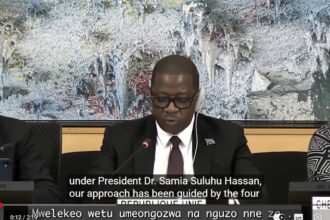
Before the UN Human Rights Council, the Congolese human rights minister presented a report covering the past year of occupation of Goma and Bukavu. Citing figures, he denounced an organised system of violence and looting, and explicitly called for sanctions against the Rwandan president.
At the rostrum of the United Nations Human Rights Council in Geneva, the tone was grave, almost cutting. The Democratic Republic of the Congo’s human rights minister, Samuel Mbemba, had not come to deliver a routine diplomatic speech. He had come, he said, “to place at the disposal of the international community a report containing chilling figures”.
Published on 21 February 2026 by his ministry, the document deals exclusively with “the twelve months of occupation of Goma, Bukavu and the surrounding areas”, in other words the past year in the cities of Goma and Bukavu. “This report was drawn up by consolidating various reports, notably those of United Nations experts and of NGOs on the ground,” he explained.
The figures he put forward are relentless. “At present, we have recorded 17,015 violations of the right to life and physical integrity.” Further on, he added: “As regards rape, a woman is raped every four minutes.” On top of this come “seven million forcibly displaced people” in a single year. “The figures are chilling,” he repeated, stressing that the data cover only the past twelve months.
For the minister, these atrocities are neither the product of chaos nor of isolated clashes. “The cause of all this is the exploitation of the DRC’s minerals, in North Kivu as in South Kivu,” he says. He then puts his finger on the sore point: the direct link between mass violence and the extractive economy.
He cites a specific example, that of the Rubaya mines. “In Rubaya, Rwandan forces have taken 30,000 artisanal miners hostage and are forcing them to extract at least three kilos of coltan every day,” he states. He then sets out the calculation: “Three kilos multiplied by 70 dollars a kilo, multiplied by 30,000 people, multiplied by 365 days: that comes to more than two billion dollars a year, in Rubaya alone.” A colossal windfall which, in his view, illustrates “systematic plunder”. He adds: “Those who do not do what the Rwandan forces demand are summarily executed.”
In Geneva, Samuel Mbemba did not stop at denunciation. He named a culprit. “The person primarily responsible for what is happening in the Democratic Republic of the Congo is President Paul Kagame,” he says, citing his role as “the hierarchical superior of the Rwandan forces, and even of their AFC/M23 auxiliaries”. The most damning line came a few moments later: “Paul KAGAME’s Rwanda is killing more people in the DRC than King Leopold II of Belgium did.”
In a forum accustomed to carefully guarded language, the comparison is striking. According to the minister, it is intended to highlight the historic scale of the loss of life accumulated over three decades of violence in the east of the country, which Kinshasa puts at more than ten million deaths. But the report presented in Geneva, he insists, documents only the last year of occupation.
The appeal to the international community was blunt. “For the Minister of Human Rights of the DRC, silence is not synonymous with neutrality. It corresponds to complexity,” he said, before adding, according to the transcript of his speech, that this silence “is beginning to resemble complicity”. “The time must be for action; the time for silence is over,” he insisted.
The demand is explicit: “The DRC calls for sanctions against Paul KAGAME.” Kinshasa says it is ready to cooperate with an independent international commission of inquiry, while asking: “Do we really need yet another inquiry to confirm that Rwanda is killing and plundering in the DRC? The answer is no.”
In a matter of minutes, the Congolese minister shifted the debate from the humanitarian realm to that of political responsibility and economic interests. By directly linking violence, strategic minerals and the chain of command, he touched a raw nerve: the intersection of regional geopolitics, critical resources and diplomatic hesitation. In Geneva, the Congolese message was clear: after a full year of occupation documented by damning figures, merely taking stock is no longer enough. Kinshasa now expects decisions.
Translated from French. The French original prevails.