To read the previous parts: https://ltdn.org/la-crimee-au-xxe-siecle-dune-republique-tatare-a-la-cession-a-lukraine/ and https://ltdn.org/pourquoi-la-crimee-nest-pas-russe-histoire-droit-et-volonte-de-ses-peuples/
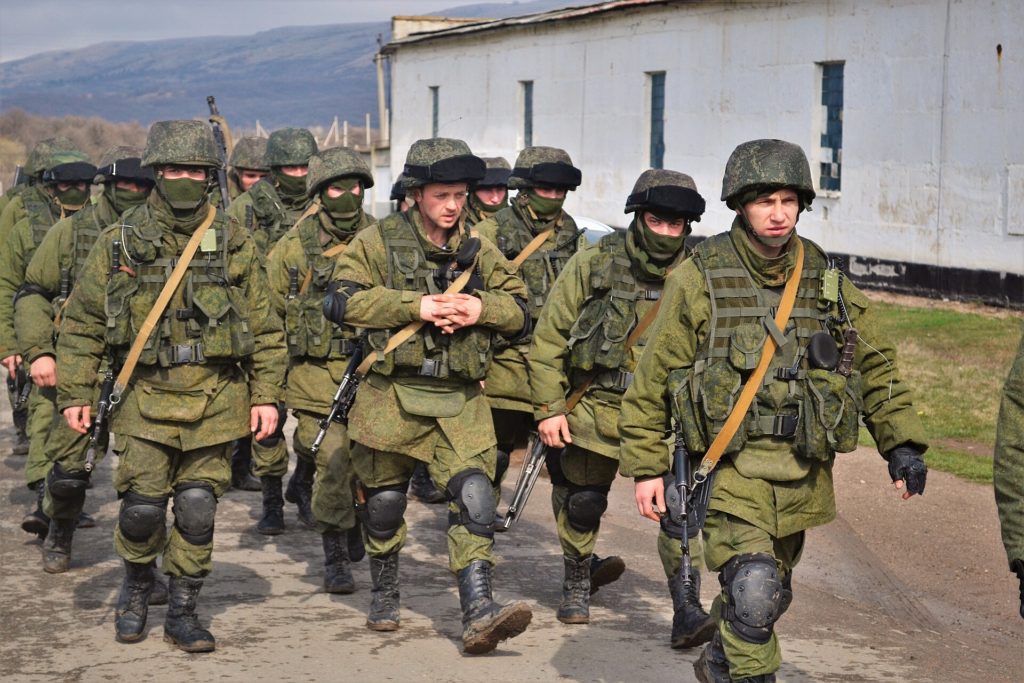
The little green men who landed in Crimea and then in the Donbas. Russian soldiers without insignia.
In the late 1980s, the policies of glasnost and perestroika launched by Mikhail Gorbachev weakened the Soviet Union’s repressive grip. For the first time in decades, it became possible to speak openly about the deportations and rights violations, and to demand the rehabilitation of convicted dissidents.
In 1989, the Supreme Soviet of the USSR adopted a declaration recognising the deportation as criminal and condemning the policy of the Stalinist regime, de facto paving the way for the return. It was a legal signal: the ban on residing in Crimea was no longer legitimate.
The state could no longer effectively control migration, harshly suppress civic movements or maintain the old system of prohibitions. This “loss of control” opened a window of opportunity. The Crimean Tatars began returning en masse to their homeland.
This return was not a “granted right” but the result of decades of non-violent resistance: petitions and letters to the Soviet authorities from the 1950s onwards, and mass appeals to Moscow in the 1960s and 1970s. This movement forged the people’s political agency and laid the groundwork for the mass return.
It took place with almost no support from the state. People were returning to a Crimea where their homes were occupied, their land had been redistributed and their very right to live there was contested. Despite this, the Crimean Tatar people rebuilt their communities, their language, their religion, and the Kurultai and the Mejlis as representative institutions.
At that point it became clear that Crimea was not “Russian land”, even demographically: the indigenous people had not disappeared – there had been an attempt to destroy them, but they had survived and returned.
This is where the contemporary chapter of Crimea’s history begins – one in which the question is no longer one of myths, but of law, memory and responsibility.
1991: Crimea’s choice
The collapse of the Soviet Union was not sudden: it was a long process of disintegration of an imperial construct in which the republics had lived without genuine sovereignty. At the end of 1991, when that system finally fell apart, the question concerned not only borders, but also the will of the people living within them.
By then, Crimea had already been part of the Ukrainian Soviet Socialist Republic for almost forty years. The peninsula was fully integrated into Ukraine’s economic, administrative and logistical space. It was Ukraine that built roads, power stations, irrigation systems, seaside resorts and towns. It was through Ukraine that Crimea received water, electricity and food.
On 1 December 1991, the all-Ukrainian referendum on independence took place. The inhabitants of Crimea took part in it. The result was clear and legally incontestable: more than 54% of voters in Crimea and more than 57% in Sevastopol backed Ukraine’s independence. That vote became the basis for the international recognition of Ukraine within its current borders, Crimea included.
Russia officially recognised those borders. In the 1990s, this was confirmed by several international agreements, including the Budapest Memorandum (1994) and the Russian-Ukrainian Treaty of Friendship (1997), in which Crimea was recognised as an integral part of Ukraine without any reservation.
In 1991, Russia did not dispute Crimea’s status. Because there was not yet any need to build a myth: history, law and reality coincided.
2014: an annexation, not a “return”
The events of February and March 2014 were the logical continuation of Russia’s imperial approach towards Crimea. After the Revolution of Dignity in Ukraine, the Kremlin took advantage of the political instability and sent troops without insignia – the “little green men” – onto the peninsula. Without a declaration of war, without an international mandate, in breach of every agreement in force.
The “referendum” of 16 March 2014 was in no way democratic or legal. It was held under a military presence, without international observers, without a status quo option, and with serious manipulation of the results.
The international community clearly characterised these events: the UN General Assembly affirmed Ukraine’s territorial integrity and the non-recognition of the annexation. No democratic state recognised Russian sovereignty over the peninsula.
It was not “the choice of the people”, but a military seizure of territory disguised as a pseudo-legal procedure of popular consultation.
The results announced by Russia: a turnout of 83% of registered voters and 96.7% of votes “in favour of Crimea joining Russia”. These figures are not recognised by most countries and are considered to have been falsified.
After 2014, Crimea once again became a territory of fear, silence and repression. The Crimean Tatars were particularly targeted: the banning of the Mejlis, persecution, arrests, disappearances, house searches and political trials.
The Mejlis of the Crimean Tatar People was banned once again. Activists, journalists and human rights defenders began to be persecuted, arrested and abducted. House searches, politically motivated cases and convictions on fabricated charges became the “norm”. People were punished not for their actions, but for their identity and the stances they took.
Russia is once again attempting to alter the demographics of Crimea – settling tens of thousands of Russian citizens on the peninsula while pushing disloyal populations to leave. This is a direct parallel with the policy of the 18th and 19th centuries and stems from the same logic: if you cannot change people’s will, you replace the people themselves.
Before the occupation (1 January 2014), some 1.967 million people lived on the peninsula (Ukrstat). After the occupation: according to official Russian data, the population fell to around 1.90 million in 2021. Migration from Russia took place. According to Ukrainian and independent estimates, 500,000 to 800,000 newcomers, possibly as many as 1,000,000, arrived on the peninsula after 2014.
Official Russian data put the number of registered migrants at around 170,000–200,000.
Part of the local population (Ukrainians and Crimean Tatars) has left the peninsula, with estimates ranging from 50,000 to more than 100,000.
Russia has pursued a policy of “Russification”: increasing the proportion of Russians in the population while reducing that of Ukrainians and Crimean Tatars. Demographic changes have already significantly altered the population balance on the peninsula (with up to 35% of the population “replaced” over the past ten years, according to experts).
The occupation of Crimea and the “referendum” are not recognised under international law. Sanctions have been imposed on Russia and restrictions placed on economic activity. Since 2014, Ukrainian statistics have no longer kept a record of Crimea’s population.
Crimea today: occupation and militarisation
Today, Crimea has become a military base and a springboard for fresh aggression against Ukraine. Since Russia’s full-scale invasion of Ukraine in February 2022, Crimea has been turned into an outpost used for bombarding Ukrainian cities, mobilising military equipment and preparing naval and airborne operations.
Under the occupation, Crimean Tatars and citizens who do not support the regime face persecution: arrests, pressure on activists and restrictions on freedom of expression. Russia continues to reshape the demographic and cultural landscape: the active construction of military facilities, the settlement of Russian citizens and a ban on teaching the Crimean Tatar language in schools.
The Russian authorities control the education system: curricula have been brought into line with Russian standards and Russian is compulsory, while the Crimean Tatar language and culture are marginalised or relegated to optional classes. This applies to nursery schools and secondary schools alike, particularly in areas with large concentrations of Crimean Tatars.
Crimea’s economy operates under Russian control and serves mainly the peninsula’s military needs. Its infrastructure is constantly exposed to risk: ports, roads, energy networks and water supplies have been integrated into the Russian system, cutting Crimea off from Ukraine and from international trade. Tourism and commerce, which once made up a significant share of Crimea’s economy, are in crisis because of sanctions and international isolation.
Yet Crimea today is not merely an occupied territory. It is a symbol of the struggle for the right to one’s own land, culture and freedom, and a reminder to the world that history and international law cannot be rewritten by force. As it was thousands of years ago, Crimea remains a meeting place of civilisations, but today it is an arena in the struggle for the future.
Crimea’s history tells a different story. It shows that the peninsula has never been a “natural part of Russia”. It has been home to different peoples, states and cultures. It has had its own political tradition, its own memory and its own voice — one that there have been repeated attempts to stifle, but that no one has ever succeeded in destroying.
Crimea is not an imperial trophy. It is a land where law has always been stronger than myth. And it is precisely for this reason that the question of Crimea will, sooner or later, be resolved not by force but by the restoration of justice.
Myths of Russian propaganda
Myth 1: “Crimea has always been Russian”
Reality: over 2,500 years of history, Russia has controlled Crimea for only 5% of that time, always as a result of conquest. Including the current occupation, that amounts to just 183 years.
Myth 2 : “Crimea was gifted to Ukraine in 1954”
Reality: it was a Soviet administrative decision, formalised in law.
Myth 3 : “The inhabitants never wanted to be part of Ukraine”
Reality : the majority voted for Ukraine’s independence in 1991.
Myth 4: “There was a referendum in 2014”
Reality: a sham referendum held under occupation and not recognised internationally.
Myth 5 : “Crimea is ethnically Russian”
Reality: the indigenous people are the Crimean Tatars, and the demographic make-up was altered through colonisation and deportations.
Myth 6 : “Russia was protecting Russian speakers”
Reality: no international organisation has confirmed any systematic persecution.
Myth 7 : “Crimea has returned to its homeland”
Reality: under international law, Crimea is part of Ukraine.
Bibliography
- Alan W. Fisher — The Crimean Tatars. Stanford: Hoover Institution Press.
- Brian Glyn Williams — The Crimean Tatars: From Soviet Genocide to Putin’s Conquest. London: Hurst Publishers, 2015.
- Serhii Plokhy — The Gates of Europe: A History of Ukraine. New York: Basic Books, 2015.
- Orest Subtelny — Ukraine: A History. Toronto: University of Toronto Press.
- Paul Robert Magocsi — A History of Ukraine. Toronto: University of Toronto Press.
- Edward Allworth (ed.) — The Tatars of Crimea: Return to the Homeland. Durham: Duke University Press.
French-language and further sources
- Gwendolyn Sasse — La Crimée contre l’Ukraine ?. Paris: CNRS Éditions, 2017.
- Marlène Laruelle — Russia Between Fears and Challenges (La Russie entre peurs et défis). Paris: Armand Colin, 2016.
- Anne de Tinguy — The Great Migration: Russia and the Russians since the End of the USSR (La grande migration : La Russie et les Russes depuis la fin de l’URSS). Paris: Perrin.
- Sabine Dullin — The Invention of Soviet Borders (L’invention des frontières soviétiques). Paris: La Découverte, 2015.
- Thomas Gomart — The World in Turmoil : 10 Geopolitical Challenges (L’affolement du monde : 10 enjeux géopolitiques). Paris: Tallandier, 2019.
- The Crimean question: a textbook case for geopolitical analysis? Vladislava Sergienko and Joseph Martinetti
Translated from French. The French original prevails.