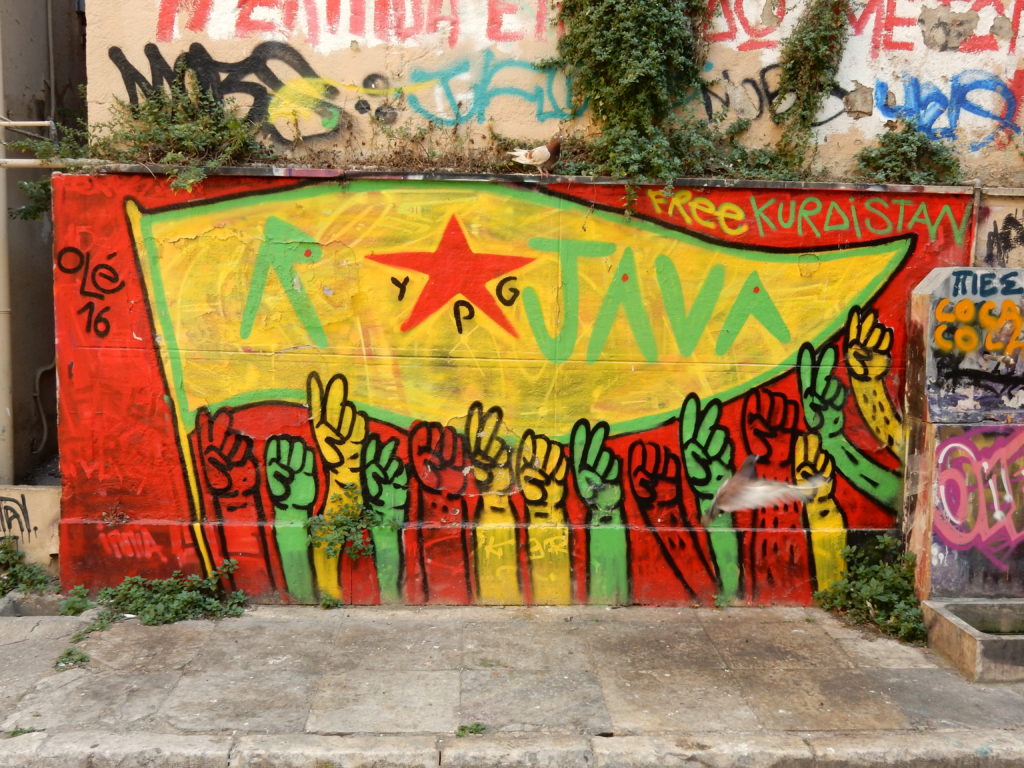
Mural in support of “Rojava, free Kurdistan” photographed in Athens, Greece.
Abandoned by the United States, the Kurds who fought Daesh during the jihadists’ offensive in Iraq and Syria in 2014, with logistical and air support from the Americans and other Western countries, find themselves alone twelve years later, facing both the determination of the new Islamist authorities in Damascus to unify Syrian territory under the authority of a central state, and Turkey, which is hostile to a Kurdish force and to any embryonic Kurdish autonomy on its border. Their dream of independence for Rojava, the term for the Syrian territory under their control, is slipping away, if not vanishing altogether.
The rout of the Syrian Kurds was preceded by statements from Thomas Barrack, the US Ambassador to Turkey and President Donald Trump’s envoy to Syria, which sealed the American ally’s abandonment of them. According to Thomas Barrack, “the original purpose of the SDF as the primary anti-Islamic State force on the ground has largely expired”.
The situation of the Kurds today is yet another demonstration of how little faith can be placed in an alliance with Washington under a Trump administration.
This U-turn, made in the name of stabilising the region, looks like yet another demonstration of how little faith can be placed in an alliance with Washington under the Trump administration. The US President’s special envoy added that “the Syrian government would henceforth assume responsibility for the remaining Islamic State prisoners”, who had until now been held by the SDF. On top of this came the forced departure of the Kurdish forces that had controlled the largest prison camp, Al-Hol, so that they could defend positions threatened by the Syrian government army’s offensive.
Some 9,000 insurgents and 30,000 members of their families are held in these camps, subjected to inhumane treatment condemned by the UN. The SDF’s defeat has reportedly already led to the escape of Salafist fighters (between 200 and 1,500, depending on the source), prompting fears in Western capitals of fresh waves of deadly attacks on their soil as homegrown jihadists who left to fight in the Levant return.
After a week of fighting, the forces of Syria’s new government, led by Ahmed al-Sharaa, have taken control of 80% of the territory held by the Kurdish-dominated Syrian Democratic Forces (SDF) in north-eastern Syria. This defeat can be explained in part by the defection of Arab tribal members within the SDF from the very first clashes, according to Fabrice Balanche, a geographer and expert on the region.
The Islamist factions of the Syrian National Army, funded and equipped by Turkey, and the former jihadists of Hayat Tahrir al-Sham who make up the new Syrian army heaped humiliation after humiliation on their opponents during the offensive on SDF-held territory, cutting off the braids of Kurdish women fighters or forcing men to bark like dogs (the worst insult in the lands of Islam).
The fiction of a West standing behind the Kurds, most of them secular and nationalist, has been shattered.
Yet an agreement was signed in Damascus on 27 January between the Syrian President, Ahmed al-Sharaa, and the SDF commander, Mazloum Abdi. Abdi says that Syrian army forces “would not be stationed in Kurdish towns and that governance would remain in the hands of the local populations”. He said that “a joint committee would be formed between the two sides to reorganise civilian and administrative institutions, notably Hasakah province and Qamishli airport”. He also says he has been assured that “the Syrian army would not enter any Kurdish town or area, in particular Kobani and the Jazira region”, and that “defence and security in these areas would remain entirely under SDF control”.
The massacres committed by jihadist militias linked to or tolerated by the authorities in western Syria against the Alawites, who supported the rule of one of their own, Bashar al-Assad, and against the Druze in the south, give the Kurds good reason to worry about how reliable the new Syrian authorities’ promises of national harmony really are. They also raise fears that this agreement is merely a way of buying time, or a decoy.
Some SDF officials believe that the occupation of territory with an Arab-majority population, such as Raqqa, which was under the control of the Islamic State between 2014 and 2017, has ultimately led to today’s situation, in which Kurdish-majority towns find themselves at the mercy of the jihadists of Hayat Tahrir al-Sham, parading through Hasakah in their 4×4 pick-ups with index fingers raised (the Salafist rallying sign).
With the new masters of Damascus asserting their authority over Kurdish territory and the Americans abandoning the Kurds, the fiction of a West standing behind a secular, nationalist Kurdish people has been shattered. That will not, however, stop European leaders from issuing statements full of empathy, nor prevent demonstrations of solidarity with the Kurdish people in the cities of Europe.
Translated from French. The French original prevails.