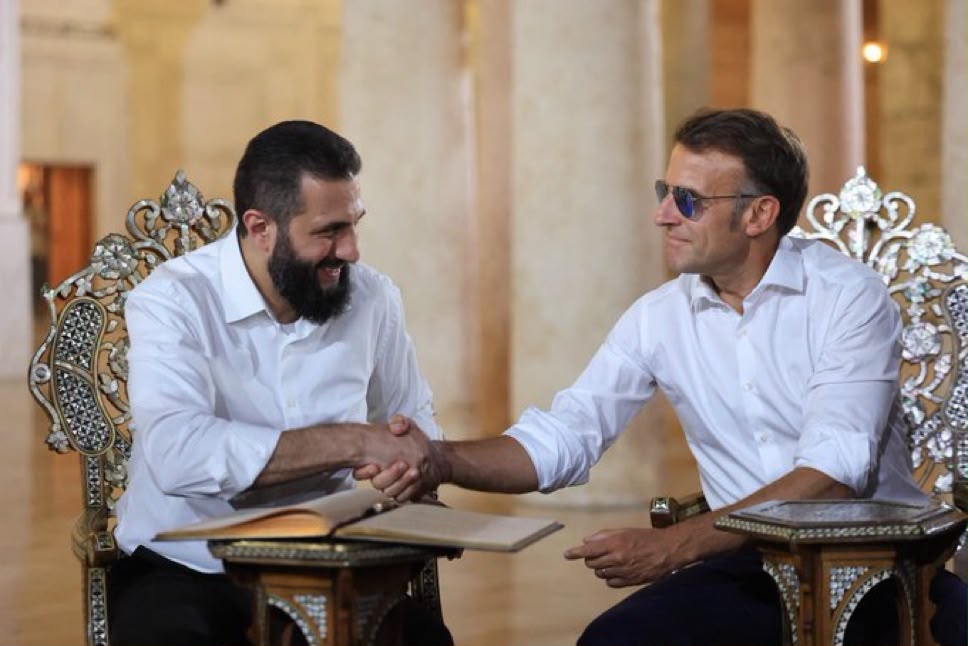
In travelling to Damascus, Emmanuel Macron is not only looking at Syria’s reconstruction. He is also trying to recover, by way of Syria, the French influence that has waned in Lebanon. But the new Syrian chessboard is already occupied by Washington, Ankara, Israel and the Gulf monarchies.
Emmanuel Macron’s visit to Damascus is not merely a diplomatic gesture. It marks France’s symbolic return to a post-Assad Syria in which Paris had retained only residual influence, challenged by Turkey, the United States, the Gulf monarchies and Israel. But this return raises a broader question: is France really returning to the Levant, or is it simply trying to regain through Damascus the influence it has lost in Beirut?
Two explosions rocked Damascus during the French president’s visit. The image is almost too perfect. France is returning to Syria, but Syria remains an unstable, fragmented country, still riven by cycles of violence, revenge and sectarian score-settling. The symbolism is striking: Paris wants to talk about reconstruction, investment and stability; Syrian reality is a reminder that nothing has yet been consolidated.
Officially, the French visit is part of Syria’s reconstruction. The task is immense. The World Bank puts it at more than $216 billion. Roads, energy, water, ports, infrastructure, hospitals, transport networks: almost everything has to be rebuilt. In these circumstances, it is hardly surprising that French companies are following in the president’s wake. Syria could once again become a market, a crossroads and a transit territory between the Mediterranean, Iraq, the Gulf and Turkey.
But behind Syria lies Lebanon
Sidelined on the Lebanese question, France is now trying to return to Lebanon through the Syrian back door. For several years, Paris has watched its role in Lebanon erode. Washington has taken charge of the key issues: the disarmament of Hezbollah, security on the southern border, relations with Israel and the future of the Lebanese army. Paris retains networks, a shared memory and a cultural presence, but it no longer holds the keys to decision-making. Lebanon, long presented as the natural sphere of French influence in the Levant, is now a theatre in which the United States, Israel, Iran, Saudi Arabia, Qatar and, increasingly, Turkey carry more weight than the former mandatory power.
France’s problem in Lebanon is not merely its diplomatic retreat. It is also that its word has worn thin. Emmanuel Macron promised the Lebanese a great deal, often in a tone perceived as condescending, preachy and at times domineering. He spoke of reform, of accountability, of political change, of support for the Lebanese people. Yet, in the eyes of part of Lebanese public opinion, these commitments have done little to change their lives or the way the state functions. France sought to lecture a political class that it never truly managed to bring into line.
It is against this backdrop that the presidential visit to Damascus should be read. Positioning himself as the preferred interlocutor of the new Syria may be an attempt to find an indirect way back into the Lebanese file. Since the closure of the land corridor linking Iran to Hezbollah, Syria has become a strategic chokepoint. For Israel, this rupture represents a major gain. For Washington, Damascus could become a means of putting pressure on Hezbollah. For Paris, it could once again become a gateway to Beirut.
Provided, that is, that this gateway is not already controlled by others
Turkey, first of all, makes no secret of its ambitions. It backed the reshaping of power in Syria, maintains a military presence in the north of the country and is signing one cooperation agreement after another with Damascus. Ankara sees the new Syria as a natural strategic extension: securing its border, containing the Kurds, gaining sway over trade routes, steering reconstruction and expanding its military and economic influence. This logic extends the new strategic balances in the Levant already examined in the report Turkey, Syria, Israel: the new strategic balances of the Levant.
The Gulf monarchies, for their part, are moving their pieces into place with pragmatism. Saudi Arabia, Qatar and the United Arab Emirates know that Syria’s reconstruction will also be an instrument of influence. In a region where money often rebuilds faster than rhetoric, French promises risk carrying little weight against the financial firepower of the Gulf.
Israel, meanwhile, views Syria with cold realism. Ahmad al-Sharaa is no ally. His jihadist past, his networks and the fragility of his grip on power rule out any illusions. But as long as Damascus breaks with Tehran, and as long as the Iranian corridor to Hezbollah remains closed, the new Syria may appear, in Israel’s eyes, less an immediate threat than a temporary stabilising factor. This is not trust; it is calculation.
Finally, the United States views Damascus through the prism of its regional posture. Washington is seeking to curb Iranian influence, isolate Hezbollah, strengthen the Lebanese army and bring about a new security balance in the Levant. Within this architecture, Damascus is treated not as an equal partner but as a point of leverage: a bulwark against Iran, a means of pressure on Hezbollah and a cog in the new security order the United States wants to see.
The UNIFIL question lends this realignment particular urgency. The mandate of the United Nations Interim Force in Lebanon expires on 31 December 2026, ahead of a gradual withdrawal planned for 2027. For France, which has always attached symbolic and strategic importance to its presence in southern Lebanon, the prospect weighs heavily. How can France maintain military or security influence in the area if the UN mission disappears? In what form? With which partners? And above all, with whose consent?
Washington believes that the Lebanese army must now take sole responsibility for security in the south. Israel considers that UNIFIL failed to prevent Hezbollah from rearming. The two actors who matter most on the issue are therefore hardly in favour of keeping an arrangement that would prolong the French presence in another form.
This is where Syria becomes central once again
If Damascus is to play a role in Lebanon’s balance of power, if its border with Lebanon becomes a means of applying pressure on Hezbollah, and if Ahmad al-Sharaa ‘s government is recognised as a legitimate regional actor, then Paris can hope to regain a place in the game. But this scenario carries a major risk: that of bringing Syria back into Lebanese affairs through another door.
The Lebanese have not forgotten the price of the Syrian occupation. For decades, Damascus weighed on their sovereignty, their institutions, their security services, their sectarian balances and their diplomatic choices. But this domination was not merely political. It also left behind memories of abductions, disappearances, assassinations, bombings and property confiscated or stolen. Imagining a post-Assad Syria today as an instrument for stabilising Lebanon may appeal to some Western strategists. For many Lebanese, above all it reawakens an old nightmare.
All the more so as Syria itself remains fragile. The new government says it wants to rebuild a pluralist state. But the reality on the ground tells a different story. The Alawites on the coast, the Druze in the south, the Kurds in the north-east and the Christians scattered between Damascus, Aleppo, Homs and the Orontes valley are still living in uncertainty. Sectarian dynamics did not disappear with Assad’s fall. They have shifted, reshaped themselves and at times grown worse.
The Christian question illustrates this silent erosion. Syria’s Christians, once an essential component of the country, now make up only a small, ageing and anxious minority. Their gradual disappearance is not solely down to the civil war. It is the result of a long movement of exile, accelerated by insecurity, economic collapse, fear of the future and the absence of lasting guarantees.
The refugee issue confirms this instability. Syrian returns are happening, but they do not necessarily mean normalisation. Some Syrians are going home because Lebanon has become unliveable. Others are heading back to Lebanon because Syria remains dangerous. Two movements cross paths: return out of exhaustion on one side, flight out of fear on the other. It would therefore be unwise to mistake the movement of populations for political stabilisation.
Syrian President Ahmad al-Sharaa
Against this backdrop, Ahmad al-Sharaa is playing a delicate game. A former jihadist who fought in Iraq and was detained by US forces, Ahmad al-Sharaa, long known by his nom de guerre Abu Mohammed al-Jolani – “al-Jolani” referring to the Golan in Arabic – went on to lead the al-Nusra Front, al-Qaeda’s Syrian affiliate. After breaking with Islamic State over control of the Syrian branch, and then formally splitting from al-Qaeda, he founded Hayat Tahrir al-Sham, an Islamist organisation that became the main instrument of his political and military rise.
But his power still rests on fragile balances, disparate alliances and local power dynamics. It also relies on a constellation of Islamist groups, including former foreign jihadists — Uzbeks, Uyghurs and others — as well as groups that emerged from the al-Qaeda movement. Hurras al-Din, or Horas ad-Din depending on the transliteration, has indeed announced its dissolution and the integration of some of its members into Syria’s new security structures. But an administrative dissolution does not erase an ideological trajectory. Its former fighters have not forgotten where they come from, and several abuses committed against Alawites have been attributed to these groups or to factions from the same jihadist milieu.
What role can France still play?
France wants to believe that a new Syria is possible. It is right not to leave this ground to the Turks, Americans, Israelis or Gulf states alone. It is also right to want to defend a vision that does not reduce Syria to a mere tool against Iran or Hezbollah. But it would be wrong to believe that the memory of its former influence is enough to win it back a place.
The old French Levant is no more. Syria is no longer the Syria of the Mandate. Lebanon is no longer the Lebanon of the 1990s. The Eastern Christians no longer constitute a political lever. Cultural networks no longer make up for the absence of power. And grand diplomatic declarations are no substitute for aircraft, soldiers, funding or security guarantees.
In this respect, the case of Air France is almost anecdotal, but telling. Just as Paris is proclaiming its ambition to return to the Levant, France’s national carrier remains cautious about resuming its flights to Beirut. Other airlines never fully withdrew or returned more quickly. The contrast is cruel: diplomacy wants to regain a foothold, but operational reality is still hesitant to touch down.
Emmanuel Macron’s visit to Damascus therefore opens an important chapter. It may mark the return of a more active French diplomacy in the Levant. But it may also reveal, once again, the gap between ambition and means. France wants to return to Syria so as not to vanish from Lebanon. Yet the Syria welcoming it has not been stabilised, the Lebanon it has in its sights is no longer under French influence, and the powers already shaping the new regional balance have not waited for Paris.
Damascus may once again be becoming a gateway to Beirut. But there is nothing to say that France still holds the key.
Also read in La Tribune des Nations
• In Meerab, the new Syria reaches out to Damascus’s historic adversaries
• Turkey, Syria, Israel: the Levant’s new strategic balance
Other sources
• Reuters – Bomb attack rocks Damascus during Macron visit
• World Bank – Syria’s post-conflict reconstruction costs estimated at $216 billion
• UNIFIL – Mandate and final extension until 31 December 2026
Translated from French. The French original prevails.