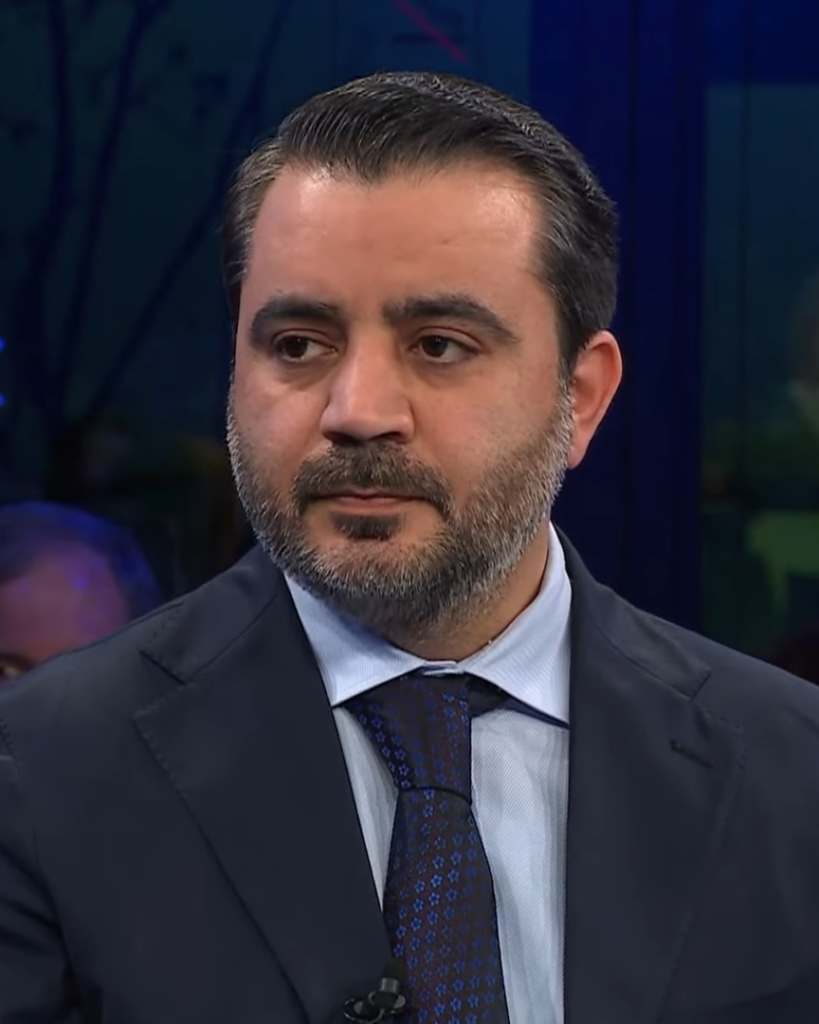
Syrian Foreign Minister Assaad al-Chaibani.
The visit by Syrian Foreign Minister Assaad al-Chaibani to Samir Geagea is a political gesture of great symbolic significance. By travelling to the headquarters of the leader of the Lebanese Forces, long regarded as one of the most determined opponents of Syria’s former tutelage over Lebanon, Damascus is seeking to showcase a new approach: dialogue, caution and recognition of Lebanon’s delicate balances.
Syrian Foreign Minister Assaad al-Chaibani continued his visit to Lebanon with a meeting in Meerab with the leader of the Lebanese Forces, Samir Geagea. After the talks, Syria’s top diplomat said the discussion had been “frank and transparent”, while expressing Damascus’s desire to strengthen relations between Lebanon and Syria.
Meerab, the Lebanese Forces stronghold
Meerab, often transliterated as Maarab, is no mere meeting place. Located in Keserwan, north of Beirut, the site is Samir Geagea’s political headquarters and one of the places most closely identified with Lebanon’s Christian sovereigntist camp. For Lebanon’s political class and foreign chancelleries alike, Meerab has become an obligatory stop for anyone seeking dialogue with the Lebanese Forces, one of the country’s main Christian parties.
Samir Geagea, Damascus’s historic adversary
Samir Geagea holds a special place in Lebanon’s contemporary history. A former military commander during the civil war turned political leader, he now heads the Lebanese Forces party. For decades he has established himself as one of the most consistent figures in the opposition to Syrian tutelage over Lebanon, and later to the influence of Hezbollah and the Iranian axis. It is precisely for this reason that a Syrian minister’s visit to Meerab goes beyond mere protocol.
The message sent by Damascus is therefore clear: the new Syria intends to talk to political forces that were long regarded as adversaries, or even enemies, by the former Syrian regime. In calling on Samir Geagea, Assaad al-Chaibani is not merely addressing a party leader. He is addressing a part of Lebanon that retains painful memories of the Syrian presence and remains deeply wary of any attempt to restore Damascus’s influence.
Assaad al-Chaibani, a diplomat who emerged from the Syrian rebellion
Assaad Hassan al-Chaibani’s personal background sheds further light on the significance of this visit. Born in 1987 in the Hasakah region and a graduate of Damascus University, he belongs to a generation shaped by the Syrian civil war. Before his appointment as head of Syrian diplomacy, he had joined the Syrian revolution as early as 2011 and taken part in founding the Salvation Government, a structure set up in the rebel enclave of Idlib. This background sets him radically apart from the old Baathist apparatus.
In other words, the man who now speaks of stability, state-to-state relations and support for Lebanon does not come from Damascus’s traditional diplomatic establishment. He comes from the political and administrative apparatus of the Syrian rebellion. That past calls for caution, but it also lends his approach an unexpected dimension: a former official from rebel-held Idlib is now visiting the stronghold of a Lebanese Christian leader who was one of the most determined opponents of Syria’s grip on Lebanon.
Damascus’s message: reassuring Beirut
The Syrian minister sought to reassure. According to him, “Syria is ready to stand by Lebanon”. He added that Lebanon’s stability was in Damascus’s interest and that Syria was committed to supporting Lebanon in maintaining its security and political stability. These remarks mark a notable shift in Syria’s vocabulary towards Lebanon. The tone is no longer that of a guardian power, but that of a neighbour seeking to present itself as a partner.
This caution can be explained by the regional context. The new Syrian leadership is seeking to redefine its place after the fall of Bashar al-Assad’s regime. It must contend with a fragmented Lebanon, the extreme sensitivity of the Hezbollah issue, American pressure and the conflicting expectations of regional powers. This sequence of events extends the realignments already analysed by “La Tribune des Nations” concerning the new strategic balances in the Levant.
Hezbollah in the background
The Hezbollah question remains in the background. Damascus says it has no wish to intervene militarily in Lebanon, while hinting that dialogue with Hezbollah could be considered should circumstances require it. This stance reflects a fine balancing act: Syria wants to reassure Lebanon without appearing to be an instrument of outside pressure, but it also wants to show that it is no longer automatically aligned with the old Assad-Hezbollah-Iran balance of power.
That is what makes this visit particularly interesting. By going to Meerab, Syria’s new rulers are speaking to the heart of a camp that was built in opposition to Syrian domination and to the grip of non-state weapons in Lebanon. They are also sending an indirect message to Hezbollah: the new Syria no longer seems willing to be locked into the old regional equation that made Damascus the strategic backyard of the Iranian axis.
Concrete tests ahead
For Beirut, the challenge will now be to gauge how solid this new Syrian posture is. Declarations of intent will have to be followed by concrete action on the most sensitive issues: border control, security, Syrian refugees, Lebanese detainees, cross-border trafficking and strict respect for Lebanese sovereignty.
An unexpected Syrian diplomacy
Assaad al-Chaibani’s visit to Meerab is therefore a strong signal. It reveals a Syrian regime that is more flexible, more calculating and more attentive to symbolism than one might have imagined. For many observers, this new Syrian diplomacy has come as a surprise. It remains to be seen whether it heralds a lasting break with Damascus’s old methods or is merely a tactical adjustment to a profoundly transformed regional balance of power.
Read also:
• La Tribune des Nations – Turkey, Syria, Israel: the Levant’s new strategic balance
https://ltdn.org/turquie-syrie-israel-les-nouveaux-equilibres-strategiques-du-levant/
• L’Orient-Le Jour – Samir Geagea receives Syria’s chargé d’affaires in Lebanon at Meerab
https://www.lorientlejour.com/article/1507290/samir-geagea-recoit-le-charge-daffaires-syrien-au-liban-pour-une-prise-de-contact-.html
• Arab News FR – Appointment and career of Assaad Hassan al-Chibani
https://www.arabnews.fr/node/499846/monde-arabe
Translated from French. The French original prevails.