As wars, the exploitation of natural resources and the digital revolution upend the global balance, the UN is opening a strategic session in Geneva devoted to the rights of indigenous peoples. For the first time, artificial intelligence has emerged as a major issue of cultural sovereignty, the protection of ancestral knowledge and digital justice.
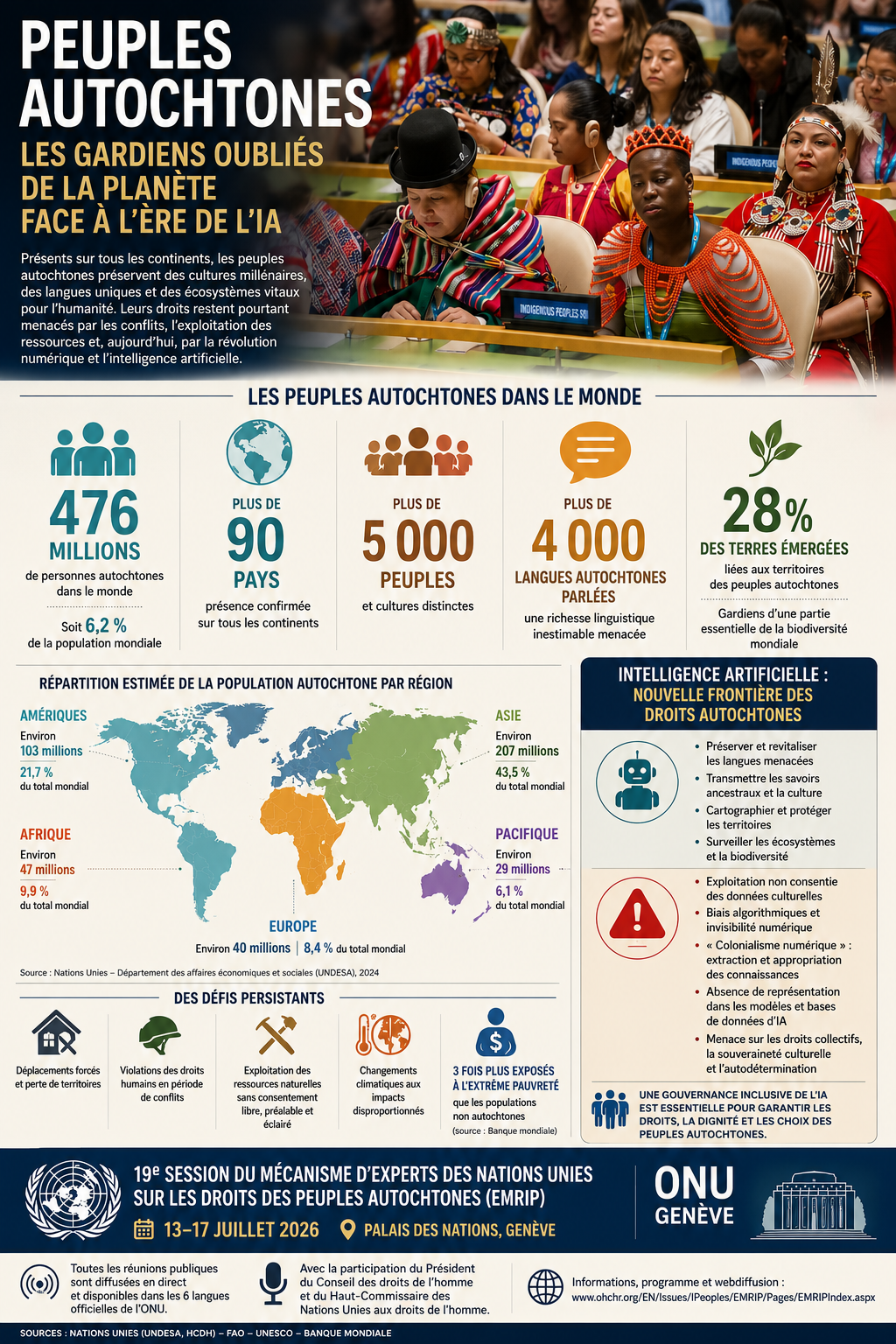
From 13 to 17 July 2026, Geneva will host the 19th session of the United Nations Expert Mechanism on the Rights of Indigenous Peoples (EMRIP) at the Palais des Nations. Yet behind an institutional gathering that attracts little media attention lies a crucial question: how can communities already weakened by conflict, climate change and economic pressures be protected in a world now transformed by artificial intelligence?
Established in 2007 by the United Nations Human Rights Council, the Expert Mechanism is made up of seven independent specialists tasked with providing expertise to the UN system and supporting the implementation of the United Nations Declaration on the Rights of Indigenous Peoples (UNDRIP). Adopted in 2007 after more than two decades of negotiations, the declaration recognises, among other things, their rights to self-determination and to their lands, resources, languages and traditions.
Almost twenty years on, these principles still come up against a far more complex reality. Indigenous peoples number around 476 million people in more than 90 countries, or almost 6% of the world’s population. Yet they remain among the communities most exposed to human rights violations, forced displacement and the consequences of armed conflict.
Conflict: an existential threat to indigenous lands
One of the highlights of this session will be the presentation of a study on the rights of indigenous peoples in conflict and post-conflict situations.The subject has become central. From the Amazon to the Arctic, from parts of Africa to territories in the Asia-Pacific region, many indigenous communities live in areas that have become strategic because of their natural resources: critical minerals, rare earths, forests, water or energy reserves.
These territories are sometimes at the heart of tensions between states, armed groups, private companies and local populations. Conflicts do not merely destroy infrastructure: they threaten ways of life, systems of cultural transmission and spiritual ties to the land.
The question being asked in Geneva therefore goes beyond traditional humanitarian protection: how can it be ensured that peace, reconstruction and development processes genuinely take indigenous peoples into account as political actors rather than simply as victims?
These deliberations also come at a time when the global energy transition is driving up demand for certain minerals essential to green technologies. A paradox emerges: the fight against climate change, which hits indigenous peoples hard, may itself place new pressures on their territories.
Artificial intelligence: technological progress or a new form of dispossession?
But the major new feature of this 2026 session is that artificial intelligence has moved to the heart of the debate. EMRIP will hold a dedicated panel on the links between AI and the rights of indigenous peoples. The subject could become one of the major emerging issues in global digital governance. For behind the promises of AI – easier access to education, language preservation, environmental mapping and cultural transmission – new risks are emerging.
Artificial intelligence models are trained on vast volumes of data. Yet some of this information may include traditional knowledge, narratives, languages or cultural elements belonging to indigenous communities, sometimes without their consent.
A fundamental question arises: who owns a people’s cultural data? In a world where data is becoming a strategic resource comparable to the oil of the 20th century, indigenous peoples are warning of the risk of “digital colonialism”: a situation in which their knowledge would be collected, exploited or commercialised by technology players without oversight or any sharing of benefits.
The issue ties in with the major international debates currently under way on the governance of artificial intelligence: algorithmic transparency, data representativeness, tackling bias and protecting vulnerable communities.
AI trained mainly on dominant languages also risks deepening the digital erasure of thousands of minority languages. According to UNESCO, a large proportion of the world’s endangered languages are Indigenous languages. Their absence from the digital world could hasten their disappearance.
Geneva at the heart of a new diplomacy of responsible AI
The presence of the President of the Human Rights Council, Sidharto R. Suryodipuro, at the opening of the session, together with the address by the United Nations High Commissioner for Human Rights, Volker Türk, on 15 July, illustrates the political dimension these debates have taken on.
For several years, Geneva has been seeking to establish itself as one of the world’s centres for the responsible governance of artificial intelligence. With the International Telecommunication Union (ITU), the Human Rights Council, the specialised agencies and a growing ecosystem of academic and private-sector players, the international city is trying to promote a different approach: putting people before technology.
The debate on Indigenous Peoples is a major test of this ambition. For AI governance cannot concern only the major technology powers, companies or states. It will also have to include those who risk being rendered invisible in this new digital revolution.
The session will also prepare for the 20th anniversary, in 2027, of the United Nations Declaration on the Rights of Indigenous Peoples. Two decades after its adoption, the challenge is no longer simply to recognise these rights but to adapt them to a profoundly different era: that of artificial intelligence, global competition for resources and climate crises.
The question raised in Geneva this week may ultimately concern the whole of humanity: how can the technological future be built without reproducing the exclusions of the past in the digital world?
Translated from French. The French original prevails.