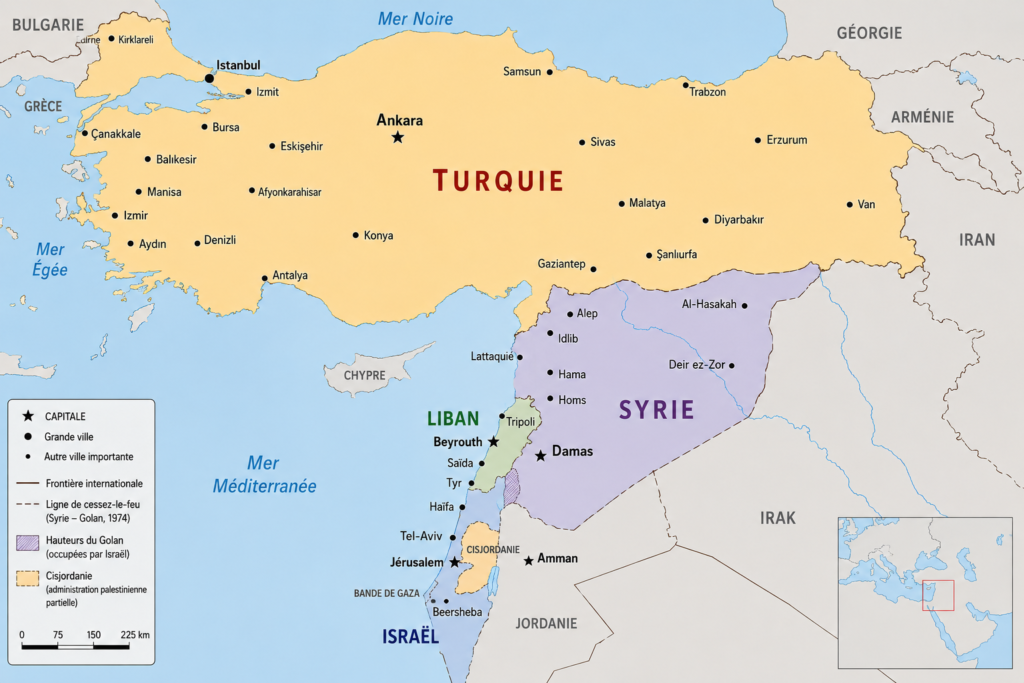
From the Ottoman Empire to the realignments of the 21st century, the Levant is once again becoming one of the main arenas of rivalry between regional powers. Syria’s gradual reconstruction, the rapprochement between Damascus and Ankara and the waning of Iranian influence are opening a new geopolitical chapter in the Middle East. For Israel, as for Lebanese officials, the questions are less about a return of the Syria of old than about the emergence of a new regional balance in which Turkey could play a decisive role.
“More than Syria’s return to Lebanon, it is the prospect of growing Turkish influence in the Levant that is now reshaping Israel’s strategic calculations.” For almost four centuries, Syria and Lebanon were part of the Ottoman Empire. Its demise in 1918 profoundly redrew the map of the Middle East without erasing the patterns of influence that had taken shape there. More than a century after the fall of the Sublime Porte, the Levant remains one of the most contested areas in the region, where the ambitions of regional and international powers intersect.
According to several reports in recent days, President Donald Trump has reportedly raised the possibility of giving the Syrian army a role in disarming Hezbollah in Lebanon, in order to avoid a prolonged intervention by the Israeli army. Whether or not it materialises, this scenario illustrates the profound strategic realignments currently under way.
For decades, the Syrian presence in Lebanon was one of the pillars of the political and security balance in the Levant. It left behind memories of enforced disappearances, political assassinations, arbitrary arrests and the placing of the Land of the Cedars under tutelage. The Assad regime in Syria also played a major part in the rise of Hezbollah, which it used for many years as an instrument of its regional influence.
The withdrawal of Syrian forces in 2005, followed by the gradual collapse of the Syrian state after 2011, sharply curtailed Damascus’s influence in Lebanese affairs.
Today, the situation is shifting once again. The rise to power of Ahmed al-Sharaa and the gradual rebuilding of Syria’s institutions are fuelling questions about a possible return of Syria as a regional player. Such a return would not, however, take place under the same conditions as before. Syria remains weakened, fragmented and dependent on outside partners, which profoundly alters the nature of its potential influence.
While Israel continues to voice its opposition to any Syrian military presence in Lebanon, its concerns now appear to centre on a more specific scenario: that of indirect Turkish influence exercised through the new Syrian institutions, particularly near the Israeli-Lebanese border. This fear is part of a much broader reading of the strategic realignments under way in the Levant.
A Syrian army still being rebuilt
After more than a decade of civil war, the Syrian armed forces remain severely weakened. Despite the reorganisation efforts launched by the new authorities, they no longer possess the conventional capabilities they had before 2011. Their air force remains limited, their equipment has suffered heavy losses and part of their structures is still being rebuilt.
On top of this come funding difficulties, substantial recruitment needs and the need to integrate the many armed factions that emerged from the civil war. The chain of command is itself still being reorganised, which further limits the Syrian army’s ability to project power beyond the country’s borders.
The make-up of this new army is also a source of concern. Some of its officers come from former Islamist factions that fought the Assad regime, notably Hayat Tahrir al-Sham (HTS), whose origins go back to al-Qaeda’s former Syrian branch, although the movement now claims to have broken with that lineage and to be pursuing an essentially Syrian agenda. Other units come from Islamist rebel groups gradually integrated into the new military structures.
Furthermore, a number of foreign fighters who took part in the civil war — notably from the Caucasus, Central Asia and the Arab world — still hold certain military or security posts. While this does not justify describing the Syrian army as a whole as “jihadist”, it is fuelling concern in several capitals. For Israel, the presence of former fighters with radical Islamist allegiances is a further source of uncertainty.
In these circumstances, a large-scale Syrian military intervention in Lebanon appears unlikely in the short term. Damascus’s priorities remain first and foremost domestic: stabilising its territory, rebuilding the economy, restoring institutions and reintegrating diplomatically.
Turkey, a new strategic variable
For many Israeli analysts, the real question is not so much what Syria is capable of doing on its own as what it could achieve with Turkey’s backing.
Since the change of regime, Ankara has established itself as one of Damascus’s main foreign partners. The two countries are cooperating on security, reconstruction, border management and the rebuilding of Syrian institutions. This cooperation is part of a much broader strategy aimed at strengthening Turkish influence in the Levant over the long term.
Many international relations specialists often describe this policy as “neo-Ottoman”. Without officially claiming to be reconstituting the Ottoman Empire, President Recep Tayyip Erdoğan regularly refers to Turkey’s historical legacy in the former provinces of the Sublime Porte. Syria and Lebanon, which were administered from Istanbul for nearly four centuries until 1918, hold a special place in this historical memory and in the strategic vision developed by Ankara.
Turkey has considerable assets: a modern army, a high-performing defence industry, recognised capabilities in the field of drones and a genuine ability to project forces rapidly, as it has demonstrated in Syria, Libya and the Caucasus.
However, Ankara currently has no significant military presence in Lebanon, and its priorities remain focused on northern Syria, Iraq and the Eastern Mediterranean. The prospect of an indirect Turkish foothold near the Israeli border is therefore more a matter of anticipated strategic scenario than of any development already observable.
For some Israeli officials, but also for part of Lebanon’s political class, this historical dimension is fuelling questions. More than a mere partnership between Ankara and Damascus, they fear that a gradually stabilised Syria could allow Turkey to extend its political, economic and security influence over a region that was once part of the Ottoman Empire. Such a development would lastingly alter the strategic balance of the Levant and place Ankara at the heart of the new regional balance of power.
From the Iranian axis to a new regional architecture?
For more than two decades, Israel’s security concerns centred on what was known as the “axis of resistance”, made up of Iran, Bashar al-Assad’s Syria and Lebanon’s Hezbollah. Syria was then the main strategic corridor for transferring weapons, munitions and military technology between Tehran and Hezbollah. This alliance shaped much of the military balance in the Levant and accounted for the many Israeli strikes carried out against Iranian or pro-Iranian targets on Syrian territory.
Ahmed al-Sharaa’s rise to power marks the start of a new chapter. Syria’s new authorities maintain far more distant relations with Tehran and are seeking to diversify their international partnerships. This shift reflects a desire to restore a degree of diplomatic autonomy and to secure the support of Arab countries and Western partners for the country’s reconstruction.
This development has led several Israeli analysts to wonder whether a new regional architecture is emerging, in which Turkish influence would gradually replace Iranian influence as the main external factor in Syria. The comparison should nonetheless be qualified. Despite recurring tensions between Ankara and Jerusalem, Turkey does not pose a threat to Israel comparable to that once embodied by the Iranian axis. For several decades, Turkish-Israeli relations have alternated between diplomatic confrontation, regional rivalry and pragmatic cooperation.
For Israel, then, the issue is not so much the emergence of a new enemy as that of a regional power capable of gradually reshaping the balance of power in the Levant. An influential Turkey in Syria could become an indispensable player on every regional issue: border security, Syrian reconstruction, the future of Lebanon, the Kurdish question, the Eastern Mediterranean and, ultimately, the strategic balance with Israel.
Hezbollah faces a new reality
For Hezbollah, the threat is of a different nature. The Shia movement does not necessarily fear a Syrian military offensive against its positions in Lebanon. Such an operation would seem scarcely compatible with the current capabilities of the Syrian army or with the priorities of the new authorities. On the other hand, a Syria that has regained more of its sovereignty and is more intent on exercising full authority over its territory could gradually call into question the logistical facilities Hezbollah had enjoyed for several decades.
Under the Assad regime, the routes linking Iran to Lebanon crossed territory largely favourable to Hezbollah’s interests. This strategic depth was one of the movement’s main assets. In future, tighter border controls, restrictions on the activities of foreign armed groups, the professionalisation of the Syrian army and a rapprochement with several Arab states could gradually curtail this freedom of action.
Hezbollah could thus face not a direct military confrontation with Damascus, but a gradual erosion of its logistical and strategic autonomy.
Lebanese parties caught between memory and caution
Beyond Hezbollah, the realignments under way are being followed with particular attention by the Lebanese political class as a whole. Some of the Christian and sovereigntist parties are watching the rapprochement between Damascus and Ankara warily. While few of them envisage a return of Syrian tutelage as it existed before 2005, the memory of that period remains deeply rooted in the collective memory.
For these parties, the prospect of renewed Syrian influence, backed by an increasingly present Turkey in the region, raises questions about Lebanon’s sovereignty and its future institutional balance.
The Marada Movement could maintain its pragmatic approach based on dialogue with Damascus. The Syrian Social Nationalist Party (SSNP), true to its historical vision of an integrated Levant, could look favourably on a strengthening of the Syrian state, while remaining attentive to how its relations with Ankara develop, given that Ankara’s regional ambitions do not necessarily match its own vision.
The Aounist movement would probably favour pragmatic cooperation with the new Syrian authorities if it contributed to regional stability. The Lebanese Forces, on the other hand, would very likely continue to oppose any return of Syrian military or political influence in Lebanon, considering that it would undermine national sovereignty.
Among the Druze, positions would also remain nuanced. Walid Joumblatt would probably seek to maintain a balance between Damascus, the Arab countries and the Western powers, while Talal Arslane would remain more favourable to a rapprochement with Syria.
Beyond their differences, most Lebanese political leaders share the same assessment: the regional balance is shifting rapidly, and Lebanon once again risks bearing the consequences of rivalries between neighbouring powers.
A regional realignment still in progress
At this stage, there is no indication that a Syrian military intervention in Lebanon is imminent, nor that a direct or indirect Turkish presence is already being deployed near the Israeli-Lebanese border. All the regional players, however, are closely watching Syria’s gradual transformation. Israel is seeking to gauge the consequences of the rapprochement between Damascus and Ankara. Hezbollah is monitoring the evolution of a neighbour that could become less open to its influence.
Lebanese political parties are trying to anticipate the consequences of a possible return of Syria as a regional player, while fearing that foreign influence will once again weigh on the country’s internal balance. At the same time, the United States, the Gulf monarchies, Russia and Turkey are pursuing their own strategic objectives in a region where no lasting equilibrium yet seems to have taken hold.
Ultimately, the real question may no longer be whether Syria will regain influence in the Levant, but in what form, with which partners and in what new strategic environment.
More than a century after the demise of the Ottoman Empire, the Levant is once again becoming one of the main theatres of competition between regional powers. Syria is trying to regain a position it had lost, Turkey is seeking to expand its influence, Israel is striving to anticipate the new balance of power, and Lebanon remains the space where these conflicting ambitions intersect. In this still unfinished realignment, the real battle may no longer be over borders, but over influence.
Translated from French. The French original prevails.