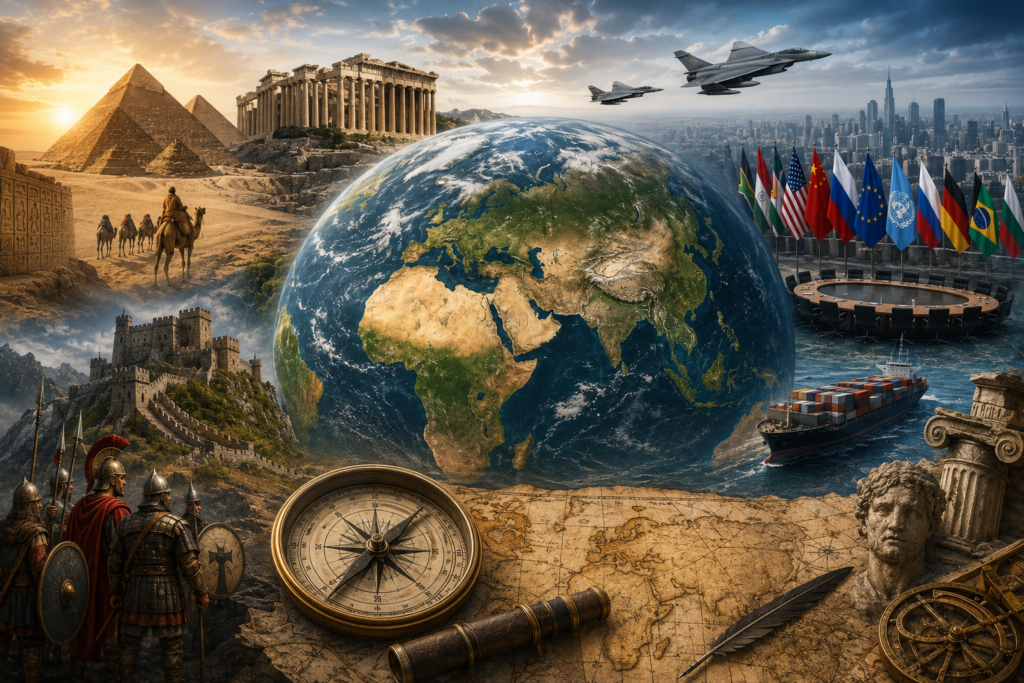
AI-generated image.
By Javier Garcia. Agrégé and PhD in history. Author of the book “Le chirurgien de l’Hermione”. Founder of Zeus Conseils
“Geography is, first and foremost, for waging war,” Yves Lacoste wrote in 1976. The commas mattered. They prevented the phrase from becoming a slogan, and geography from becoming a mere auxiliary of the general staffs. If it was first and foremost for waging war, that was because it was a knowledge of space, and therefore a knowledge of power: knowing where to pass, where to strike, where to hold; knowing the terrain, the resources, the populations and the distances; understanding that no power is exercised outside a territory. Half a century later, war has returned to the centre of European history. With it have returned borders, ports, straits, arsenals, corridors and strategic depth. Maps are once again covered in arrows. States speak of sovereignty, rearmament, economic security, reserves and strategic autonomy. Lacoste’s phrase seems less scandalous than prophetic. And yet something resists.
Never have states had so many maps, satellites, data, models and scenarios at their disposal. They track ships in real time, measure harvests from space, observe troop movements, map industrial supply chains and model the flow of goods, capital, diseases and information. The world seems entirely visible. But visibility does not necessarily produce intelligibility.
Perhaps never before have modern societies felt so often caught off guard. An epidemic brings economies to a standstill. A ship blocks a canal. A war upends Europe. A cable, a factory, a mineral or a strait suddenly emerges as the nerve centre of a power once thought to be dematerialised. In an age of the unpredictable, what purpose do history and geography still serve?
Certainly not to predict events. Neither the historian nor the geographer is a thwarted prophet. Their failure does not begin when they fail to foresee the next upheaval. It begins when they claim to be able to do so. Their role is more modest, but it is also more decisive. History and geography prevent us from confusing the unpredictable with the incomprehensible. They do not say what will happen. They show what can happen, in which spaces, out of which legacies, under which constraints and at the cost of which ruptures. Geography marks out the realm of the possible. History reveals the futures that have already begun.
The illusion of prediction
Our age does not lack information. At times it mistakes the accumulation of information for understanding. The proliferation of data has fuelled the hope of a politics freed from uncertainty. All it would take, the thinking goes, is to gather more evidence, classify it better and build more powerful models to gradually shrink the realm of the unknown. This ambition is not absurd. All policy rests on forecasts: energy needs, demographic change, infrastructure, military capabilities, climate transformations. Foresight is necessary. It becomes dangerous when it claims to abolish the event.
A curve extends a trend. An event breaks it. Political power therefore does not consist merely in extrapolating from what already exists. It requires thinking about what might come to pass, but also about what exists without yet being perceived. This is where history and geography begin. They do not, in the first instance, answer the question: “What is going to happen?” They pose two others: where are we, and how did we get here? These questions seem less ambitious. In reality, they are harder. They force us to step outside the immediate present, to change scale, to distinguish long-standing causes from new circumstances and to place a decision within a space that never coincides with the administrative map on which it is taken. To forecast is often to extend the present. To understand is to discover what it conceals.
Hormuz, or the geography of a possible standstill
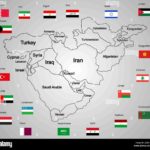
The Strait of Hormuz is enough to remind us that the world has not become flat. It links the Persian Gulf to the Gulf of Oman. On the map, it amounts to very little: a narrow opening between Iran and the Arabian Peninsula, crossed every day by ships carrying an essential share of the world’s energy. In this confined space, hydrocarbons, warships, economic interests and rival powers all converge.
Hormuz is a tiny place on a global scale. Its importance, however, is worldwide. It concentrates major energy routes, brings hostile states into close proximity, exposes civilian vessels to military tensions and turns a local geography into a global vulnerability. The strait thus recalls an elementary truth: a world economy can depend on a narrow passage.
Globalisation has not abolished geography. It has compressed it. It has concentrated immense flows into a handful of straits, canals, ports, cables and production centres. What appeared to be dispersed across the globe in fact depends on a limited number of passage points. Power often begins with the ability to guarantee access — to a sea, a resource, a technology — or with the ability to deny it to an adversary. At Hormuz, geography does not mechanically dictate policy. It does, however, set the price of every decision. A threat issued in one capital can be felt thousands of kilometres away. A local military tension can become a global energy concern.
No space is strategic by nature. It becomes so when it concentrates flows, rivalries and dependencies. Hormuz is therefore less a place than a relati: a relationship between producers and importers, between Iran and the Gulf monarchies, between the United States and its allies, between maritime security and the price of energy, between a local military decision and its distant consequences.The map does not merely show where Hormuz lies. It shows where the world can be interrupted.
The return of the material
For several decades, globalisation was described as the erasure of distance. Goods, capital and information flowed freely. Territories seemed to lose their importance to networks. But networks do not float. A trade route is still a route. A digital network rests on cables, data centres, ground stations and energy sources. An industry depends on mines, factories, ports, skills and logistics systems. Even the dematerialised economy stands on solid ground.
Flows, then, do not abolish geography. They redraw it. An army depends on distance, terrain, transport capacity and supply. An economy depends on its neighbours, its coastlines, its energy and its suppliers. An alliance depends less on shared professed values than on the practical ability of its members to come to one another’s aid. Power is not merely a quantity of resources. It is a relationship between means and space.
Having an army does not mean being able to project it. Producing a technology does not mean controlling the entire chain that makes it possible. Holding a territory does not mean being able to administer it, defend it or connect it to the rest of the country. All power is subject to the gap between what it claims to be and what it can actually reach. The map makes that gap visible. But a map never shows everything. It selects, fixes a centre and constructs peripheries. It can show a political border while concealing an economic continuity. It can depict an ocean as an empty space when it is criss-crossed by routes, cables, resources and rivalries.
Reading a map, then, is not simply a matter of knowing where things are. It means understanding why they are depicted in that way, and from what point of view. In the age of powers, geography is not used solely to wage war. It is used to identify the places where the world can be interrupted.
History is not a catalogue of precedents
History, too, is regaining a strategic function. Leaders, diplomats and commentators summon up precedents. Every crisis revives an old vocabulary. People invoke Munich, the Cold War, empires, the interwar years or the fall of Rome. This return of history carries a danger: that of substituting analogy for analysis.
History provides neither a ready-written script nor an instruction manual. An event does not repeat itself, because the actors, the technologies, the institutions, the societies and the balance of power have changed. Comparison is useful only if one begins by drawing distinctions. The function of history lies elsewhere. It shows that the new is always born amid inherited forms. States act from within borders they did not all choose, with institutions they did not entirely design, in societies marked by accumulated wounds, myths and expectations.
Governments may proclaim a clean break. They always govern from a legacy. The event may be sudden. Its conditions rarely are. A war begins on a specific date, but the perceptions of the adversary, the military arrangements, the dependencies and the frustrations that feed it predate it. An industry disappears slowly before its loss becomes, in the midst of a crisis, a strategic emergency. A revolution erupts in a matter of days, but the society that makes it possible has been taking shape for decades.
History distinguishes between these timescales. It observes the short time of decision-making, the medium time of institutions and the long time of material, social and cultural structures. It shows that several pasts act simultaneously within a single present. Some take the form of a border. Others that of a debt, a language, an infrastructure, an industrial dependency or a collective fear. What we call the present is never a pure instant. It is the meeting, often conflictual, of different temporalities. Powers have projects. Societies have a memory. Politics is often born of their collision.
Between the map and the long view
History and geography fulfil their function only if they remain bound together. Geography without history turns space into destiny. It explains a policy solely by a state’s position, as if mountains, rivers or seas mechanically dictated its conduct. Yet space does not decide. It constrains, slows, favours or permits.
A strait does not have the same strategic value depending on the routes that pass through it, the technologies available and the powers seeking to control it. A border does not carry the same meaning depending on whether it is open, disputed, fortified or recognised. A port is central only by virtue of the networks to which it belongs.
Conversely, history without geography turns the world into a narrative. It strings together intentions, ideologies and decisions without looking at the territories on which they claim to act. It recounts imperial ambitions without measuring distances, industrial projects without identifying resources, wars without studying supply lines.
History without geography overestimates will. Geography without history overestimates necessity. Between the two lies politics. To act politically is to act in a space one has not chosen and in a time one did not begin. Power consists neither in ignoring constraints nor in submitting to them. It consists in understanding them early enough to regain the capacity to act.
Europe acts too small and too late
In Europe, this question is particularly acute. The continent lacks neither knowledge, nor archives, nor maps, nor experts. What it lacks is coordination. Its industrial, energy, military and technological dependencies are continental, but decision-making remains largely national. Its vulnerabilities build up over decades; its responses follow short electoral cycles.
Europe too often acts within a space smaller than that of its dependencies and over a timescale shorter than that of its vulnerabilities. It believed that the market would automatically produce convergence, and then security. It is now discovering that the market itself is rooted in place, that it depends on ports, standards, infrastructure, technologies, shipping lanes and military guarantees.
It saw interdependence as a way of moving beyond power. It now finds that interdependence can also become power’s instrument. Becoming a power does not mean imitating empires. It means, first and foremost, knowing on which map to act and over what timescale. Europe’s political borders do not coincide with its energy, digital, industrial or military borders. Its national memories produce neither the same perception of Russia, nor the same relationship with the United States, nor the same understanding of the Mediterranean, the Gulf or Africa.
It is therefore not enough to proclaim a “Europe of power”. Its space and its time must be built. Geography reminds Europe that the relevant scale for action is no longer necessarily that of each of its states. History reminds it that no political community endures without an awareness of the experiences it shares, the ruptures it has come through and the promises it still means to keep. A European strategy can be born neither of a map without memory nor of a memory without a map.
Disciplines of orientation
History and geography are sometimes portrayed as disciplines threatened by the acceleration of the world. They supposedly belong to the age of archives, atlases, stable borders and slow transformations. The opposite is true. The faster the world moves, the more its different speeds must be told apart. The further networks extend, the more one needs to know where they are anchored. The more unprecedented events seem, the more one must identify what amounts to a rupture and what continues a long history.
Geography reminds power that it cannot abolish matter. History reminds it that it cannot abolish time. The one shows that all action takes place somewhere; the other, that it always comes after something. Neither removes uncertainty or risk. Neither guarantees a sound decision. Knowledge of the past offers no immunity against error, any more than knowledge of the terrain ensures victory.
But they do at least prevent two confusions: mistaking an event for pure accident, and mistaking will for power. They show that a surprise can be the product of long-ignored trends, and that a sudden conflict can be rooted in disputed territories, competing memories and accumulated dependencies.
They cannot tell us in advance which path the world will take. What they reveal are its narrow passages. Hormuz is one of them. There are others: straits, cables, borders, memories, fault lines.
To the question “What use are history and geography any more?”, the answer, then, must not promise the impossible. They are of no use in predicting the future. Their use is in keeping us from walking into it blind.
Translated from French. The French original prevails.