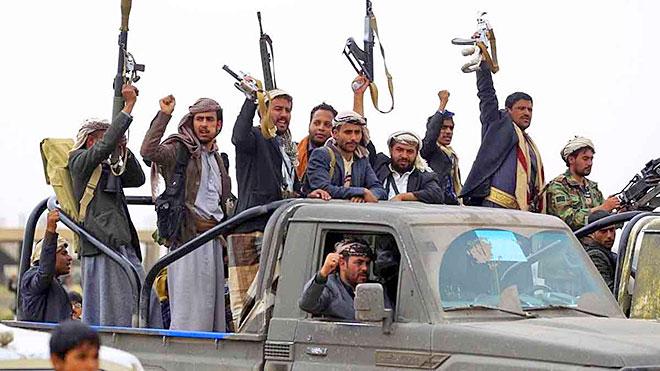
Houthi fighters. VOA / Almigdad Mojalli
24 July 2026
With Yemen’s Houthi rebels now threatening Saudi shipping in the Red Sea, as yet unconfirmed reports point to a tribal mobilisation and a Saudi military build-up ahead of a possible ground offensive. Should this scenario take shape, Riyadh would probably not seek to retake the whole of Yemen swiftly, but rather to force the Houthis into a difficult choice: protect their territory, command centres and supply routes, or sustain a maritime campaign in the Bab el-Mandeb and the Red Sea. For a movement that has become one of Iran’s main armed partners, the simultaneous opening of multiple fronts could prove its most serious test in years.
From the 2011 revolution to the capture of Sanaa
The rise of the Houthis cannot be understood without going back to the political transition triggered by the 2011 uprisings, wrongly dubbed the “Arab Spring” in the West. President Ali Abdullah Saleh, in power for more than three decades, had agreed to step down under a deal brokered by the Gulf Cooperation Council. His vice-president, Abd Rabbuh Mansour Hadi, was to lead a transition intended to reform the institutions and reconcile the country’s various factions.
This transition quickly showed its limits. The state remained weak, the army fragmented, the economy in decline and the national dialogue unable to produce a lasting compromise on power-sharing. Setting out from its stronghold of Saada, in north-western Yemen, the Ansar Allah movement, the armed wing of the Houthis, took advantage of this disarray, of social discontent and of the central government’s weakness to push southwards.
In September 2014, the Houthis entered Sanaa with tactical support from units that had remained loyal to former President Saleh, their erstwhile adversary turned ally of convenience. They gradually took control of state institutions, then put President Hadi under pressure. His departure from the capital and the Houthi advance on Aden led Saudi Arabia to intervene militarily in March 2015 at the head of an Arab coalition. The alliance between Saleh and the Houthis eventually collapsed in 2017; the former president was killed by his former partners.
The capture of Sanaa was therefore not planned in Tehran as an external operation. It was first and foremost the product of the disintegration of Yemen’s political order after the “Arab Spring”, of the Houthis’ organisational capacity and of their temporary alliance with part of the former military apparatus. Iran nevertheless quickly grasped the strategic value of a Shia movement controlling the capital and much of north-western Yemen.
A Yemeni movement turned armed partner of Tehran
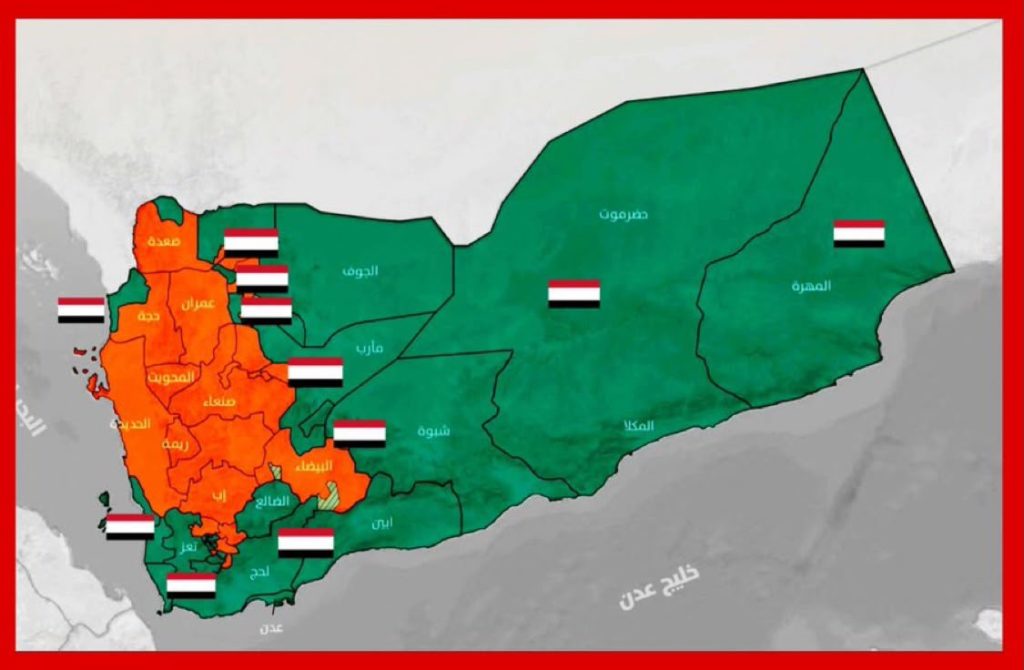
Map of Yemen showing the areas controlled by the Houthis in orange.
The Houthis are often portrayed as mere Iranian proxies. The label captures a strategic reality, but it needs to be qualified. Ansar Allah was not created by the Islamic Republic and retains distinctly Yemeni roots, leadership and objectives. The movement grew out of Zaydism, a branch of Shia Islam historically established in northern Yemen, whereas Iran and Lebanon’s Hezbollah belong to Twelver Shiism. The Houthis do not recognise Iran’s Supreme Leader as a religious authority.
This doctrinal difference has not prevented political and military convergence. The Council on Foreign Relations points out that Iranian support developed gradually, notably from the seizure of Sanaa and the Saudi intervention onwards. Tehran has supplied weapons, components, intelligence, technical assistance and training capabilities that have enabled the Houthis to evolve from a local insurgency into an organisation capable of deploying ballistic missiles, drones, anti-ship missiles and maritime warfare assets.
The 2024 report of the United Nations Panel of Experts on Yemen refers to tactical and technical training received outside Yemen, notably in Iran, Lebanon and Iraq. Hezbollah played a key role in this upgrade: training, the transfer of operational know-how, the organisation of units, propaganda, and the use of drones and missiles. The Houthis have not adopted Iranian Shiism; they have accepted assistance from Iran and Hezbollah in order to harden, organise and arm themselves.
The relationship appears to have grown stronger still. On 23 July 2026, Reuters reported, citing several sources, that commanders of the Islamic Revolutionary Guard Corps had been flown to Yemen together with missile- and drone-related equipment. Tehran has traditionally denied arming the Houthis directly, and these reports should be treated with caution, but they fit a pattern documented by arms seizures and international reports.
The term proxy therefore remains relevant at the strategic level: the Houthis serve Tehran’s regional interests, belong to the “Axis of Resistance” and give Iran a means of exerting pressure on the Arabian Peninsula, Israel and shipping routes. That does not mean, however, that every decision taken in Sanaa is dictated from Tehran. The Houthis are at once an autonomous Yemeni actor and an armed partner now deeply embedded in Iran’s regional network.
Bab el-Mandeb: the second jaw of the energy war
The Houthi threat to shipping in the Red Sea is taking on new significance at a time when the Strait of Hormuz remains at the heart of the confrontation between Iran and the United States. In Hormuz, Tehran has state resources, naval forces, coastal missiles and a strategic depth that allow it to bear directly on traffic. At Bab el-Mandeb, the Houthis cannot impose a comparable blockade, but they can raise the risk enough to divert vessels, drive up insurance costs and disrupt Saudi exports via the Red Sea.
Their strategy relies less on physically closing the strait than on creating permanent uncertainty. A handful of successful attacks, using drones, anti-ship missiles, explosive-laden boats or mines, may be enough to slow traffic and force shipping companies onto longer routes. The threat is particularly acute for Saudi Arabia, which seeks to make greater use of its Red Sea infrastructure when Gulf exports are under strain.
Ground mobilisation yet to be confirmed
Several officially unconfirmed sources report the arrival of Saudi forces in an area described as Matarih al-Karama, a large tribal encampment in the al-Rayyan region, in the east of al-Jawf province. The site is now the main rallying point for tribes answering the call to mobilise against the Houthis (Nakaf al-Karama). The aim is reportedly to prepare a ground operation against the Houthis in order to force them to ease the pressure on shipping and on Saudi interests. At this stage, there is no sufficiently solid public evidence that a large-scale offensive has been decided upon.
This mobilisation could reflect one of three scenarios: a defensive measure intended to protect the Saudi border and supply routes; a show of force aimed at compelling the Houthis to keep units away from the coast; or genuine preparation for limited operations conducted with Yemeni forces and local tribes. In all three cases, the desired effect would already be partly achieved: making the reopening of several fronts plausible and complicating Houthi planning.
The real strategic aim: dispersing Houthi resources
A ground offensive would not immediately eliminate the maritime threat. Launch capabilities are dispersed, mobile and sometimes underground. However, simultaneous pressure in Al-Jawf, around Marib, on the approaches to Sanaa, in the northern border areas or along the western coast would force the Houthis to redeploy fighters, reconnaissance drones, transport assets, communications systems and ammunition stocks.
Waging a sustained maritime campaign requires more than possessing a handful of missiles. It demands specialised teams, an intelligence chain, targeting capabilities, communications, workshops, depots and relatively secure supply routes. If these resources are absorbed by the defence of several land fronts, the Houthis will probably retain the capacity to carry out sporadic strikes, but their ability to sustain a high tempo and to select their targets effectively could diminish.
That is precisely the dilemma Riyadh would seek to impose: forcing the Ansar Allah militia to choose between protecting its territorial power and pursuing a maritime war designed to support Iran’s regional strategy. It would be difficult for the Houthis to sustain aggressive activity in the Red Sea over the long term while resisting a coordinated ground offensive on several fronts.
An operation that remains dangerous for Riyadh
This logic, however, guarantees no swift victory. The Houthis have been fighting for more than twenty years in mountainous terrain they know intimately. They have fortified positions, tunnel networks, minefields and a strong capacity for mobilisation. A ground advance could prove costly, slow and vulnerable to drones, missiles and infiltration.
Saudi Arabia would also have to brace for direct retaliation against its cities, airports, bases or energy infrastructure. The Houthis could seek to turn any ground operation into a war of attrition, while casting their fight as renewed resistance to foreign intervention. An overly ambitious offensive would thus risk recreating the conditions that left the coalition bogged down after 2015.
For Riyadh, the most likely option would therefore be a limited strategy: backing Yemeni partners, securing certain routes, threatening logistical hubs and forcing the Houthis to spread their forces thin, without launching a direct campaign aimed immediately at Sanaa. The objective would not necessarily be conquest, but coercion.
Coalition cohesion: the decisive factor
The effectiveness of such a strategy would depend above all on coordination between government forces, the tribes, units linked to the Presidential Leadership Council, southern formations and the West Coast forces. The anti-Houthi camp remains riven by political, territorial and ideological rivalries. Saudi Arabia and the United Arab Emirates do not always pursue the same priorities, while Yemeni actors defend their own spheres of influence. The autonomist or separatist forces linked to the Southern Transitional Council, for example, pursue objectives that do not necessarily coincide with those of the internationally recognised government.
In the Hadramawt region, the Islamist movement “Al-Qaeda in the Arabian Peninsula” (AQAP), regarded by the United States as one of the most dangerous jihadist groups, could take advantage of a fragmentation of the anti-Houthi front, a security vacuum or a redeployment of forces northwards to expand the area under its control. This reinforces the view that an offensive against the Houthis might temporarily bring several actors together, but without erasing their territorial, political or ideological rivalries.
A fragmented offensive would give the Houthis the opportunity to concentrate their forces against each adversary in turn, to exploit divisions and to portray the battle as foreign aggression. Conversely, coordinated pressure, backed by precise intelligence and limited objectives, could force the movement to relinquish part of its maritime initiative. The battle would therefore be decided as much by the organisation of the anti-Houthi camp as on the ground.
Imposing a dilemma rather than promising victory
If reports of the Saudi reinforcement are confirmed, the Yemeni land front could become a central element in the battle for Bab el-Mandeb. Riyadh would be seeking not so much to repeat its 2015 intervention as to exert pressure credible enough to force the Houthis to defend their territory, their supply routes and their centres of power.
The movement retains a genuine capacity for resistance and retaliation. The mere opening of a new front would neither disarm nor defeat it. But it would find it far harder to sustain an ambitious maritime campaign while simultaneously protecting Sanaa, holding Al-Jawf and Marib, securing the western coast and forestalling offensives from the north or the south. The real battle would therefore not be solely about control of territory: it would aim to break the freedom of action that currently allows the Houthis to turn a Yemeni conflict into a lever of Iran’s regional strategy.
Also on La Tribune des Nations
• After Hormuz, Bab el-Mandeb: the new front in the energy war
• Yemen: a war on many fronts in which the Houthis remain the main beneficiaries
• Iran–United States: the war redraws the strategic architecture of the Middle East
External sources
• United Nations, Panel of Experts on Yemen, report S/2024/731
• Council on Foreign Relations, “Iran’s Support of the Houthis: What to Know”
• Reuters, 23 July 2026, on recent Iranian assistance to the Houthis
Translated from French. The French original prevails.