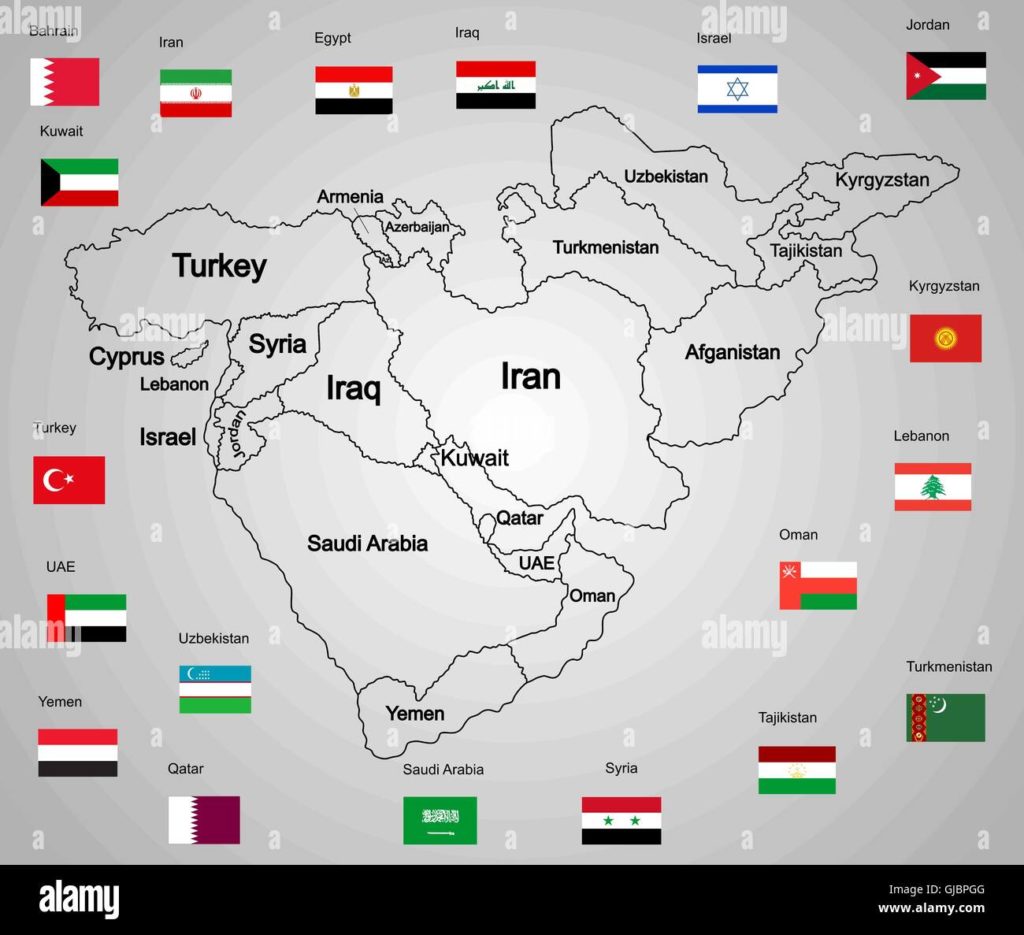
The military weakening of the Islamic Republic of Iran and its “Resistance Front” is opening a new strategic phase in the Middle East. Israel played a decisive part in shifting the balance of power, but Washington is already preparing for the post-war period with Riyadh, Ankara, Islamabad, Damascus, Baghdad and Beirut. And it seems that Washington is not ready to give Tel Aviv any role whatsoever in the new geopolitical order that is expected to redraw the Middle East following the weakening of Iran. The question is therefore no longer simply who won the war, but who will benefit from the post-war alignments.
Israel helped to change the Middle East
The war against Iran will probably go down as one of the most significant strategic upheavals in the Middle East since the Islamic Revolution of 1979. For almost half a century, Tehran had built a regional architecture based on a network of allies and armed groups: Hezbollah in Lebanon, Hamas and Palestinian Islamic Jihad, Shia militias in Iraq, Bashar al-Assad’s Syrian regime and the Houthi movement in Yemen.
This arrangement had enabled the Islamic Republic to project its influence far beyond its borders and to keep up constant pressure on Israel, which it had vowed to destroy, as well as on several Arab states.
The military operations conducted in 2026 have profoundly shaken this edifice. Iran’s military capabilities have been degraded, many senior figures in the Revolutionary Guards have been killed, its nuclear infrastructure has suffered major damage, and Tehran’s main regional proxies have been weakened.
Israel played a decisive role in this shift thanks to the quality of its intelligence, its technological superiority and its close cooperation with the United States. This military success marks a historic turning point. But it is only a first step.
Military victory does not guarantee diplomatic victory
History shows that those who win wars are not always the chief architects of the peace. An army can destroy capabilities, break a logistics network and impose a new balance of power. It does not decide on its own the alliances, economic agreements, investments and trade routes that will shape the period that follows. This question is now being raised within Israel’s own strategic debate. In an analysis published by the Jerusalem Post, Yaakov Katz asks whether Israel risks having fought the wars and paid the price, while other actors play a greater part in drafting the new regional order.
This concern does not mean that Israel would be sidelined militarily. Rather, it reflects an awareness that military power, however decisive, is not enough to build a lasting new political order.
Washington is already preparing for the post-Iran era
US initiatives clearly show that the United States is now thinking about regional stability as a whole. The talks under way with Saudi Arabia on civil nuclear cooperation, the discussions with Turkey on the future of their strategic partnership, the contacts with the new Syrian authorities and the meetings with Iraqi and Lebanese leaders all point to a far more comprehensive approach. Washington’s aim is no longer simply to contain Iran. It is now to prevent a new hostile axis from re-forming, to secure energy and trade routes and to rebuild a regional balance involving several partners. Israel remains a key pillar of this strategy. But it is no longer its only component.
Turkey regains a central position
Among the most striking developments is Turkey’s return to the forefront. The operations conducted in Idlib in 2020 had already demonstrated the ability of Turkish forces to take on Iranian-backed units effectively. Since then, Ankara has consolidated its influence in Syria, developed its defence industry and strengthened its position within NATO. The discussions surrounding a possible return of Turkey to the US F-35 aircraft programme illustrate the West’s desire to fully reintegrate Ankara into the regional strategic framework.
For Israel, this development is less an immediate threat than a profound shift in the geopolitical environment. The Levant is no longer organised solely around the stand-off between Israel and Iran. It is becoming an arena in which several powers are simultaneously seeking to exert influence over Syria, Iraq, the routes of the eastern Mediterranean and relations with the Gulf monarchies.
Gulf monarchies are also changing in scale
Saudi Arabia, the United Arab Emirates and Qatar are each pursuing a strategy of their own. Riyadh aspires to become the leading political, economic and logistical hub of the Arab world. Abu Dhabi is strengthening its diplomatic, industrial and maritime capacity for action. Doha retains its role as a favoured intermediary in several regional crises. This diversification of decision-making centres confirms that the Middle East is entering a multipolar phase. The Emirati strategies of controlling ports, straits and flows, already analysed in La Tribune des Nations, show that regional influence is now built as much through infrastructure as through military force.
Pakistan becomes a fully fledged regional player
Pakistan is not a Middle Eastern state in the geographical sense. It can, however, no longer be treated as an outside player. A nuclear power with a large army and a growing defence industry, it has close relations with Saudi Arabia, Turkey, China and the Gulf monarchies, while sharing a long border with Iran.
The strategic defence partnership between Islamabad and Riyadh has given this relationship a new dimension. In 2026, the deployment of Pakistani forces to Saudi Arabia showed that Pakistan could become a direct player in Gulf security, rather than merely a provider of training or military cooperation.
At the same time, Islamabad is seeking to preserve a diplomatic role. Its mediation with Qatar between the United States and Iran has demonstrated Pakistan’s ability to talk simultaneously to Washington, Riyadh, Beijing and Tehran. The consultation framework bringing together Pakistan, Saudi Arabia, Turkey and Egypt also confirms the emergence of a coordination hub that extends beyond the traditional borders of the Middle East.
The economic dimension is just as important. The China-Pakistan Economic Corridor and the port of Gwadar give Islamabad the ambition of linking China, Central Asia, the Middle East and the Indian Ocean. Pakistan is thus becoming at once a military partner of the Gulf, a relay for Chinese strategy and a potential trade crossroads between Asia and the Arabian Peninsula.
This rise in power does not mean that Islamabad can impose a new regional order on its own. Its economic fragilities, tensions in Balochistan and the security of its infrastructure limit its room for manoeuvre. But its military weight, its geographical position and its alliances now make it impossible to leave it out of any serious thinking about a post-Iran order.
New trade routes: with or without Israel
The regional realignment is not being played out solely in capitals and military headquarters. It can also be read on the maps of ports, railways, oil pipelines, digital cables and energy terminals. Yet these maps do not all give Israel the same place. The main project likely to integrate Israel is the India–Middle East–Europe Economic Corridor, or IMEC. It is intended to link India to the Gulf ports, then cross the Arabian Peninsula by rail before reaching the eastern Mediterranean, Israel and Europe. Digital cables and energy infrastructure are to complement the route. In this configuration, the port of Haifa could become one of the major outlets for trade between Asia, the Gulf and the European continent.
But IMEC depends on demanding political conditions: normalisation between Israel and Saudi Arabia, stability in Jordan and the Levant, the security of infrastructure, and a sufficiently lasting settlement of the Palestinian question to make the corridor politically acceptable. Its route offers Israel an exceptional opportunity, but its completion remains conditional. By contrast, the Development Road is set to link the major port of Al-Faw, in southern Iraq, to Turkey and then to Europe. Backed by Iraq, Turkey, Qatar and the United Arab Emirates, this rail and motorway corridor bypasses Israel entirely. It offers the Gulf an overland route to Europe via Iraq and Anatolia.
The rail and logistics agreements signed in June 2026 between Saudi Arabia and Turkey reinforce this momentum. They do not yet amount to the announcement of a direct, continuous line between the two countries. They cover standards, technologies, signalling, digitalisation, training and transport integration. But they lay the groundwork for the technical compatibility of a future corridor linking the Arabian Peninsula to Turkey, either directly or via Iraq and the Gulf networks.
The China–Pakistan Economic Corridor offers another option. By linking western China to Gwadar, on the Arabian Sea, it opens a north–south route that can be connected to Gulf markets, East Africa and Central Asia. Here again, Israel is not needed for the project to function.
The same logic is at work in the energy sector. Saudi Arabia’s East-West pipeline to Yanbu, the Emirati Habshan–Fujairah pipeline and Iraqi exports to Turkey make it possible, or seek to make it possible, to bypass the most vulnerable straits. These infrastructures run outside Israel. The 2026 war underscored their strategic value: when Hormuz or Bab el-Mandeb become uncertain, states favour routes they control or those that cross partners regarded as indispensable.
Beyond IMEC, the most advanced or most immediately usable projects therefore largely bypass Israel. This creates a paradox. Israel can remain the leading military power in the region while being circumvented by some of the new trade and energy infrastructure. The military map and the logistics map of the Middle East do not overlap.
What role for Israel?
Israel retains considerable assets. Its military superiority, intelligence capabilities, defence industry, technological lead and partnership with the United States give it an exceptional position. The real question lies elsewhere: how can it turn military success into lasting political influence? How can it play a full part in shaping the new regional rules? How can it preserve its strategic advantage while fitting into a broader architecture in which Turkey, Pakistan, the Gulf monarchies, Iraq and several Arab states will also play a decisive role?
To become a crossroads and not merely a fortress, Israel will have to make its territory useful to regional trade. That means consolidating the agreements with the Emirates, preserving cooperation with Jordan, achieving normalisation with Saudi Arabia and reducing the political cost that the Palestinian question imposes on any visible economic integration.
The stakes, then, are not purely diplomatic. They concern Israel’s ability to offer safe ports, high-performing infrastructure, protective technologies, energy and water solutions, and territorial continuity stable enough to persuade its partners to route part of their trade through its territory. These questions go far beyond Israel’s security alone. They concern the future of the Middle East as a whole.
The war against Iran has not merely weakened the Islamic Republic. It has opened a period of strategic realignment whose outcome remains uncertain. The Middle East now emerging will probably be neither the one Tehran has envisaged since 1979 nor one organised around a single regional power. It will be the product of a new balance between the United States, Turkey, Pakistan, the Gulf monarchies and several Arab states that have once again become fully fledged players.
Israel will undoubtedly remain one of the military pillars of this architecture. But regional power will also be measured by the ability to control ports, rail corridors, oil pipelines, digital networks and supply chains. If IMEC materialises, Israel could become one of the hinges of trade between Asia, the Gulf and Europe. If, on the other hand, the Development Road, the Turkish-Saudi networks, the China-Pakistan corridor and bypass pipelines prevail, it could remain on the margins of some of the new flows.
The question now is not only what Israel’s place will be in the new regional order, but whether the other powers will see an interest in including Israel in that order.
⸻
LTDN articles to read
• After Hormuz, Bab el-Mandeb: the new front in the energy war
• Hormuz: negotiation has given way to armed intimidation
• The United Arab Emirates: the pursuit of strategic autonomy
• The Qatari paradox: how Doha became an indispensable player in the Middle East
External articles and documents to read
• Saudi Press Agency – Rail cooperation between Saudi Arabia and Turkey
• Turkish Presidency – Memorandum on the Development Road between Turkey, Iraq, Qatar and the Emirates
• International Energy Agency – Oil routes bypassing Hormuz
Translated from French. The French original prevails.