By Professor El Hassane HZAINE
Since the outbreak of the US-Israeli war against Iran in February 2026, the Strait of Hormuz has been transformed from a global economic artery into a tense naval battlefield. The Hormuz war has not ended and is entering a new phase of hybrid war of attrition, set to last until one of the main belligerents is exhausted or undergoes internal political change. On 8 April, through Pakistani mediation, hostilities ceased, as did Iran’s response, and the strait remained open, but under a maritime regime controlled by Tehran, with transit fees of up to two million dollars per vessel. On 13 April 2026, the United States in turn declared a blockade of Iranian ports – a weapon that proved more cost-effective than military strikes.
In June 2026, a window for peace opened when the United States and Iran reached a historic agreement in Geneva in the form of a roadmap to establish peace and reopen the strait ; the agreement provides for a gradual lifting of sanctions in exchange for IAEA monitoring of Iran’s nuclear facilities. Since the end of August, the United States has pivoted to a strategy of financial and economic asphyxiation known as ” Economic Outcast “, announced with great fanfare by Treasury Secretary Scott Bessent.
This configuration has produced a situation of neither war nor peace: a near-parity of deterrence on the military side and a condominium regime for the logistical management of the strait. Neither side can impose its maximum terms, nor sustain a continuation of hostilities. The result is a Nash equilibrium: a stable, self-sustaining but collectively sub-optimal state, in which a low-intensity conflict persists without clear resolution.
The parity of deterrence described above, together with the construction of bypass infrastructure (gas pipelines, rail corridors, alternative energy sources), notably by the UAE and Saudi Arabia and potentially by Iraq and Kuwait, will ease the pressure on transit through Hormuz, whose importance will diminish over time. It is worth recalling that a strait, or any route or “logistical choke point”, does not automatically retain its strategic value simply by virtue of its geographical position; its centrality will depend on the ability of the coastal or transit states to guarantee the security, predictability and continuity of transit.
In our humble view, a way out of the Hormuz war that allows the two main belligerents to save face could be built around two strands: first, a political and diplomatic strand centred on the future of Iran’s nuclear programme (restoration of IAEA inspections, with or without the removal of the enriched uranium or its destruction on site under international supervision); and second, an economic and logistical strand involving the introduction of a new system of governance for the strait, modelled on that of the Strait of Malacca.
This article will dwell on the second aspect, recalling that the Sultanate of Oman had proposed a governance model similar to that of the Strait of Malacca, which today stands as one of the few tangible and lasting successes in the shared management of international straits.
Governance of the Strait of Malacca: a unique architecture
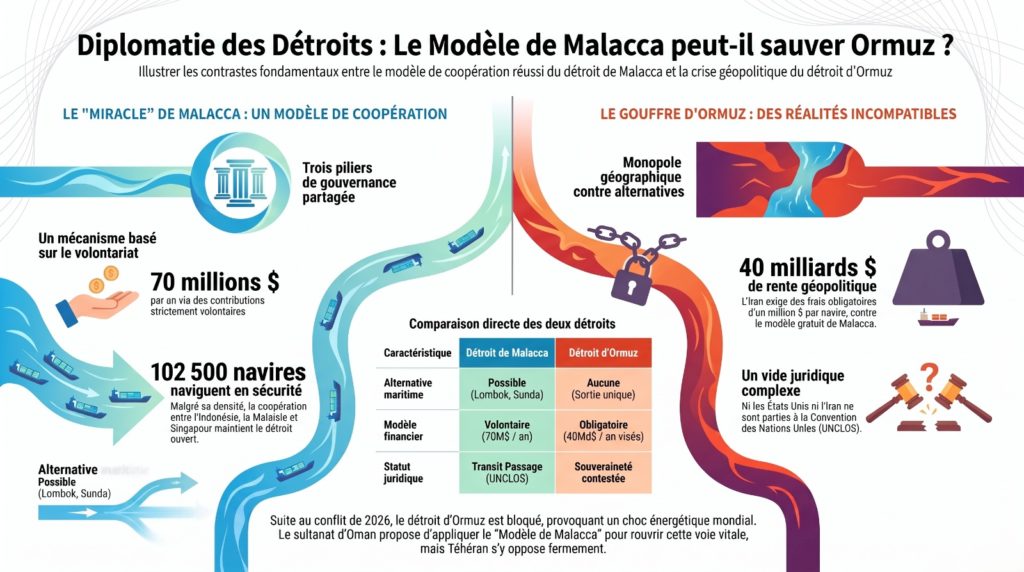
Stretching 900 kilometres between the Malay Peninsula and the Indonesian island of Sumatra, it narrows to just 2.7 kilometres at its narrowest point. In 2025 alone, more than 102,500 vessels sailed its waters, carrying the lifeblood of the Chinese, Japanese and South Korean economies. Despite this density and the persistent threats of piracy, collision and ecological disaster, Malacca remains open thanks to a carefully designed diplomatic architecture.
This architecture draws its foundations, on the one hand, from Article 43 of the 1982 Montego Bay United Nations Convention on the Law of the Sea (UNCLOS), which requires that “user States and States bordering a strait should by agreement cooperate” on navigational safety and the prevention of pollution.
Indeed, the governance architecture of the Strait of Malacca rests on a legal compromise: although the waters of the strait fall directly under the territorial sovereignty of Indonesia, Malaysia and Singapore, international law guarantees there a regime of unrestricted innocent transit passage for merchant ships and warships from around the world. This duality prohibits the coastal States from unilaterally suspending navigation, while conferring on them exclusive responsibility for policing and security within their respective jurisdictions.
To give practical effect to this shared sovereignty in the face of transnational threats such as piracy and marine pollution, the institutional architecture relies on the Malacca Straits Patrol mechanism. This framework incorporates the MALSINDO programme, which coordinates each country’s naval operations along the maritime boundaries, and the combined air initiative “Eyes in the Sky”, since extended to Thailand, which provides continuous surveillance of the airspace. These physical security operations are backed by a real-time military intelligence-sharing group, creating technical interoperability without merging national military commands.
At the macroeconomic and logistical level, this architecture is complemented by the Cooperative Mechanism, established in 2007 under the auspices of the IMO, which provides a framework for dialogue and funding between the littoral states and user states, and enables major user states (such as China and Japan) to make voluntary contributions towards the maintenance of infrastructure and aids to navigation. This model preserves the sovereignty of the littoral states while guaranteeing the security of this vital global artery.
The mechanism rests on three pillars:
- The Cooperation Forum: a platform for dialogue bringing together the littoral states, user states and the shipping industry.
- The Project Coordination Committee: which manages infrastructure and safety projects.
- The Aids to Navigation Fund: the financial arm for maintaining the strait’s physical and digital aids to navigation.
What distinguishes the Malacca mechanism is that its funding is strictly voluntary: contributions from user states and shippers are voluntary and “separate from the exercise of transit passage and are not regarded as charges, tolls or payments imposed on passing ships”. Financed by non-profit organisations such as the Nippon Foundation and by industry players, the Aids to Navigation Fund raises a modest sum of around $70 million a year. As Ambassador Tommy Koh, the architect of the model, points out: “We are the only strait in the world to have what is called a cooperative mechanism.”
Why has this mechanism proved resilient to geopolitical turbulence?
The resilience of tripartite cooperation in the Strait of Malacca rests first and foremost on a robust security consensus (Fan Jairiu, Security consensus, institutional networks, and the resilience of small multilateral cooperation in the Strait of Malacca, 2026): the national interests of the coastal states converge, as Indonesia, Malaysia and Singapore share an existential interest in keeping the waters open; they have a “wholly common interest” in preventing collisions, minimising pollution and funding responses to oil spills, backed by the deep solidarity of the other ASEAN members (Robert Beckman, emeritus professor at the National University of Singapore).
The other decisive factor that drove the coastal states to overcome their territorial disputes and present a united front was the perception of an imminent external threat: the risk that user states would intervene and interfere to maintain security in the strait should the coastal states fail to do so. Examples included the US Regional Maritime Security Initiative (RMSI) and the joint patrols proposed by Japan, initiatives perceived as direct threats to their national sovereignty.
This consensus rests on a twofold imperative: preserving strict regional autonomy in the face of external pressure on the one hand, and coordinating the fight against non-traditional threats such as terrorism and piracy on the other. Although extreme sensitivity over sovereignty rules out full military integration under a single command, the internal political stability of the three countries and their shared membership of ASEAN have provided the essential foundation for sustaining this momentum.
Strait of Hormuz under condominium: transitional governance between internationalisation and national appropriation
Over the course of 2026, the management of the Strait of Hormuz gradually moved away from Tehran’s ambitions of unilateral control towards a more concerted approach. This shift originated in the joint declaration of 23 June 2026, signed by Oman and Iran. The text established a bilateral working group mandated to define future arrangements for navigation and to regulate any “service fees” in strict compliance with international law, while also providing for the involvement of the other coastal states.
This welcome development is in keeping with the spirit of the United Nations Convention on the Law of the Sea (UNCLOS), which, while guaranteeing the right of transit passage, encourages regional cooperation on maritime security, thereby charting a middle course between the sovereignty of coastal states and the imperative of keeping global trade flowing smoothly.
At the end of August 2026, this diplomatic momentum produced an initial operational compromise: a temporary transit corridor, some seven miles wide, organised into two separate inbound and outbound lanes. According to statements by Iran’s Deputy Foreign Minister, Kazem Gharibabadi, the inbound lane into the Gulf would run through Iranian territorial waters, while the outbound lane would extend across both Iranian and Omani maritime zones. This configuration resembles a pragmatic arrangement more than a rigid division of the area or outright control by Tehran. The scheme is expected to be accompanied by joint initiatives to secure and clear the waters of mines. However, the precise navigation protocols and the exact nature of the financial mechanisms have yet to be clarified.
The fragility of these talks is all the more evident given that they are taking place under the close watch of the United States and the other members of the Gulf Cooperation Council (GCC). Regional powers such as Saudi Arabia and the United Arab Emirates (UAE) have already made it known that they would firmly oppose any normalisation of exclusive Iranian control or the introduction of tolls, regarding the passage as a strategic common good.
In this context, the commitment made on 23 June to consult the “riparian states” goes beyond mere diplomatic courtesy: it is an absolute geopolitical necessity if an outright rejection of the agreement is to be avoided. On top of this regional pressure comes the weight of Washington. Tehran is invoking the Single Undertaking rule, linking the full opening of the strait to American concessions, notably on sanctions and the blockade of its ports, and on the situation of its proxies in Lebanon and Yemen.
Can the Malacca model be applied to the Strait of Hormuz?
The course of the negotiations between Oman and Iran shows that a model inspired by the Strait of Malacca could offer a third way between Iranian control and the full internationalisation of the management of Hormuz. Oman’s July proposal was based on a regional mechanism involving the two states, with voluntary contributions to fund certain maritime services. Iran rejected it, arguing that a 50/50 split of the routes did not address its security concerns. Since then, the two countries have moved towards a temporary compromise: a corridor of about seven miles, with its entrance in Iranian territorial waters and its exit via a lane running through Omani and Iranian waters, coupled with planned cooperation on mine clearance.
However, transposing the Malacca model to the Strait of Hormuz runs up against three sets of difficulties that must be overcome. First, geography: the Strait of Malacca has alternatives – the Lombok and Sunda Straits – whereas Hormuz is the main maritime outlet of the Arabian-Persian Gulf. Admittedly, bypass routes exist (Bab el-Mandeb and the Cape of Good Hope), but they considerably lengthen distances and increase costs. Overland oil and gas pipelines are either operational (Saudi Arabia’s East-West Pipeline, carrying 7 million barrels per day, or the Emirati pipeline to Fujairah) or under development, as with the Iraqi and Kuwaiti projects to Turkey and Syria. According to Goldman Sachs, this infrastructure could divert 7.3 million barrels per day by 2028. It nonetheless remains vulnerable, costly and slow to develop. Hormuz’s monopoly is not absolute, but it gives Iran considerable strategic leverage.
Second, the law poses a major obstacle. The legal status of Hormuz is divisive. For most states, the strait falls under the regime of transit passage (UNCLOS, Articles 37 to 44), which guarantees continuous passage that cannot be suspended (Iran and the United States have not ratified the Convention). Tehran favours an interpretation based on innocent passage, which grants the coastal state broader prerogatives. This interpretation is disputed: many regard transit passage as a rule of customary law (the GCC countries, the international community and the IMO). As regards the imposition of charges, Article 26 of UNCLOS allows the coastal state to levy fees for services actually rendered to ships in transit, but it cannot therefore justify a toll.
Finally, politics, complicates any attempt to transpose the model. The Malacca model works because the three littoral states share a common interest in keeping the strait open and have built mutual trust over decades. Nothing of the kind exists in the Gulf; Iran intends to turn the strait into an instrument of power. Regional rivalries, notably with Saudi Arabia, and external pressures make it harder to reach a consensus.
However, regional diplomatic developments following the signing of the Mecca Defence Pact on 7 August 2026 by Saudi Arabia, Turkey and Pakistan could change the picture. According to unconfirmed reports, Iran has been invited to join. Talks between Iran and the Gulf states, under the auspices of Qatar, are being prepared, and some observers do not rule out a scenario – still hypothetical, and in the longer term – in the form of Iran’s association with the Gulf Cooperation Council (GCC); such a development could ease tensions and pave the way for shared governance of the strait.
A lasting compromise could rest neither on a toll imposed by Iran nor on a mechanism giving a single state a veto over transit; the most realistic option would be functional, regional governance: coordinated routes, transparently paid maritime services, joint mine clearance, and consultation of the other littoral states and the main users. The Malacca model would not be replicated identically, but adapted to the geography, the balance of power and the legal constraints specific to Hormuz.
The crisis in the Gulf holds a lesson for the rest of the world. The rules governing international maritime chokepoints are not immutable laws but fragile diplomatic constructs. The closure of Hormuz has already forced Asian countries to look nervously towards Malacca. If the international community accepts a new practice for managing transit passage through straits, in this case the imposition of transit fees, it will mark the starting point of a new international custom that could spread to other straits and in future become positive law, codified in a new United Nations Convention on the Law of the Sea.
Translated from French. The French original prevails.