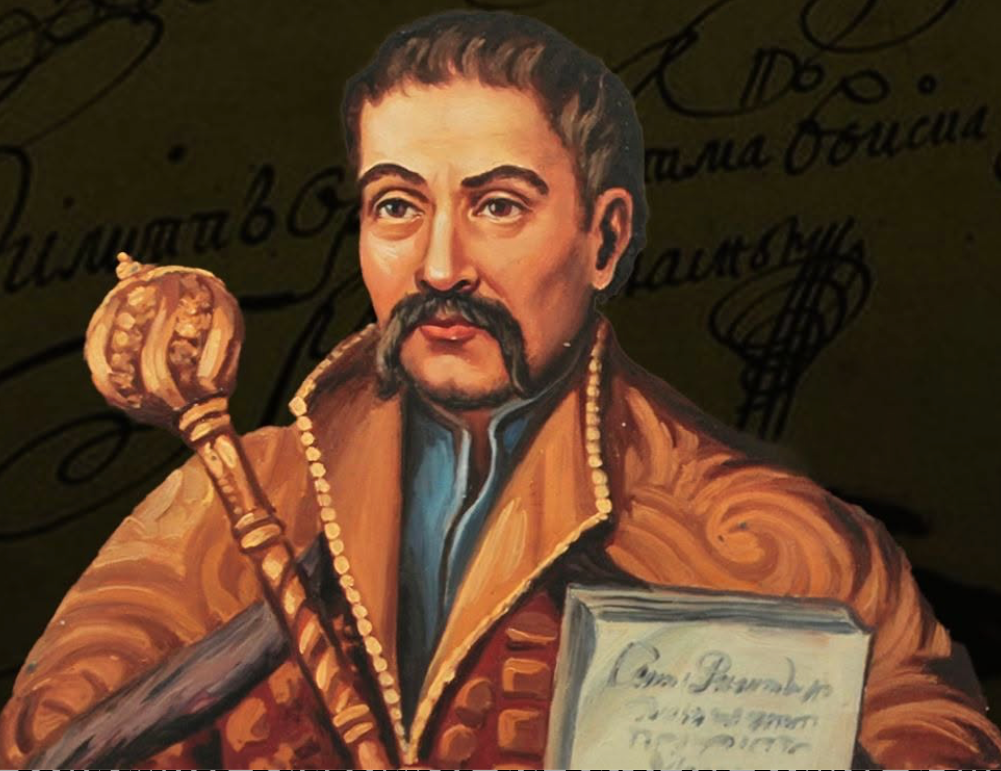
Painting of Pylyp Orlyk holding the 1710 Constitution.
Empires are rarely content merely to conquer territory. Land can be lost. Peoples can rise up. Borders can shift. A true imperial power therefore aspires to something more: it seeks to appropriate a past. For whoever appropriates history is also trying to appropriate the future. For several centuries, Russia has waged not only wars for territory but also a war for memory. Its greatest trophy is Kyivan Rus’ — a state that took shape on the banks of the Dnieper long before a modest settlement appeared in the forests of the north-east and later became Moscow. Contemporary Russian historical mythology strives to convince the world that Rus’ and Russia are one and the same. According to this narrative, Russia is the sole and direct successor to the ancient state of Rus’, while Ukraine is merely an accidental branch of the great tree of history. Yet the facts tell quite a different story.
Read parts 1 and 2 here: https://ltdn.org/rus-de-kyiv-la-guerre-des-origines-partie-1/
https://ltdn.org/rus-de-kyiv-la-guerre-des-origines-partie-2/
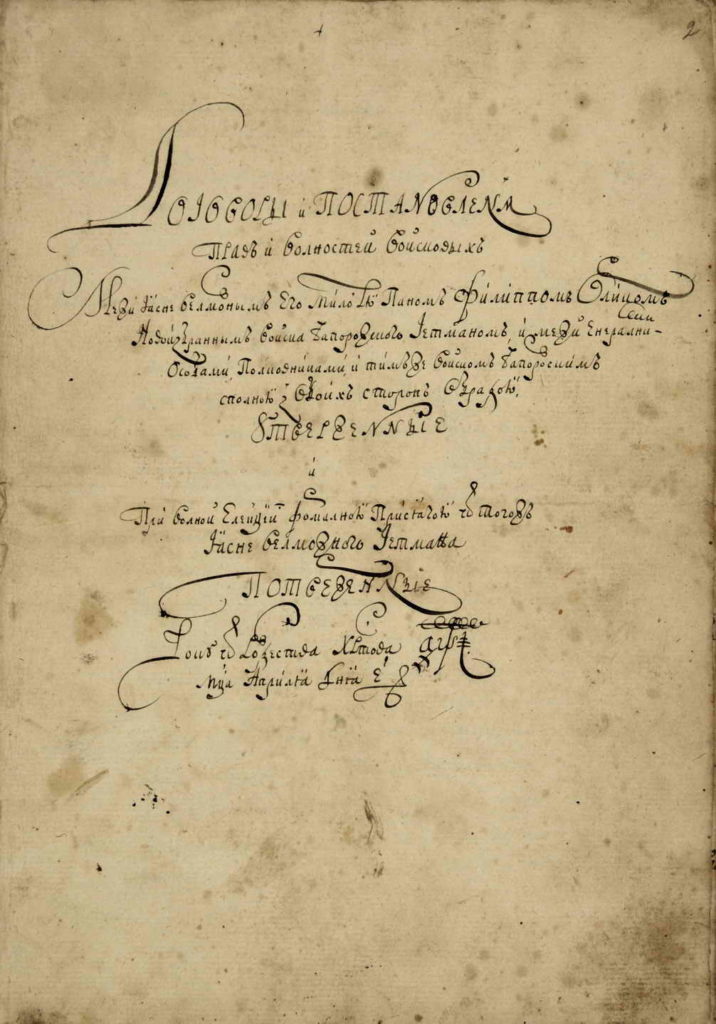
If the Hetmanate became the political heir to the Ukrainian tradition of statehood in the early modern era, the Constitution of Pylyp Orlyk was its most accomplished intellectual synthesis. In 1710, after the defeat of Hetman Ivan Mazepa and the Battle of Poltava, part of the Ukrainian political elite found itself in exile. One might have thought that this was precisely the moment when the Ukrainian tradition of statehood would lose its political voice. Yet the opposite happened. It was then that one of the most remarkable politico-legal documents of its time came into being: the “Pacts and Constitutions of the Rights and Freedoms of the Zaporozhian Host”, concluded by the new hetman, Pylyp Orlyk.
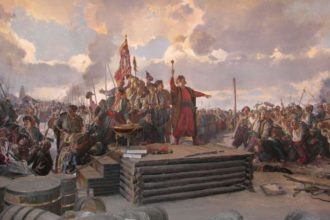
Hetman Ivan Mazepa, seeking to preserve Ukrainian autonomy and to prevent the Hetmanate’s growing subjugation to the Muscovite state, concluded an alliance with King Charles XII of Sweden. The defeat of the Swedish-Ukrainian forces at the Battle of Poltava in 1709 marked a turning point, leading to tighter Muscovite control over the Hetmanate and to the exile of part of the Ukrainian political elite.
Today, the document is often described as the “first European constitution”. It is an appealing formula, but one that calls for caution. European political thought already had constitutional traditions, and some states had instruments limiting monarchical power. The significance of Orlyk’s document lies elsewhere: it shows how the Ukrainian political elite conceived of its own state. The Constitution rests on a fundamental principle: power is not the personal property of the ruler. The hetman is not above the law, nor is he the sole source of political will. His powers are defined by an agreement with the Zaporozhian Host, while the state’s most important affairs are to be decided with the participation of the General Council — a representative body required to meet regularly and to oversee the hetman’s conduct.
At the beginning of the 18th century, this was a remarkably modern political conception. The state was understood not as a sovereign’s personal domain, but as a community in which power was bound by law, by mutual obligations and by a political contract. It would be simplistic to claim that the Orlyk Constitution was actually put into practice. It remained the programme of a state that had lost control of its territory. But the historical significance of a document is not always measured by what it changed immediately; it is also measured by what it bore witness to.
The Orlyk Constitution bore witness to the existence of a distinct Ukrainian political tradition — one that stemmed not from Muscovite autocracy, but from the Cossack conception of liberty, of the election of leaders and of the contractual nature of the state.
And it is precisely here that history takes a particularly revealing turn. In Bender, in 1710, as the new hetman Pylyp Orlyk was drafting his “Pacts and Constitutions…”, Peter I was completing, to the north-east, an entirely different state project. In 1721, the Tsardom of Muscovy officially became the Russian Empire. The tsar took the title of emperor, while the new state proclaimed itself heir to the great historical tradition of Rus’. Autocracy thus received its full ideological justification.
History rarely offers such telling parallels. Almost at the same moment, on the same historical foundation of ancient Rus’, two different models of statehood were taking shape. One rested on the idea that power must be bound by law, representation and political agreement. The other asserted that the might of the state rested on centralisation, the concentration of power and the supremacy of the monarch. Both states were products of their time. But their political ideals were already moving in different directions.
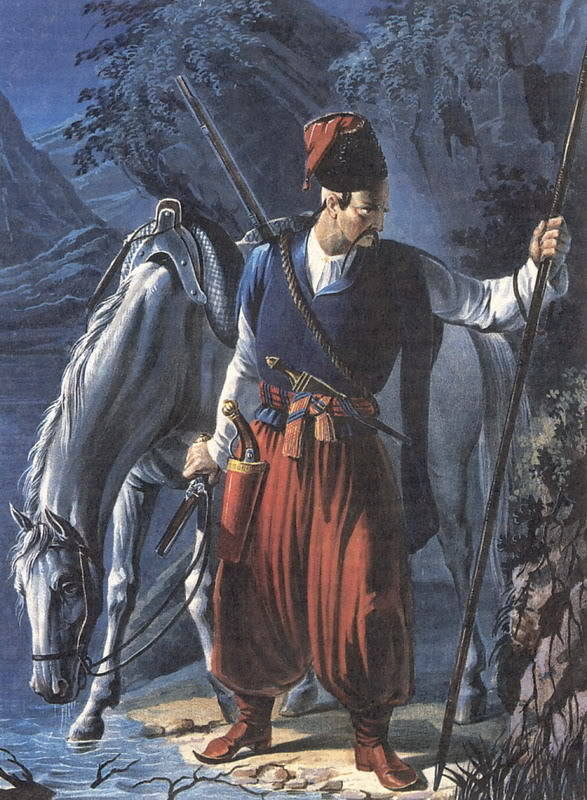
Drawing of a Zaporozhian Cossack in the 18th century.
The Ukrainian model was not a democracy in the modern sense. It remained based on social estates and was limited in scope. But the very idea that power must be bound by law, election and political agreement was fundamentally different from the one developing in the Russian Empire. And for the Russian Empire, this Ukrainian autonomy began to pose a problem that was not only political, but historical too.
The very existence of the Hetmanate contradicted the imperial thesis that all the lands of Rus’ were naturally destined to gravitate towards a single autocratic centre. It was proof of another possibility: the legacy of Rus’ could lead not only to an empire but also to a political tradition in which power rested on consent, election and law.
In the second half of the 18th century, the Russian Empire set about systematically dismantling Ukraine’s autonomous institutions. In 1764 the Hetmanate was abolished; in 1775 the Zaporozhian Sich was destroyed; and then, step by step, the regimental and company system was abolished as well. This was not merely an administrative reform. It was the suppression of an alternative political model which, by its very existence, contradicted the imperial vision of a single path of development for the Ruthenian world.
With the autonomous institutions went the mechanisms through which Ukrainian society could organise its own government. The former Cossack elite was gradually absorbed into the imperial system, local institutions were replaced by administrative models common to the whole Empire, and the space for a distinct Ukrainian political self-government shrank ever further. Yet the disappearance of political institutions did not mean the disappearance of historical memory.
And it is precisely here that another struggle begins — a struggle not only for territory, but also for the right to name one’s own past. For the Empire did not seek merely to incorporate the Ukrainian lands into its territory. It sought to convince the world that a distinct Ukrainian political tradition had never existed.
That is why the questions of Rus’, the Cossacks, the Hetmanate and the Constitution of Pylyp Orlyk have not merely become subjects of historical research. They have turned into a field of confrontation between two different visions of the past: on the one hand, a tradition in which Ukraine appears as an autonomous historical actor; on the other, an imperial conception that seeks to present it as no more than a part of other people’s history.
Translated from French. The French original prevails.