To mark the publication of his book Pionniers, voyage aux frontières de l’intelligence artificielle, the journalist and essayist Guillaume Grallet will be in Geneva on 19 March to give a talk on the major transformations that AI could bring about in the years ahead. Spanning scientific revolution, democratic stakes and technological rivalries, he calls for anticipating a shift that is already under way.
The spectacular advances in artificial intelligence may be only a prelude. For Guillaume Grallet, editor of the Science and Tech section at the magazine Le Point, the next stage could profoundly transform the economy and our societies: machines capable not only of holding a conversation but also of understanding the physical world.
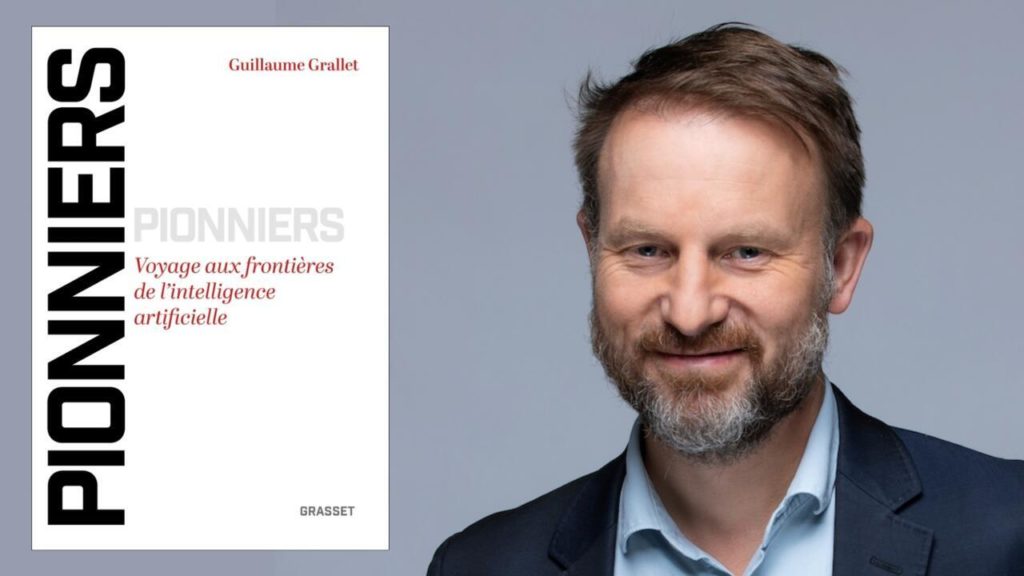
In his book Pionniers, voyage aux frontières de l’intelligence artificielle (Grasset), winner of the 2025 prize for best economics book, the journalist met the researchers, entrepreneurs and engineers shaping the next generation of technologies. In his view, today’s AI, driven by large language models, is still limited. “Current models are extremely good at understanding and producing language, but they have no experience of the physical world. They do not really understand gravity, heat or matter.”
To overcome these limitations, researchers are working on what are known as “world models”, which can give machines a representation of reality. This development could come about in particular through humanoid robots, fitted with sensors and powered by artificial intelligence. “These systems will be able to learn by interacting directly with their environment,” he explains. “This could be the next big step for AI.”
A scientific revolution… and a political one
For Guillaume Grallet, the applications could be immense: faster scientific research, new forms of automation, advances in understanding physical and biological phenomena. Quantum computing could also act as an accelerator by considerably increasing the computing power available to artificial intelligence. But this technological revolution also poses major challenges.
In his view, AI could profoundly transform the production of knowledge, but it could also create unprecedented risks: manipulation of information, infringement of intellectual property and the concentration of technological power. “It is a matter of being neither naively enthusiastic nor alarmist,” he explains. “It is about understanding what is happening and taking part in it.” Faced with the technological dominance of the United States and China, Guillaume Grallet believes that Europe still holds a decisive advantage: its scientific excellence. “We have extraordinary researchers and a very strong scientific tradition,” he stresses.
But to turn this excellence into technological leadership, Europe will have to meet one challenge: scaling up to industrial level. In his view, this will require more investment, better commercialisation of research and public support for strategic innovations.
Geneva, a forum for dialogue on AI
Amid growing technological rivalry between the major powers, hubs such as Geneva could play a particular role. With its international organisations and its diplomatic tradition, Switzerland could become a forum for dialogue on the governance of artificial intelligence. “Research must remain open and international,” Guillaume Grallet insists. “Places for cooperation and discussion are more necessary than ever.”
It is precisely to anticipate these transformations that the conference “Anticipating the World to Come” will be held, devoted to the scientific, economic and geopolitical challenges of artificial intelligence. Initiated by Claude Gonet, Adviser to the General Management of the bank Eric Strudza, the conference will take place on Thursday 19 March 2026 — 6pm at the Fédération des Entreprises Romandes, Route de Saint-Jean 98, 1201 Geneva.
Translated from French. The French original prevails.