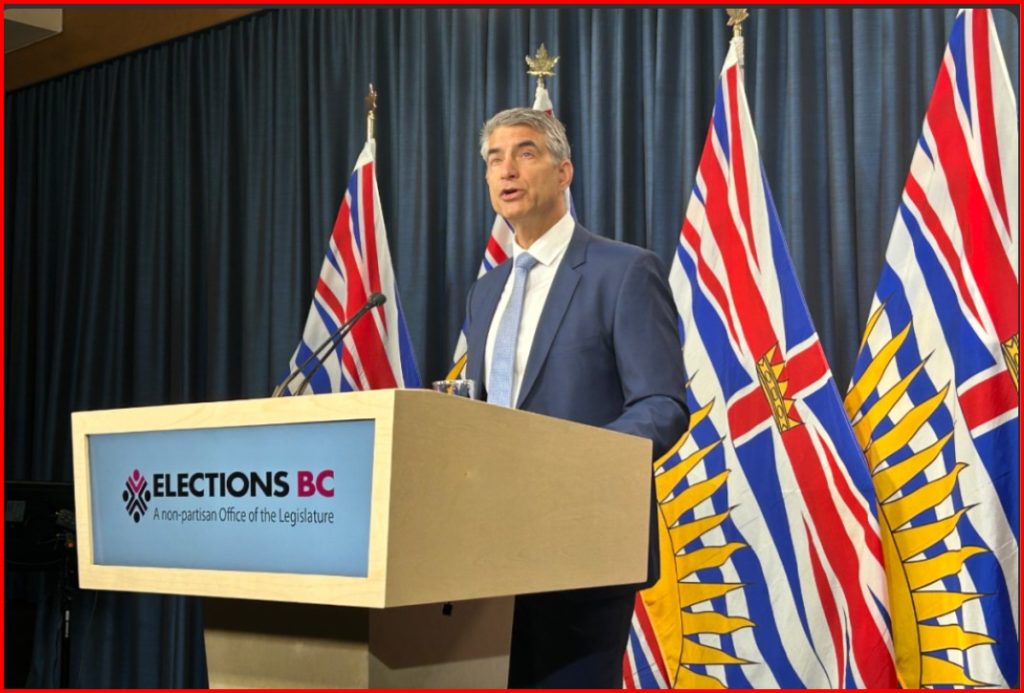
Anton Boegman, then Chief Electoral Officer of British Columbia, at an Elections BC press briefing. Photo credit to be confirmed before publication.
On 13 March 2026, the Minister of Public Safety, Gary Anandasangaree, announced the appointment of Canada’s first-ever Foreign Influence Transparency Commissioner: Anton Boegman, Chief Electoral Officer of British Columbia from 2018 to 2025 [1]. At the time, the post he was to fill did not yet really exist in law. That is no longer the case: an order in council published at the end of June 2026 sets 4 August 2026 as the date on which the law comes fully into force, and Boegman will be formally appointed commissioner that day [2][3]. For the first time in its history, Canada is acquiring a public registry listing who is acting here on behalf of foreign governments.
Across the Western world, democracies are trying, with varying degrees of success, to build the same tool — a public registry requiring anyone acting on behalf of a foreign government to declare themselves. Canada has come late to this stage. And the experience of its cousins — the United States, Australia, the United Kingdom — ought to make it nervous rather than confident.
What Canada is building
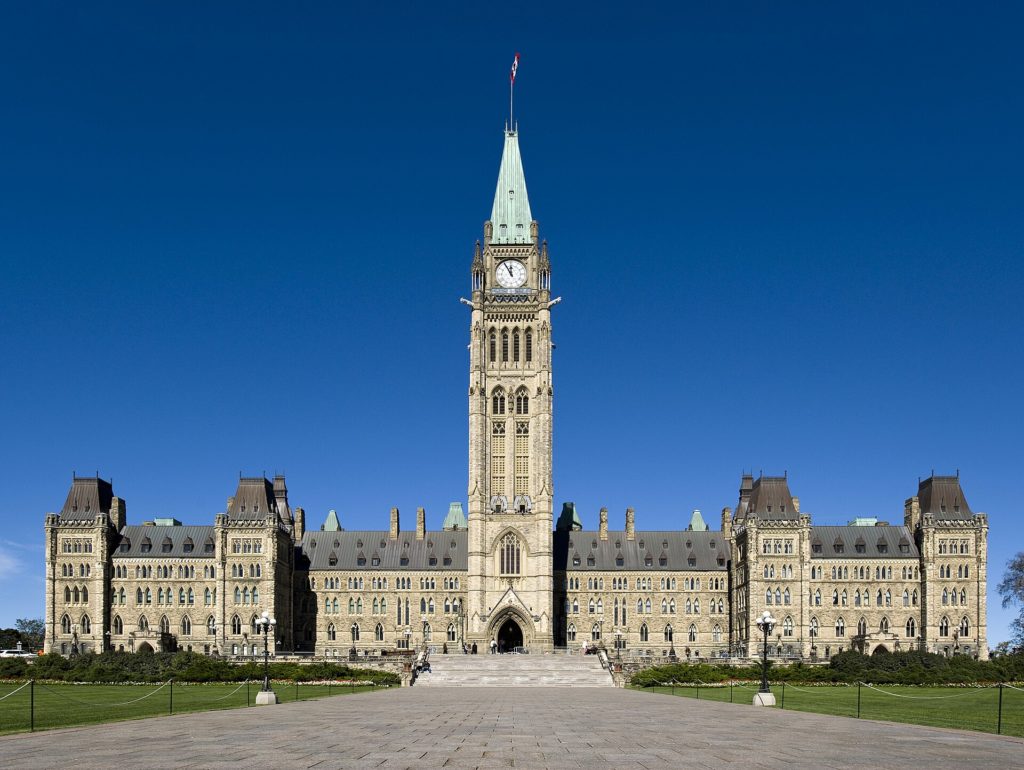
Parliament. Wikimedia Commons, licence CC BY-SA 3.0
The Foreign Influence Transparency and Accountability Act (FITAA), passed in June 2024 as part of Bill C-70, creates a public registry in which anyone acting under the direction of, or in association with, a “foreign principal” — a foreign state, but also its affiliated entities — to influence a Canadian political or governmental process will be required to register [4]. Its scope is broad: it would one day cover attempts at influence directed at every level of government in the country, including municipal administrations [4].
The penalty regime is robust on paper: administrative monetary penalties ranging from $50 to $1 million and, for the most serious breaches — false statements, obstructing the commissioner’s work — criminal prosecutions carrying fines of up to $5 million on summary conviction, $200,000 on indictment, or five years’ imprisonment [4]. The final regulations were published in the Canada Gazette on 1 July 2026 [4]. Any new arrangement with a foreign principal entered into after 4 August will have to be declared within 14 days; for arrangements already in place on that date, the deadline is 60 days — meaning early October 2026 [4]. The total cost of implementation is estimated at $25.9 million between 2026 and 2035 [5].
One detail is worth noting: the law will not come fully into force on 4 August. The government has chosen not to bring into force, for the time being, the provisions covering arrangements with Indigenous governments and entities — that component will become subject to the registry at a later, unspecified date [4]. This is a documented political choice, not a grey area: Ottawa deliberately postponed this part of the regime rather than including it from the outset.
Boegman did not have long to wait, then: the preconditions for his formal appointment — parliamentary approval, the entry into force of the act and its regulations, and the establishment of the commissioner’s office — will all be met on the same day, 4 August 2026 [2][3]. Canada chose its referee before it had even finished building the pitch, but the pitch itself will be ready on time.
Original model collapses just as Canada adopts it

Robert F. Kennedy Department of Justice Building, Washington, D.C., Wikimedia Commons, CC BY-SA 4.0 licence
Here is the irony that few articles have noted so far. The very concept of a foreign agent registry comes from the United States — the Foreign Agents Registration Act (FARA), passed in 1938. After decades of under-enforcement, FARA enjoyed a revival from 2017, when the FBI set up a Foreign Influence Task Force to counter Russian attempts at election interference [6].
That revival has just come to an end. On 5 February 2025, barely after taking office, Attorney General Pam Bondi issued a memorandum redefining the Department of Justice’s priorities — and FARA is no longer among them [6]. Criminal enforcement of the act must now be confined to cases resembling traditional espionage, a far narrower definition than before [7]. The Foreign Influence Task Force created in 2017 has been disbanded [6]. A regulatory reform proposed in January 2025 to tighten the act remains frozen, caught up in the regulatory freeze order signed by the president as soon as he took office [6]. The country that invented this transparency tool is putting it away at the very moment Canada is starting to use it.
Australia: transparency scheme stalls, criminal convictions handled separately
Nor does Canada need to look far for a more direct warning. In 2018 Australia set up its own registration regime, the Foreign Influence Transparency Scheme (FITS). A joint parliamentary committee on intelligence and security, tasked with reviewing it after six years in operation, delivered a damning verdict: the number of registrations remains low, and compliance and enforcement measures remained minimal throughout that period [8]. The committee made 14 recommendations to put things right, including tightening the definition of “foreign principal” and giving the government the power to register a person who refuses to do so themselves [8].
A more scathing analysis, published by The Conversation, describes the scheme as an “abject failure” that cannot be fixed in its current form [9]. The most striking example: the scheme detected nothing during the 2023 referendum on the Indigenous Voice, even though the Australian Strategic Policy Institute says it identified a network of accounts on X likely linked to the Chinese government and spreading content hostile to the referendum [9].
A precise distinction is needed here, one that media coverage sometimes blurs: this verdict of failure concerns the registration scheme (FITS), not the separate criminal laws against foreign interference, passed in the same year, 2018, which have produced genuine convictions. Di Sanh “Sunny” Duong, a former Liberal Party candidate and a figure in Melbourne’s Chinese-Vietnamese community, became in December 2023 the first person found guilty under these criminal laws, for cultivating a relationship with a federal minister on behalf of the Chinese Communist Party through a $37,450 donation to a hospital [10]. He was sentenced to two years and nine months in prison [11]. In March 2026, the Sydney consultant Alexander Csergo became the second person convicted under the same laws, for selling reports on sensitive subjects, including the AUKUS defence pact, to two individuals he knew were probably linked to Chinese intelligence services; he faces up to 15 years in prison [12].
Two criminal convictions in seven years, then, set against a transparency scheme that has almost never been enforced. The message is consistent: Australia has the will to punish the most serious cases after the fact, but not to compel systematic disclosure beforehand — the exact opposite of what a transparency register is meant to achieve.
United Kingdom: a register that deliberately excludes the country most often cited as a threat
Canada’s third cousin, Britain’s Foreign Influence Registration Scheme (FIRS), came into force on 1 July 2025, nearly two years after the passage of the law that created it. It operates on two tiers: a general “political influence” tier, and a far more demanding “enhanced” tier, reserved for countries explicitly named by the government [13].
At launch, only two countries were placed on this enhanced tier: Russia and Iran [14]. China, despite being repeatedly identified by MI5 and the FBI as a major interference threat targeting Western democracies, was explicitly left out, notwithstanding a debate in the Commons in which the opposition described the omission as “astonishing” [15]. The government merely replied that it would assess each country “separately”, without saying when, or whether, China would ever be added [15]. The result: a register that works on a technical level, but whose real reach is determined as much by the commercial and diplomatic calculations of the moment as by intelligence assessments.
What it means for Canada
Three precedents, three different failures, but linked by a common thread: building a register is easy; enforcing it, without hollowing it out through political calculation, is much harder. The United States had the will to enforce, lost it, and has just shelved it. Australia had the law, but never the resources or the will to enforce it on a large scale, except for a handful of serious criminal cases handled separately. The United Kingdom has the law and the will to enforce it, but deliberately excludes the country that its own intelligence agencies identify as a major threat, so as not to complicate a trading relationship.
Canada, as things stand, crosses the starting line in eleven days. Anton Boegman brings a genuine asset — seven years at the head of an electoral body, and long practice in enforcing transparency rules in the face of powerful interests. But no amount of electoral experience truly prepares anyone to secure, year after year, the budget and the political mandate needed to genuinely enforce a regime such as this one — which is precisely where Australia failed, and where the United Kingdom chose, from the outset, to go easy on China.
References
[4] Blakes, “Foreign Influence Transparency and Accountability Act Coming Into Force: What Businesses Need to Know”, July 2026 ; Canada Gazette, Part II, Volume 160, Number 13, final regulations published on 1 July 2026 (dated 22 June 2026).
[7] ICNL, “Navigating the Foreign Agents Registration Act”, updated March 2026.
[15] UK Parliament, Hansard, “Foreign Influence Registration Scheme”, debate of 1 April 2025.
Translated from French. The French original prevails.