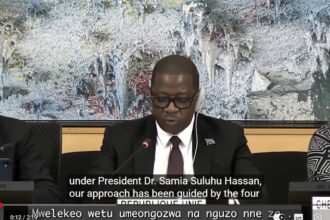
Ahead of his address to the Human Rights Council on Wednesday, the Minister Samuel Mbemba Kabuya took part in a lunchtime conference in Geneva, where Kinshasa stepped up pressure on the international community, while the chair of the commission of inquiry called on civil society to mobilise.
Just hours before a keenly awaited address to the plenary session of the Human Rights Council, the Democratic Republic of the Congo chose to take the initiative. On Tuesday, in a meeting room at the Palais des Nations, diplomats, NGO representatives and international experts gathered for a lunchtime conference assessing resolution S-37/1, one year after its adoption. It was a meeting of considerable political significance, attended by the Minister of Human Rights, Samuel Mbemba Kabuya.
Held on the sidelines of the Council’s session, the lunch was intended to go beyond a mere stocktaking exercise. “The aim of this lunch is to provide a platform for dialogue in order to assess the implementation of the recommendations (…) and to identify concrete ways of accelerating the operationalisation of the resolution,” said the organisers, drawn from a coalition of international NGOs. Behind this wording lay a shared determination: to turn diplomatic commitments into concrete action.
Against this backdrop, the presence of the Congolese minister was far from incidental. On the eve of his official address to the Human Rights Council, Samuel Mbemba Kabuya used this informal forum to deliver an unambiguous message: the international community must act. A year after the resolution was adopted, “the operationalisation of the independent commission of inquiry (…) has still not taken effect to this day,” he lamented, pointing to a delay that, according to Kinshasa, is fuelling a sense of impunity.
The minister recalled the deadlines set by the United Nations, notably a first field mission by the commission expected by June 2026 at the latest, as well as the submission of successive reports to the Human Rights Council and the General Assembly. But it was above all the gravity of the situation on the ground that dominated his remarks. “The human rights situation in the east of the DRC is extremely worrying,” he stressed, citing “massive and systematic violations” against civilian populations.
Killings, rape used as a weapon of war, forced displacement, the recruitment of child soldiers, the plundering of natural resources: the list drawn up by the minister is long and damning. He cited figures reflecting the scale of the tragedy, including “millions of displaced people” and sexual violence occurring at an alarming rate. All of this was intended as a reminder that, behind the diplomatic talks, the humanitarian crisis continues to worsen.
“The Congolese people are waiting for this commission to become operational so that the facts are truly established and responsibilities are genuinely determined,” he said, calling for the effective mobilisation of international partners. Kinshasa, which says it has “nothing to hide”, insists on the need to provide the commission with the financial, logistical and political resources essential to fulfilling its mandate.

Following on from this address, the chair of the independent commission of inquiry, Arnauld Akodjenou, spoke in a tone that was both complementary and more introspective. Welcoming the contributions of the NGOs present, he was keen to place the commission’s mission in a victim-centred perspective. “The debate must be placed where it belongs: with the victims,” he said, stressing that it is they who must guide the action of the international community.
Faced with questions about delays, he was keen to offer reassurance. “We will meet the deadlines that have been set for us,” he said, pointing to work already under way internally: drawing up a methodology, defining investigative approaches and stepping up exchanges between the commission’s members. “We have worked on the mandate, we have worked on the methodology (…) we have spared no effort,” he stressed.
But the chair of the commission did not gloss over the difficulties. “The difficulties are immense,” he acknowledged, describing a “particular” environment, that of “a region still at war” and “under occupation”. In these conditions, gathering testimony promises to be especially complex. “Are the victims we are talking about free to speak?” he asked, highlighting the constraints weighing on the investigative work.
It was against this backdrop that he made a strong appeal to civil society, giving his remarks a central place in the discussions. “I am asking for your assistance,” he said, urging the organisations present to mobilise actively in support of the commission. He stressed the need for practical support, whether by providing information, passing on testimony or raising the alarm about events that might escape the investigators. “Each of you, at your own level (…) give your support to this commission,” he urged.
Going further, he encouraged participants to make their priorities heard from this informal setting onwards: “do not hesitate (…) to set out the points you consider important, which we should take up”. It was an invitation to place civil society at the very heart of the investigative process, in a spirit of closer cooperation.
The lunchtime conference, which brought together international NGOs, state representatives and experts, thus served both as a platform for exchange and as a diplomatic lever. By highlighting the urgency of the situation and calling for collective mobilisation, the DRC is seeking to turn international attention into concrete commitment. On the eve of the Human Rights Council plenary, the message from Kinshasa is clear: given the scale of the crimes committed in the east of the country, the time for statements must give way to the time for action. It remains to be seen whether this appeal, bolstered by the expected mobilisation of civil society, will be heeded within the walls of the United Nations.
Translated from French. The French original prevails.