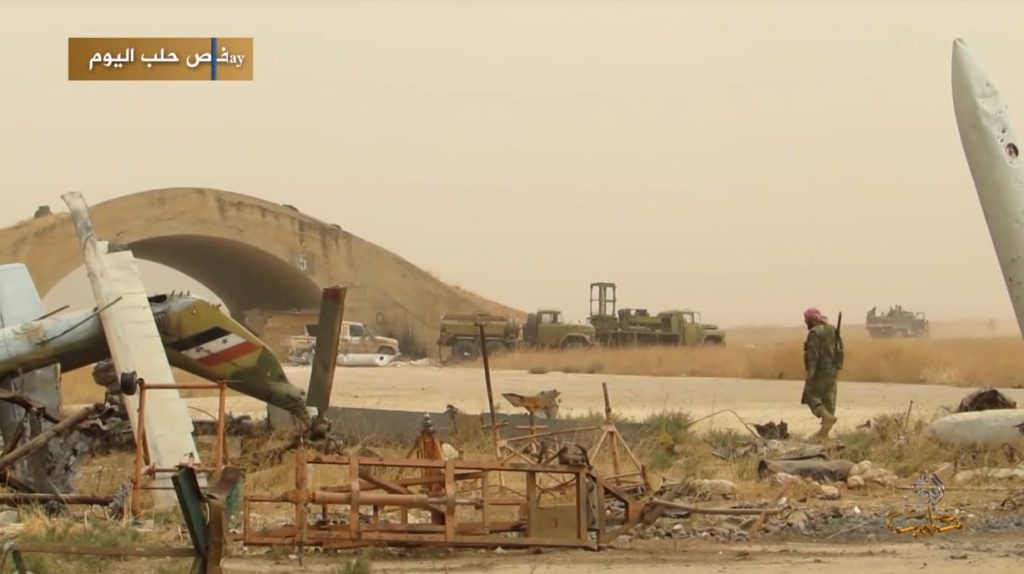
Syria’s Abu al-Duhur air base. Halab Today TV, CC BY 3.0, via Wikimedia Commons
The eight Israeli strikes on Syria’s Abu al-Duhur air base are not merely another episode in Israel’s campaign in Syria. By stating that it sought to prevent a Turkish military deployment, and by acting without warning Ankara, Israel has brought to light a risk that had until now been largely theoretical: that of a direct military incident between two of the main regional powers present in Syria. Washington is now seeking to set up a deconfliction mechanism involving Israel, Syria and Turkey.
On 18 August, eight strikes hit the runway and storage facilities at Abu al-Duhur air base in north-western Syria. No deaths were reported. Located in Idlib province, some 70 kilometres from the Turkish border, the base had not been used as a dedicated military airfield since 2013. Reuters. Yet the significance of the event lies less in the damage than in the justification Israel gave a few hours later.
The office of Israeli Prime Minister Benjamin Netanyahu said that Israel and Syria had agreed on a security status quo and that Damascus was on the verge of breaking it by allowing Turkish forces to deploy to an air base near Aleppo. According to the Israeli statement, Damascus had reportedly been warned on several occasions that such a presence would be regarded as a threat to Israel’s security. The Syrian authorities are said to have chosen to ignore these warnings. Israel has therefore warned that it will not tolerate any threat to its security, while stating that it is in favour of a return to the status quo.
In Israel’s sights: Turkey
For almost two decades, Israeli strikes in Syria followed a clearly defined logic: preventing Iran from turning Syrian territory into strategic depth and disrupting arms transfers to Lebanon’s Hezbollah. The fall of Bashar al-Assad in December 2024 profoundly altered that equation. Iranian influence collapsed, while Turkey became one of the main backers of the new Syrian government of President Ahmed al-Sharaa. Ankara is helping to train the Syrian army, supporting the rebuilding of certain institutions and providing the new regime with military and diplomatic backing. Syria, however, has long held a major strategic place in Turkey’s regional policy, well before the fall of the Assad regime.
Israel’s strategic equation is therefore gradually changing in nature. It is no longer simply a matter of preventing Iran’s return to Syria. It is also a matter of preventing a Syria rebuilt with Turkish assistance from eventually acquiring military capabilities that could constrain Israel’s freedom of action.
This shift had already been analysed in La Tribune des Nations on 25 June, in “Turkey, Syria, Israel: the Levant’s new strategic balance”: the central question for Israel was becoming less what Syria could do on its own than what it might rebuild with Turkey’s political, technological and military backing. Abu al-Duhur now gives this rivalry a concrete military expression.
Ankara was not warned
However, statements by the US Special Envoy for Syria, Tom Barrack, give the incident an even more worrying dimension. Barrack, who is also the US Ambassador to Turkey, said that Turkey had not been warned in advance of the Israeli strike. Ankara therefore saw Israeli aircraft heading north, towards the Turkish border, without knowing their target.
According to Barrack, Turkey could then reasonably have prepared its own military response. He added that sufficiently level-headed officials had made it possible to avoid an escalation. The precedent of 24 November 2015 remains significant in this respect: a Turkish F-16 shot down a Russian Su-24 near the Syrian border, with Ankara asserting that the aircraft had violated Turkish airspace after several warnings, a claim Moscow disputed. This point is crucial.
For an Israeli-Turkish clash to occur in Syria, Jerusalem and Ankara need not deliberately decide to confront each other. It would be enough for an Israeli air movement to be interpreted as a threat, for a Turkish anti-aircraft battery to lock on to an aircraft, for a drone to be shot down or for a unit deployed at a Syrian installation to be hit during a strike. From that moment, strategic rivalry could turn into military confrontation.
Barrack does not, however, confirm the Israeli account
Washington does, however, introduce a nuance worth preserving. Tom Barrack did not confirm the Israeli claim that Ankara had actually decided to deploy forces to Abu al-Duhur. He explained that the Israeli strikes reflected a perception — accurate or mistaken — that Turkey might soon increase its presence at the base. The distinction matters. What is certain is Israel’s perception of the threat, not the existence of a Turkish deployment order.
Ankara condemned the strikes and denounced a violation of Syria’s territorial integrity. The Turkish authorities have not confirmed the presence of their forces at the base. Axios even reports a Turkish official’s denial of any Turkish presence at Abu al-Duhur.
It would therefore be premature to assert that Turkish units were already stationed at Abu al-Duhur or that a deployment timetable had been finalised. But the mere fact that Israel judged this prospect credible enough to resort to force shows the depth of mistrust between the two powers.
Washington seeks to avert the next incident
The United States is now seeking to strengthen the mechanisms designed to prevent such an episode from escalating. The need is all the more pressing because Israel regularly carries out incursions into Syrian airspace, particularly near the Golan Heights, which it has occupied since 1967 and whose annexation, proclaimed in 1981, is not recognised by the international community.
Israel and Turkey already had a communication line intended to prevent incidents between their forces operating in Syria. That arrangement now appears inadequate. Tom Barrack has therefore announced that a more robust framework involving Israel, Syria and Turkey is being prepared.
A deconfliction mechanism is not a political agreement, still less an alliance. It is an arrangement that allows different military forces to exchange enough information to prevent an operation by one from being interpreted as the start of an attack on another.
Barrack believes that the Abu al-Duhur incident demonstrates precisely why these exchanges need to be broadened. Washington already facilitates some contacts but wants to put in place a system with greater resources and more procedures. The paradox is telling: having long organised deconfliction between Israel and Russia in Syria, the United States must now avert a collision between Israel and Turkey, a NATO member and the main foreign backer of the new regime in Damascus.
Syria becomes the meeting ground for Turkish and Israeli ambitions
Above all, the Abu al-Duhur incident shows how far the regional balance of power has shifted. The fall of Bashar al-Assad’s regime and the dramatic weakening of Iran have not left a lasting vacuum. Other powers are seeking to fill it. Turkey now wields considerable influence over the new Syrian government. It is helping to rebuild the country’s armed forces and regards Syria’s stability as directly linked to its own security.
Israel reasons differently. Having enjoyed near-total freedom of action in the skies over Syria for years, it does not want to see the emergence of military capabilities – notably radar or air defence systems – that could erode this superiority. The Financial Times reports that Turkish officials had recently visited Abu al-Duhur and that Turkey is more broadly involved in restoring Syria’s defence capabilities.
This rivalry had already begun to surface in 2025, when the two countries were forced to open technical deconfliction talks after Israeli strikes on several Syrian facilities earmarked for future Turkish deployments. Abu al-Duhur marks a further step.
This time, Israel is no longer merely striking capabilities inherited from Bashar al-Assad’s army. It is striking infrastructure that it believes could be used to establish Turkish military power in the new Syria.
A new fault line in the Levant
For now, this confrontation remains indirect. Neither Ankara nor Jerusalem appears to be seeking open war. Both countries know that a military clash would have far-reaching consequences, not least because of Turkey’s membership of NATO and the strategic partnership between Israel and the United States. But their interests in Syria are clearly beginning to overlap.
Turkey wants to help rebuild a Syrian state strong enough to secure its borders, stabilise the north of the country and consolidate the political influence it has gained since the fall of Bashar al-Assad. Turkish and Israeli objectives are hard to reconcile. Iran was until recently Israel’s main adversary in Syria. Its retreat does not mean that regional competition is disappearing. On the contrary, it allows a new rivalry to fill the vacuum it has left.
At Abu al-Duhur, Israel struck to prevent what it saw as a Turkish advance.
Further reading from La Tribune des Nations:
- Turkey, Syria, Israel: the Levant’s new strategic balance
- Middle East: Syria is back
- Mecca Agreement: a new defence alliance redraws the Middle East
Further reading elsewhere
- Reuters — US working on deconfliction mechanism among Turkey, Israel and Syria, US envoy says (18 August 2026)
- Reuters — Israeli airstrikes hit Syrian airbase, drawing Turkish condemnation (18 August 2026)
- Axios — Israel defends strike on Syria as U.S. frustration with Bibi grows (18 August 2026)
- Associated Press — Israel strikes an air base in northwest Syria to prevent Turkish troops from deploying (18 August 2026)
- Financial Times — Israeli strikes on Syrian air base criticised by US and Turkey (18 August 2026)
- Le Monde — Israel bombs Syrian airbase, sending warning to Damascus and Ankara (19 August 2026)
- Reuters — Turkey talks with Israel about deconfliction in Syria when needed (9 April 2025)
- Reuters — Russia’s NATO flyovers recall Turkey’s deadly but risky decision 10 years ago (1 October 2025)
Translated from French. The French original prevails.