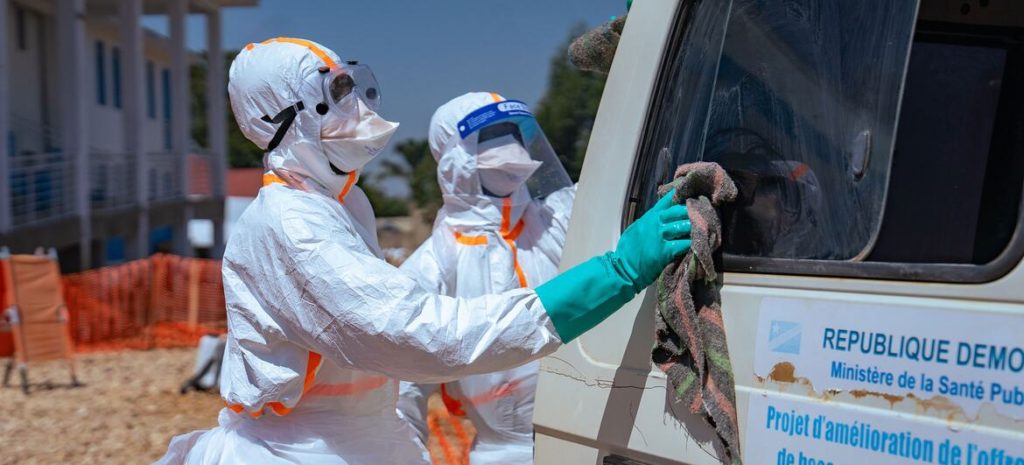
Health workers disinfect a vehicle during the Ebola outbreak in eastern Democratic Republic of the Congo.© WHO/Josua Mulala Raymond
The Democratic Republic of the Congo is facing the largest Ebola outbreak ever recorded on its territory. While the response is still struggling to slow the spread of the Bundibugyo virus, the World Health Organization (WHO) and the Congolese authorities are speeding up the launch of clinical trials of treatments and vaccines.
The aim is finally to have specific tools against this particularly lethal strain of the virus, for which there is currently no licensed vaccine. According to the WHO, research is now entering a decisive phase, with several therapeutic and vaccine candidates now ready to be evaluated in real-world conditions.
At a press conference in Geneva on Tuesday, Dr Vasee Moorthy, head of the WHO’s “R&D Blueprint” programme, which speeds up research and development activities during outbreaks, announced the roll-out of several clinical trials against the Bundibugyo strain.
This acceleration, he said, builds on several years of preparation carried out with international partners. Research protocols had been drawn up in advance so that they could be activated as soon as a potential treatment or vaccine became available.
Ituri, a testing ground for the response
On the ground, the PARTNERS therapeutic trial is already recruiting patients at three centres in Ituri province, the epicentre of the outbreak, in eastern Congo. Led by the Congolese National Institute for Biomedical Research (INRB) in partnership with WHO and several health NGOs, it already includes more than 50 patients with confirmed cases.
At the same time, a trial of a potential post-exposure prophylaxis treatment is also under way in the province. More than 25 patients have already been recruitedto assess whether obeldesivir, an oral medicine given for ten days to people heavily exposed to the virus, can prevent the disease from developing.
Prevention is the other pillar of this scientific strategy. Several vaccine candidates are advancing simultaneously.
The first vaccine designed specifically against the Bundibugyo virus, developed by the University of Oxford and the Serum Institute of India, entered Phase 1 clinical trials in the United Kingdom on 24 July. A second candidate, developed by the pharmaceutical company Moderna, is due to begin this first phase of evaluation in Canada this week.
Meanwhile, new preclinical data on Ervebo – the vaccine already licensed against the Zaire strain of Ebola – are informing research to determine whether it might also offer protection against the Bundibugyo virus.
An epidemic that continues to spiral
This acceleration in research comes as the epidemic continues to spread at an unprecedented rate. In one week, 567 new cases and 296 deaths were recorded, the highest weekly tolls since the outbreak began on 15 May.
According to the latest situation report published by the WHO, the DRC now has 3,748 confirmed cases, 1,657 deaths and 708 recoveries.
The disease affects 49 health zones across five provinces – Ituri, as well as Haut-Uélé, North Kivu, South Kivu and Tshopo. While Ituri still accounts for nearly 90% of cases, the spread of transmission to several provinces is complicating control efforts.
Nearly 17,000 contacts are currently being monitored, around 80% of them on a daily basis, a system that is essential in trying to break chains of transmission.
In the face of this trend, the WHO considers the resources deployed to be still insufficient. “We need greater support, both financially and in operational resources, in order to strengthen every component of the response,” said Tarik Jasarevic, the organisation’s spokesperson.
According to the UN agency, these additional resources are needed to increase capacity for patient care, strengthen investigation teams, support safe burial operations and back the community workers mobilised against the epidemic.
Translated from French. The French original prevails.