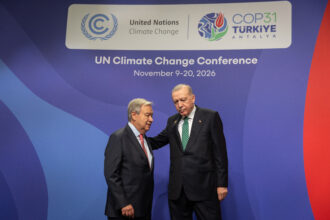
UN / Florence Mondou
UN Secretary-General António Guterres spoke at Climate Action Week in London as a deadly heatwave continues to grip Europe. UN Secretary-General António Guterres issued an impassioned call for more ambitious global action on climate change caused by fossil fuels, in order to avoid irreversible damage.
He called on artificial intelligence (AI) companies to ensure full transparency on the environmental footprint of their data centres, particularly with regard to carbon emissions, water consumption and land use. He stressed that the world’s dependence on oil was fuelling both the climate crisis and a crisis of energy sovereignty, the latter linked to massive disruption to shipping in the Strait of Hormuz and to the conflict between Iran, Israel and the United States.
“These crises may seem distinct, but they share the same destructive root: fossil fuels. And they demand the same response: a rapid and fair transition to clean energy, together with stronger adaptation, resilience and climate justice for those already suffering the harmful effects of climate change,” said Mr Guterres, calling on political leaders to deliver a global transformation comparable to the one that was needed to phase out leaded petrol and ban the chemicals responsible for the hole in the ozone layer.
The UN plan for energy independence
- Cut emissions rapidly: emissions must peak now and reach net zero by 2050, notably through a global initiative to curb methane pollution.
- Accelerate the expansion of clean energy: renewable energy must continue to be expanded, subsidies for fossil fuel projects must end and the profits made from fossil fuels must be taxed in order to support vulnerable communities and the energy transition.
- Clean up AI: require large artificial intelligence (AI) companies to disclose the environmental impact of their data centres and to power them with renewable energy by 2030.
- Ensure a just transition: make sure that the shift to clean energy creates jobs, supports communities and delivers development benefits to developing countries.
- Strengthening climate resilience: increasing investment in adaptation, early warning systems and other measures to protect the people most vulnerable to the effects of climate change.
- Unlocking fair finance: widening access to affordable finance for developing countries so that they can invest in clean energy, climate change adaptation and sustainable development.
- Defending science and truth: building trust in science, tackling climate disinformation and protecting environmental journalists and human rights defenders.

Extreme weather events linked to climate change are causing droughts and floods such as this one in Thailand.© UNICEF/Arun Roisri
The Earth’s tipping points
More than a decade has passed since world leaders agreed in Paris to limit the rise in global temperature to 1.5°C above pre-industrial levels, a remarkable display of international unity under the auspices of the UN. Today, although that agreement remains in force – and despite the United States formally withdrawing for the second time in January this year – UN-backed scientists are warning that average annual temperatures are likely to exceed that threshold in the coming years.
“Every fraction of a degree matters,” the Secretary-General stressed, warning of irreversible damage to coral reefs unable to survive in overheated waters, of melting ice sheets that threaten to redraw coastlines and displace millions of people, and of the real possibility that some small island states could disappear beneath the waves.
Faced with this existential scenario, “the task before us is to strictly limit this overshoot, shorten its duration and bring temperatures back below 1.5°C as quickly as possible,” Mr Guterres argued.
“The mother of all energy shocks”
While stressing that “any peace agreement is welcome and would bring much-needed relief”, in reference to a 60-day truce intended to allow talks between Iran and the United States to continue in Switzerland, the UN chief noted that the crisis in the Middle East had triggered “the mother of all energy shocks”, comparable to the oil crisis of the 1970s and Russia’s full-scale invasion of Ukraine.
Devastating as the war in the Middle East has been for highly industrialised countries, the UN Secretary-General insisted that developing countries had been hit even harder: “It is a debt shock, a food shock, a development shock,” he told the London audience.
“There is no embargo on sunlight and no blockade on the wind”
“The good news is that – unlike every past energy crisis – we now have a clear way out, a clean way out,” Mr Guterres continued. He pointed out that since 2010 the cost of solar power has fallen by almost 90%, that of onshore wind by more than 70% and that of battery storage by 95%.
Renewable energy has avoided carbon dioxide emissions greater than the combined annual emissions of the United States, the European Union and Japan, the UN chief said, adding that investment in clean energy now attracts almost twice as much funding as that devoted to fossil fuels.
“There is no embargo on sunlight and no blockade on the wind,” he stressed.

© UNDP / Tanzania Workers install solar panels in Tanzania.
A seven-point plan for energy independence
As part of his action plan to break definitively with fossil fuels, the Secretary-General set out seven key measures:
1 Emissions must peak immediately and fall sharply this decade, reaching net zero by 2050. The G20, the group of wealthy nations, “must lead the way” in this area, as it is responsible for around 80% of global emissions, Mr Guterres said. Among the ambitious measures is a global call to action on methane aimed at cutting emissions of this gas, which traps around 80 times more heat than carbon dioxide but breaks down in the atmosphere within just one or two decades.
“The world phased out leaded petrol. We eliminated ozone-depleting chemicals. Methane pollution must be next,” the UN chief stressed.
2 Clean energy projects must be promoted and public subsidies for new fossil fuel projects scrapped. “The eight largest fossil fuel companies reported pocketing an additional $6.5 billion in the first quarter of this year alone… I urge governments to tax them” in order to help vulnerable families and communities and to speed up the transition to clean, affordable energy, Mr Guterres said.
3 Every major AI company should “measure and publicly disclose the full environmental impact” of its data centres – their carbon footprint, water consumption and land footprint – and commit to powering every data centre with renewable energy by 2030. AI data centres already consume more electricity than most countries; “it is time to put our cards on the table”, the Secretary-General noted.
By 2030, AI data centres could consume enough water to meet the basic needs of the 1.3 billion people of sub-Saharan Africa for an entire year, the UN chief observed.
4: “No more extraction without development” : Mr Guterres called for greater support for the transition to clean energy, in a way that benefits workers and communities everywhere, as well as developing countries, driven by the United Nations Climate Change Conference – COP31 – to be held in Türkiye. “The transition itself is no longer in question,” he stressed, adding: “It will be either managed or chaotic; either fair or unequal; either a source of stability or a source of deeper division; and those choices are still ours to make.”
5 Those most exposed to climate hazards must be protected by helping them to adapt, because this “saves lives, protects homes and communities, helps economies absorb shocks and keeps societies together”, the Secretary-General insisted. Emergency systems must be put in place before shocks turn into humanitarian and economic disasters, Mr Guterres added. At the same time, developed countries must honour their “long-standing commitment to double adaptation finance, with a clear pathway to tripling it”, he said.
6 Support fair financing for the phase-out of fossil fuels and for the green transition at scale and at pace: many developing countries face borrowing costs two to three times higher than those of wealthier economies.
“Countries rich in renewable potential are being shut out of the clean energy revolution,” the Secretary-General said, citing the example of African countries, which receive just 2% of global investment in clean energy despite having 60% of the world’s best solar resources.
Mr Guterres highlighted the additional lending capacity of $600 billion to $800 billion available to multilateral development banks such as the World Bank. This should be used “dynamically” to finance the infrastructure of tomorrow and adaptation to climate change, alongside other investment measures such as taxing high-emitting sectors, he stressed.
Likewise, “developed countries must keep their promises”, notably by supporting the Fund for responding to Loss and Damage and the Green Climate Fund, the Secretary-General continued, stressing that the $300 billion pledged to developing countries must be delivered and accompanied by concrete measures to mobilise $1.3 trillion a year by 2035.
7 Support science as the foundation of truth and of early warning systems. The UN Secretary-General called for the fight against false information about the climate, because “disinformation is deliberately spread to delay climate action, entrench vested interests and erode trust”.
Human rights defenders and journalists covering climate and environmental issues must be protected, and trust in data and institutions must be strengthened, Mr Guterres insisted, citing the Global Initiative for Information Integrity on Climate Change, led by the UN, UNESCO and Brazil in pursuit of this goal.
Translated from French. The French original prevails.