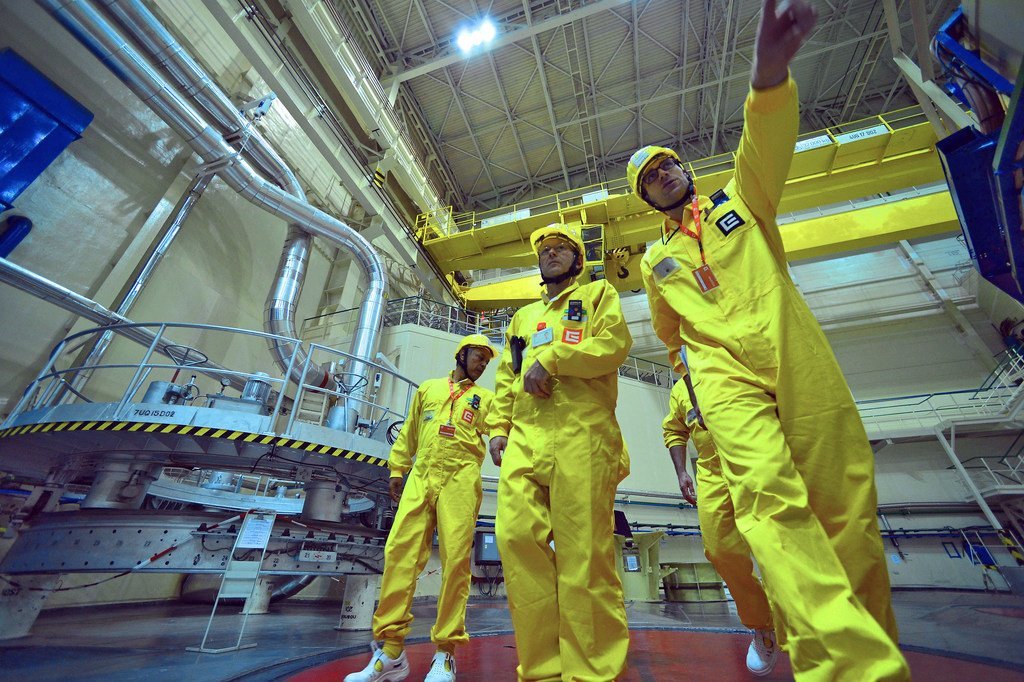
Photo: IAEA
The IAEA applies safeguards to verify that states are complying with their international legal obligations to use nuclear material for peaceful purposes only.
The 2015 nuclear agreement with Iran cannot serve as a starting point for a new deal with the country, the head of the International Atomic Energy Agency (IAEA) said in New York on Wednesday.
Rafael Mariano Grossi was speaking at a press conference held at United Nations Headquarters, on the sidelines of the latest Review Conference of the Parties to the Treaty on the Non-Proliferation of Nuclear Weapons (NPT).
He said that the Joint Comprehensive Plan of Action (JCPOA) – concluded between Iran, the five permanent members of the Security Council, Germany and the European Union – “cannot constitute a basis” for a new agreement and that “we need to consider a different approach”, as Iran’s nuclear programme has changed too significantly.
“We are seeing that multilateralism is under intense pressure, that various elements of treaties essential to international security are under strain…”
Mr Grossi was also asked about enriched uranium which, according to some reports, is now buried under rubble following recent US-Israeli air strikes in Iran.
The IAEA was inspecting highly enriched nuclear material until June 2025, he said. Its teams had placed some 440 kilograms of uranium under seal during their last visit, “so we need to verify that this is still the case”.
He stressed that until inspectors were able to return to the site, the Agency “cannot confirm that this is indeed the case”.
Addressing participants at the NPT Review Conference, Mr Grossi called for a renewed commitment to non-proliferation, warning that “a world with more countries possessing nuclear weapons would not be a safer world”.
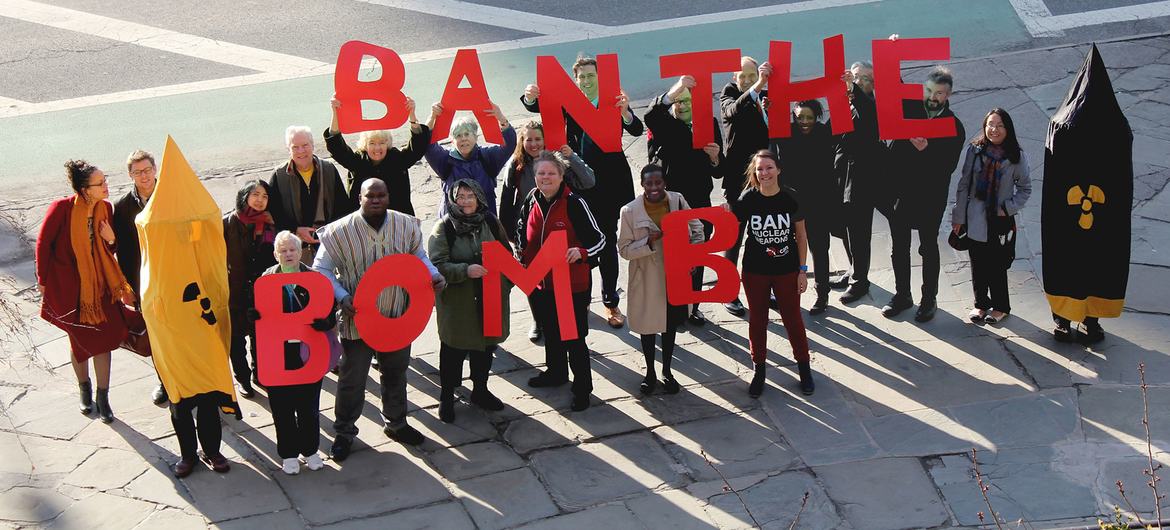
© ICAN Protesters speak out against nuclear weapons.
Threat of nuclear testing
Meanwhile, at a time of persistent global tensions and with multilateralism under strain, efforts to ban nuclear testing remain crucial, the head of the organisation tasked with overseeing the Comprehensive Nuclear-Test-Ban Treaty (CTBT) told journalists.
“We are seeing multilateralism under intense pressure, various elements of treaties vital to international security under strain… and rhetoric emerging about threats of nuclear testing, a return to such testing, and even concerns about their potential use,” said the Executive Secretary, Robert Floyd.
“That is why the work of organisations such as the CTBTO — which strive to limit the proliferation of nuclear weapons as well as their further development — is of absolutely critical importance.”
Near-universal support

Simonis Wien Robert Floyd, Executive Secretary of the Comprehensive Nuclear-Test-Ban Treaty Organization.
The test-ban treaty prohibits all nuclear explosions anywhere on the planet, whether in the atmosphere, underwater or underground.
Opened for signature 30 years ago, the CTBT has “virtually stemmed the flow of nuclear weapons tests”, with fewer than a dozen tests carried out since then.
Mr Floyd described the text as “a treaty that has garnered near-universal support for banning nuclear tests, whatever their yield”, and which relies on “a verification system that inspires confidence among nations, thereby establishing a powerful norm against the practice of testing”.
Not yet in force
Although 187 States have signed the treaty – 178 of which have ratified it – it has not yet entered into force: its entry into force requires ratification by nine key countries possessing nuclear technology: China, Egypt, India, Iran, Israel, North Korea, Pakistan, Russia and the United States.
Asked whether there had been any progress in this regard, Mr Floyd said it was necessary to “find a way for the United States, Russia and China to address the issue of the treaty and its ratification together”.
“In my view, it is highly unlikely that any one of them will take a step in that direction without the others acting simultaneously and in concert. That is certainly something I would encourage all these States to consider; such a move would undoubtedly be a major step forward.”
Verification system
On monitoring, he said that more than 90% of the verification system was already in place, with 307 facilities operational and installed around the world.
“All six North Korean tests were detected, including the very first, even though it was of very low intensity,” he added.
This verification system will enable the CTBTO to detect any nuclear explosion with a yield of 500 tonnes of TNT equivalent or more — roughly 2 to 3% of the yield of the atomic bomb dropped on the Japanese city of Hiroshima during the Second World War.
It will be “an invaluable asset for all of humanity; indeed, any state contemplating developing a nuclear weapon would be compelled to carry out a test — and if it did so, the whole world would know about it immediately”.
Countering disinformation
Mr Floyd also highlighted another strand of his organisation’s work: countering disinformation surrounding seismic events, as happened in late 2024 with regard to Iran.
“Social media quickly caught fire, with some users claiming that these seismic events were in fact nuclear tests,” he recounted. “However, the analyses carried out by my colleagues showed that these phenomena were entirely consistent with the characteristics of natural seismic events — earthquakes — occurring in northern Iran.”
Translated from French. The French original prevails.