Munich Security Conference: Europe gripped by paralysis on defence
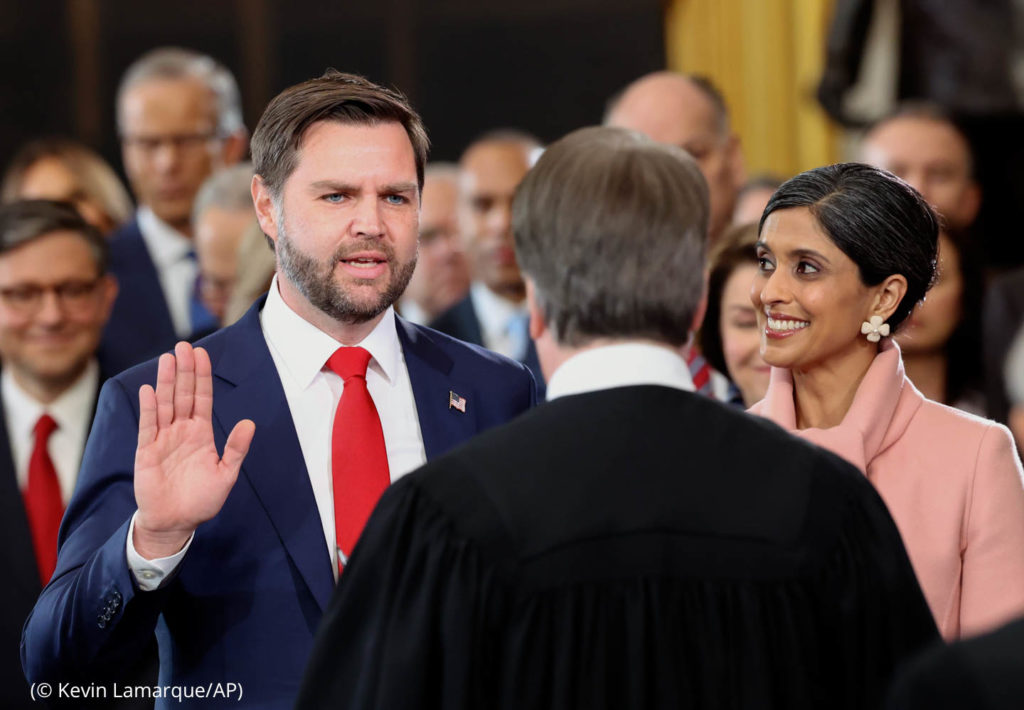
History will record that the international career of the new US Vice-President, J.D. Vance, probably began at the Munich Security Conference on 14 February 2025. While the international community gathered there was expecting a speech on geopolitics and global security, America’s number two launched a fierce attack on a dependent Europe. In 2007, the West neither listened to Putin nor responded to his warnings. Will it repeat the same fatal strategic mistake in 2025, now that J.D. Vance has formally recorded the break in the “transatlantic link”?
So much so that the Old Continent, which seems to have been caught completely off guard since last November, is struggling to see clearly and keeps commenting on and criticising every move of the new US administration instead of moving forward. While many EU leaders rushed to congratulate the billionaire on his return to the White House after the election of 4 November, in a bid to win his sympathy/compassion, few understood that everything the Republican candidate had announced in his campaign programme was not a barrage of fake news and empty threats: like everyone else, Europe would pay dearly for American support and, even more so, for the transformation, or even the withdrawal, of that support. Whereas the Union ought to see this as an opportunity to emerge, it prefers instead to curl up into itself, even though for decades the Americans did everything they could to stop us from building the famous Europe of defence. We are facing a genuine test of truth, like the ordeals of the Middle Ages, those trials by fire experienced as the judgement of God.
For a month now, the European Commission has been struggling to make its voice heard in the face of an America that has decided to put its own interests first, after years in which, as it sees it, many partners took advantage of it and lived off the American bone, in terms of both the trade balance and American aid of every kind. Europe, which has proclaimed for so many decades that it had grown up and could at last take charge of its own defence, has never managed to do so. What has become of the much-vaunted “geopolitical Commission” so lauded by Ursula Von der Leyen? What of European strategic autonomy and its “Strategic Compass”? We have already lost the South, we are in the process of losing the North with the Atlantic Alliance, and, deep down, we have completely lost our bearings. Not only does our Strategic Compass have no heading, it now no longer seems to make any sense at all.
Europeans have been lulling themselves with illusions and incantatory slogans for years, but where is the real programme for the Defence Union? Since Donald Trump’s return to power, and his daily tsunami of announcements, not even a summit of European heads of state has been planned to take stock of the changes in the transatlantic relationship and decide on a major strategic and military plan. No one has dared to give Trump credit for wanting us to spend 5% of our budget on defence so that we can use it for our own interests. That is the money that could have gone, in particular, towards creating a European arms industry.
We are shaking like leaves instead of acting. How, then, can we blame the Americans for choosing to retreat after paying too much, as they see it? Even though the European Union has created a formidable area of economic exchange, it has remained a political and geopolitical dwarf that spends its time handing out good and bad marks to the rest of the planet: an armada of officials, a legislative one-upmanship, a moralising discourse – everything that is bound, to say the least, to irritate the new occupant of the White House, whose mouthpiece J.D. Vance became in Munich.
Times have changed for a passive Europe: the era of protectionism, but also this new era of resurgent American supremacy, which Trump summed up in his famous MAGA (Make America Great Again), should have been anticipated. For months, he has been saying that he had decided to allocate the floods of money poured out across the planet to far nobler and fairer goals – to America first (America First). And Europe is left with little more than its eyes to weep with, spending its time playing the hard-done-by victim and reproaching the United States for heading off: customs tariffs, an end to support for Ukraine, negotiations with Russia to wrap up a peace deal as quickly as possible, the deployment of a peacekeeping force funded by the Europeans and the Europeans alone.
Friday 14 February 2025 was far from a lovers’ rendezvous with this new America led by Donald Trump, the 47th President of the United States. Within a few hours, following the words of J.D. Vance, the Bavarian capital became, for many Europeans, the tribunal of an American Holy Inquisition on European soil. To bipolar Europeans, at once so pro- and anti-American, the whole affair looked like a cruel, one-sided trial of the Union. Europe complains, Europe bristles at the Trump administration, but Europe would do better to sort out its own problems rather than lecture the United States. That, in essence, is the message he sought to convey.
In his speech, the US Vice-President waded into the democratic debate, where he was not necessarily expected. Europeans, powerless, continue to believe that America will always be behind them to guarantee a security and defence that they are unable to build into a shield of sovereignty. Munich has become an unmissable gathering for the players who matter in international relations, and the fate of Europe is being decided right now, following the first exchanges that have just taken place between Donald Trump and Vladimir Putin. Outside the canons of beauty of international law and the multilateral institutions so dear to the European Union, Washington is sketching out a peace plan between Moscow and Kyiv from which the Old Continent would be completely shut out. We have paid to supply Ukraine in the face of Russian aggression and to defend it, but from now on we are going to pay to ensure the maintenance of the peace that the US President is trying to wrest from Putin and Zelensky. In both scenarios, the Europeans, starry-eyed and caught up in their Atlanticist fantasy, like so many of Washington’s useful idiots, will once again have to bleed themselves dry in the hope of finally obtaining security. At present, there is no room in the words of Trump and Vance for the complaints and laments of the Europeans. It is hard to take after the strategic choices made by Brussels to support Ukraine (with no expectation of return) since Vladimir Putin’s invasion of 24 February 2022.
But rather than address this crucial issue at such a critical moment, JD Vance chose to use his speech to attack the very foundations of Europe, which he likes no more than his boss does, putting on trial a democracy he portrayed as under attack from all sides (notably from immigration and terrorism). In his view, Europeans are the first to flout the common values they share with Americans. That is, of course, open to debate. While he criticised the annulment of the Romanian election, in which a far-right candidate had come out on top, he backed Elon Musk and his statements in support of the AfD, with Germany’s elections just a week away. To challenge the remarks of the world’s richest man, when they were supposedly no more than a mere opinion, amounts in his view to a direct attack on democracy and on freedom of opinion itself.
It seems that, for once, Europe is being singularly called to account for its paternalism and for lecturing the whole world on human rights. And it hurts. But this must prompt us to reflect on our future and our own security: are we to define ourselves a little more each day in opposition to this new world that is emerging, or through negotiation and coexistence with it ? Faced with a Trump and a Vance, we have lost what remained of our political credibility and of our lofty human-rights moralising.
In any case, nothing we stand for at home impresses the new administration, or even interests it. Last November, Ursula Von der Leyen prostrated herself before Trump, barely re-elected, and absurdly laid her cards on the table by offering, without consulting anyone, to buy more American gas. That “bargaining chip” should have been kept for a future negotiation. Nothing weaker or more absurd can be imagined, since we now have nothing left to offer in the face of the pressure currently being exerted by Washington. That is also why the new administration supports every political movement seeking to ward off fate and rise up against the gradual transformation that Trump and Vance consider harmful and about which the Commission is doing nothing: a form of descent into lawlessness and of letting Europe go to seed! What those two detest most about us is European ponderousness and our inertia: if illegal immigration is a problem, something must be done. If support for Ukraine has not brought victory, something else must be done. Washington is giving the European tree a hard shake. It is like a business: if the results are not there, the strategy must change. Trump and Vance do not understand the obstinacy of the Union, which lives on dreams, fantasies and mirages: Ukraine’s victory, the collapse of Putin’s Russia, Kyiv’s accession to NATO, a return to the pre-2014 borders, and so on. Pete Hegseth, the Secretary of Defense, dampened our last remaining ardour on 12 February, declaring at the NATO meeting that Ukraine would never be in NATO and that there would be no return of Crimea or of the Russian-speaking territories conquered by Russia since 2022.
So why did J.D. Vance lay into Europe so relentlessly in Munich, as if to hammer the last nail into the coffin? Has Europe become its own enemy? It could well resemble the behaviour of a manipulative pervert, the sadist who keeps hounding his victim to sap their confidence. But what else, ultimately, would wake Europe up? We have said it time and again: the next four years are a unique opportunity for the EU to do everything in its power to stand on its own feet in terms of economic, energy and defence sovereignty. It is high time Europeans seized the opportunity offered by Donald Trump’s return to power to assert their strategic autonomy. That is what the young JD Vance, Vice-President of the United States, put his finger on one February day in Munich. This is what is known as “shocking system” therapy. It is no longer up to the United States to play nanny. In the new global jungle, and in an era of citizens coddled by social media, Europe must reinvent itself and bare its teeth, very quickly, or risk being devoured.
Translated from French. The French original prevails.