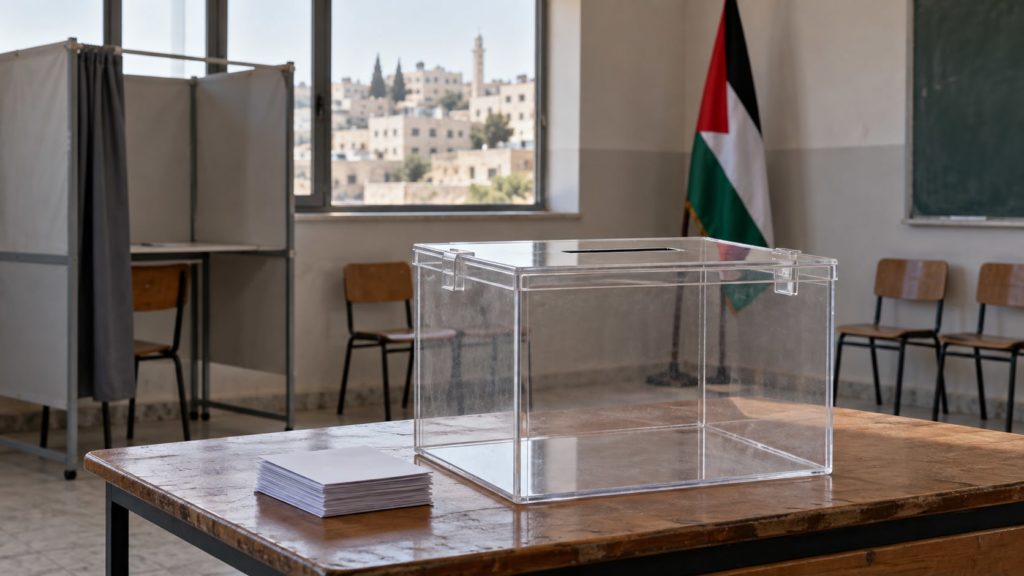
Twenty years after the last legislative elections, the renewal of Palestinian representation remains stalled. The practical difficulties of holding a vote are real, but they are compounded by rivalries among leaders, the division between the West Bank and Gaza, and the constraints imposed by Israel. Understanding this deadlock requires distinguishing between the institutions, the parties and the interests of their foreign partners.
The Palestinian legislative elections scheduled for 28 November 2026 have officially been postponed. On 10 October, Mahmoud Abbas issued a decree setting 11 September 2027 as the date for both the legislative and presidential elections. Hussein al-Sheikh, Vice-President of the State of Palestine and one of Fatah’s principal leaders, had informed France of the prospect of this postponement in a letter dated 8 October, according to Reuters. [1] [12]
What is at stake goes beyond the timetable. An election allows voters to choose representatives, hold those in power to account and pass judgement on their record. When this national event vanishes for two decades, power continues to function, but its connection with voters weakens. The Palestinian postponement therefore raises a simple question: how can an authority be reformed if those it governs cannot renew its leadership?
Four names to understand the Palestinian system
The Palestinian Authority (PA) is an administration that emerged from the Oslo Accords between the Palestine Liberation Organization and the State of Israel. The Declaration of Principles signed on 13 September 1993 provides for transitional Palestinian self-government. Established in 1994, the PA runs public services and civil institutions, among other things. It does not, however, wield the powers of a fully sovereign state. In the West Bank, its authority is exercised over fragmented territory, where Israel retains decisive prerogatives, particularly in military matters. Diplomatic recognition of the State of Palestine does not remove these limits on the ground. [2] [13]
The Palestine Liberation Organization, or PLO, represents the Palestinian national movement on the international stage. It carries the movement’s diplomatic commitments and remains bound by the agreements it has signed. Fatah, the political movement historically associated with its late leader Yasser Arafat, dominates both the PLO and the Palestinian Authority. Mahmoud Abbas, who succeeded him at the head of all three bodies, concentrates power within them. A distinction must therefore be drawn between the administration, the representative organisation and the party that dominates them. [11]
Hamas is a Palestinian Islamist movement with a political organisation and armed forces. Its confrontation with Fatah led in 2007 to its seizure of control of Gaza and the ousting of forces loyal to Abbas. Since then, the separation between the two territories has gone hand in hand with a political rift. Organising a joint vote also means attempting to bring together areas that do not answer to the same chain of command. [11]
Legislative elections choose the members of the Palestinian Legislative Council, the parliament; the presidential election chooses the president. Elected in 2005, Abbas has not put his mandate to a fresh national vote. The timetable adopted on 10 October now provides for both elections to be held on the same day. They would not, however, renew the PLO’s bodies. This institutional coexistence limits what an election can resolve. [11] [12]
The 2006 precedent remains etched in memory
On 25 January 2006, Hamas, running under the Change and Reform banner, won 74 of the Legislative Council’s 132 seats, against 45 for Fatah. Turnout reached 77%. The election then used a mixed system: half the seats were allocated in constituencies and the other half to national lists. A majority of seats therefore did not necessarily mean an absolute majority of the vote across the country as a whole. [3]
The result immediately posed an international problem. The Quartet on the Middle East, bringing together the United States, the European Union, the United Nations and Russia, demanded that the future government commit to non-violence, recognise Israel and accept previous agreements. It announced that aid would be reviewed in the light of compliance with these principles. Electoral victory was therefore not enough to secure the diplomatic relations and funding needed to govern. [4]
The armed split of 2007, followed by Abbas’s dissolution of the Legislative Council in 2018, prolonged the institutional paralysis. The 2006 precedent thus remains a warning for leaders and their partners: the ballot box can bring to power a party they do not wish to recognise or do not know how to work with. [5]
A fresh Hamas victory is by no means inevitable. But the main players assess the vote in terms of the political risk it poses to them. This fear shifts the debate: rather than discussing only the conditions for a free vote, the priority becomes securing the arrangement of power that will emerge from it.
Jerusalem: a real obstacle and a political choice
In April 2021, Abbas postponed the general elections, citing the impossibility of holding them in Jerusalem. The decree published by the Central Elections Commission suspended the process until conditions were in place throughout the Palestinian territory, first and foremost in the city claimed as its capital. [6]
For Palestinians, voting in East Jerusalem carries national significance: forgoing the vote there could be read as accepting their political exclusion from the city. The Central Elections Commission points out, however, that in 2021 it was prepared to consider other arrangements, subject to instructions from the political leadership and consultations with the factions. Alternative solutions could therefore have been discussed; the obstacle did not necessarily require a postponement. [7]
At the same time, Fatah was facing a challenge from within its own ranks. A list backed by Marwan Barghouti, a Palestinian figure imprisoned in Israel, and Nasser al-Qudwa, a former foreign minister, was contesting the official list. The postponement could thus address a territorial difficulty while also shielding the leadership from a contest that had become risky. [8]
A distinction must be drawn between the official, documented reason and the political advantages that some officials may derive from a decision. The two can coexist, without the postponement being reducible to a mere pretext.
Rejection of the leadership does not automatically benefit Hamas
Conducted from 5 to 8 August 2026, the survey by the Palestinian Center for Policy and Survey Research (PCPSR), an independent institute based in Ramallah, shows the extent of the desire for change. In a hypothetical three-way presidential race, Marwan Barghouti wins 54% of voting intentions among those who say they intend to vote, against 26% for Khalil al-Hayya, head of Hamas’s political bureau, and 14% for Mahmoud Abbas. In addition, 79% of respondents want Abbas to step down. [9]
These figures do not predict the outcome of the legislative elections. In a separate parliamentary scenario, the same institute puts Fatah on 32% and Hamas on 29% among voters who say they intend to take part, with 21% undecided. The survey is based on 1,270 interviews in the West Bank and Gaza, with a stated margin of error of 3.5%. The war and the displacement of the population call for additional caution. [9]
The loss of confidence in Abbas does not, therefore, necessarily translate into support for Hamas. It may benefit Fatah figures opposed to his leadership, other lists or abstention. Presenting the situation as a fixed contest between Abbas and the Islamists obscures this demand for renewal.
Factions that negotiate before letting the institutions decide
The political scientist Ibrahim Dalalsha, founder and director of the Horizon research centre in Ramallah, points to a structural weakness: the factions of the national movement remain entangled with public institutions. In his view, this hold deprives the government of control over the electoral timetable: its ministers may learn from the press of decisions concerning the elections. [10]
The weight of the factions is also evident in the rules on candidacy. Ghaith al-Omari, a former adviser to the Palestinian Authority and a fellow at the Washington Institute, a US think tank specialising in the Middle East, notes that the commitment to the PLO charter required of participants, under the conditions announced, closes the door to Hamas taking part under its own banner. [10]
This raises a question: should a comprehensive agreement between the factions be secured before the vote, or should voters be allowed to decide between their competing visions? A minimum of agreement is needed to ensure security and to enforce the outcome. But demanding prior consensus on everything may hand each organisation a means of blocking the vote indefinitely.
A single authority with a monopoly on weapons meets a basic requirement of government: a public decision cannot be implemented if an armed organisation retains the power to oppose it. The issue is particularly sensitive in an environment where an armed incident involving Israel can trigger violent reprisals and jeopardise the political process. The timetable and guarantees for disarmament still need to be spelt out, however. Otherwise, it risks becoming a perpetually deferred condition, leaving the elections in limbo.
Israel and foreign partners also weigh on the timetable
Elections require more than ballot papers: candidates must be able to move about, campaign and meet residents; voters must be able to reach polling stations; electoral officials must be able to transport equipment and oversee the process. In a territory subject to restrictions on movement and scarred by destruction, these conditions are essential. Their absence can undermine the freedom of the vote as much as its practical organisation.
Neomi Neumann, former head of research at Shin Bet, Israel’s domestic security service, believes that the Israeli government is pursuing an ideological policy of weakening the Palestinian Authority and of de facto annexation in the West Bank. Her analysis, presented at the Washington Institute, is a reminder that the PA’s capacity to reform also depends on decisions beyond its control. [10]
Foreign partners face another difficulty. They want a representative Palestinian leadership capable of governing and negotiating. But supporting an election also means contemplating an outcome contrary to their preferences. The Quartet precedent shows that recognising the result and the conditions imposed on a government can come into conflict. This difficulty must be addressed before the vote, without choosing leaders on the voters’ behalf.
Breaking the cycle of endless postponement
A credible date must come with verifiable conditions: clear rules on candidacy, guaranteed freedom to campaign, precise arrangements for Gaza and East Jerusalem, independent observation and a commitment to respect the results. Provision must also be made for who will settle disputes and how the elected institutions will be able to exercise their mandate. These guarantees make it possible to distinguish genuine preparation from a diplomatic announcement.
No election will, on its own, end the occupation, the territorial division or the armed rivalries. But waiting for these obstacles to disappear amounts to making democratic renewal conditional on an ideal situation that may never arise. The challenge is to secure sufficient guarantees to hold a vote, and then to allow the institutions to function.
The postponement temporarily preserves the balance of power among leaders. It does not restore public trust. For the Palestinian Authority, the danger lies in seeking international legitimacy while endlessly deferring the renewal of its popular legitimacy. Reform cannot be confined indefinitely to reorganising the top: it must give voters a real hold over those who govern them.
Sources and verification links
Sources consulted and updated on 12 October 2026. The numbered references and the names of the two researchers in the article are clickable.
[1] Reuters — 9 October 2026. Postponement announced and September 2027 proposed as the new deadline
[2] Larousse — Reference entry. Origins and limited powers of the Palestinian Authority
[3] Central Elections Commission (Palestine) — 2006. Official results of the 2006 legislative elections, in Arabic
[4] United Nations — 30 January 2006. Quartet statement and conditions imposed on the future government
[5] Associated Press — 8 October 2026. Talks between the factions and obstacles to the vote
[6] Central Elections Commission (Palestine) — 30 April 2021. Official decree postponing the general elections
[7] Central Elections Commission (Palestine) — Background file. Participation of Jerusalem and alternative solutions discussed in 2021
[8] Reuters Archives — 31 March 2021. Rival list backed by Marwan Barghouti and Nasser al-Qudwa
[9] PCPSR — 12 August 2026. Poll number 97, conducted from 5 to 8 August 2026
[10] Washington Institute — 24 July 2026. Summary of the forum with Neumann, Dalalsha and al-Omari
[11] International Crisis Group — 1 February 2023. Report on the Palestinian succession and institutions
[12] WAFA — 10 October 2026. Decree setting the legislative and presidential elections for 11 September 2027
[13] United Nations — 13 September 1993. Declaration of Principles signed by Israel and the PLO
Biographical note. Ibrahim Dalalsha
Biographical note. Ghaith al-Omari
Websites for further monitoring
Palestinian Central Elections Commission
United Nations: Question of Palestine
Follow the author on X
Further reading from LTDN
West Bank settler violence opens a home front for the Israeli army
Gaza: Trump proclaims Hamas disarmament, but each side is already describing a different deal
Translated from French. The French original prevails.