By Lyna HAMANI, intern at the Observatoire Géostratégique. Presentation of research and analysis
To mark the celebrations of the Jewish New Year, Israeli settlers went to the Al-Aqsa Mosque compound on Friday 21 September to perform religious rites under police protection. This latest in a long series of incursions was condemned by the Waqf, as it violated the 1967 status quo, under which non-Muslims may visit the compound only at specific times, and may not pray there.
These incursions, which are growing in number and enjoy the backing of certain political figures, reflect the changing place of messianism within Israeli society. In its geopolitical dimension, the Al-Aqsa Mosque compound has thus become an allegory of an unresolved religious and territorial conflict.
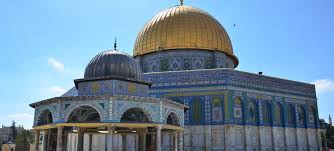
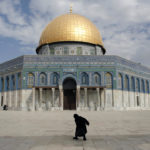
Al-Aqsa Mosque compound, Temple Mount: two names for an intertwined history
As the saying goes, Jerusalem, the “thrice-holy” city, is the crossroads of the three great monotheistic religions. For Christians, it is linked to the death and resurrection of Jesus. For Jews, it is the founding city where King Solomon’s First Temple was built. For Muslims, Jerusalem is the starting point of the “Night Journey” undertaken by the Prophet Muhammad, and is home to the Al-Aqsa Mosque, the third holiest site in Islam after Mecca and Medina.
The Esplanade of the Mosques lies in the Old City, in the east of Jerusalem. Jews prefer the term “Temple Mount”, which is closely bound up with Hebrew history. The Esplanade is indeed built on the remains of Solomon’s First Temple, erected in the 10th century BC and destroyed in 586 BC by Nebuchadnezzar II, King of Babylon. After the Persians took Babylon, Cyrus II ordered the Jews to return to their lands and rebuild the temple there, which would later be considerably enlarged by Herod I the Great. However, during the First Jewish–Roman War, in AD 70, the Emperor Titus ordered his army to plunder the Temple and destroy it for good. One remnant survives today: the Wailing Wall, or Western Wall, which supports the Esplanade of the Mosques and is regarded by Jews as the holiest place of prayer.
For Muslims, the Esplanade and its construction symbolise the reach of the Arab-Muslim empire’s conquests in the 7th century. After the conquest of Jerusalem in 638, Caliph Omar Ibn al-Khattab had the ruins of the Temple cleared and prayed there, and allowed the Jews to return to Jerusalem. Construction of the Dome of the Rock was completed under the Umayyad caliphate of Abd al-Malik, although the site has suffered numerous episodes of destruction and rebuilding over the centuries.
A partition at the root of the discord
On 18 February 1947, the British announced their intention to end their Mandate for Palestine, granted by the League of Nations in 1922. The World Zionist Organization then demanded the establishment of a Jewish national home in Palestine, in line with the Balfour Declaration of 1917, while the Arabs called for independence. The United Nations General Assembly adopted Resolution 181 on 29 November 1947, providing for the creation of a Jewish state and an Arab state.
Jerusalem was to be placed under international trusteeship, but this arrangement satisfied neither the Jews nor the Arabs. After David Ben-Gurion proclaimed Israel’s independence in 1948, numerous desperate wars would break out: for the Arabs, the stake was to “reconquer” these lands; for the Jews, it was an opportunity to extend their sovereignty over the whole territory.
Sovereignty and control of the Esplanade after 1967
The question of sovereignty over the Esplanade of the Mosques soon arose. Some, such as Rabbi Shlomo Goren, called for its destruction, while others warned of potentially serious consequences.
It is against this backdrop that the impact of the rise and accession to power of messianic Jews can be seen, a situation examined in particular by Charles Enderlin in his book Au nom du Temple, published in 2023.
Shlomo Goren eventually set up a synagogue within the precincts of the site, but it was quickly cleared. The Minister of Defence, Moshe Dayan, declared in 1997: “We have not come to conquer the holy places of others or to restrict their religious rights, but to ensure the integrity of the city and to live in it in fraternity.“
This position rests on the status quo for the Esplanade of the Mosques established in 1967 between Jordan and Israel by Dayan himself. In 1967, East Jerusalem was under Jordanian sovereignty, but it was captured by Israel during the Six-Day War. Moshe Dayan decided, on his own initiative (for which he would later be criticised), to let the Waqf, the body appointed by Jordan to oversee and manage the Islamic buildings of the Al-Aqsa Mosque compound in Jerusalem’s Old City, retain the management of the Muslim holy sites. Security, however, would be provided by the Israeli police, who were responsible until 2000 for ensuring that the agreement was respected and that Israelis did not go to pray on the Esplanade of the Mosques.
This arrangement would not please the most extreme religious Zionists, and it led in particular to the Al-Aqsa massacre, in which members of the extremist Jewish movement “Temple Mount” attempted to lay the cornerstone of a Third Temple, sparking riots in which 17 Palestinians were killed and more than 150 injured.
Tensions rise again amid messianic extremism
In 2001, Ariel Sharon, the leader of Likud, visited the Esplanade of the Mosques. This act, which could hardly be called a misstep given his very firm opposition to the two-state solution, was perceived by Palestinians as a provocation and would mark the beginning of the 2nd intifada. It would leave more than 4,000 Palestinians and 1,500 Israelis dead. Since then, more and more Israelis have been going to the Esplanade to assert what they regard as their historical legitimacy, often leading to clashes, as in 2015 during the Jewish New Year.
These incursions are actively encouraged by Israel’s religious far right. Movements such as the “Temple Mount Faithful”, founded by Gershon Salomon, even obtained symbolic permission from the Israeli Supreme Court in 2001 to lay the foundation stone of the Third Temple. The proclaimed legitimacy of these actions rests on a biblical reading of the site, going beyond a political approach that seeks to calm tensions. The prophecy of the red heifer illustrates this dimension: the birth of a flawless red heifer would be the sign of redemption and of the rebuilding of the Temple. In 2015, in an article published on France info, Charles Enderlin revealed that the Temple Institute had prepared to breed the red heifer: “The messianic movement has therefore moved on to the final stage of its project”, the journalist wrote. Nevertheless, to this day rabbis consider that no such heifer meeting all the criteria has ever been found, which keeps messianic expectation alive.
The influence of this movement can also be seen in the Knesset, where more than half of the seats are now held by religious far-right parties, lending political legitimacy to frequent visits to the Esplanade by members of the government, such as Itamar Ben Gvir.
To date, no solution has been found, and ongoing works beneath the Esplanade are raising fears of fresh clashes of even greater intensity. The Al-Aqsa Mosque compound, or Temple Mount, seems set to remain the mirror of a deadly, wider conflict, pitting an expansionist power that disregards the 1947 partition against a Palestinian civil society struggling to assert itself.
Appendix:
- Bakunetwork. (n.d.). Analytical report: Druze community in Syria. Bakunetwork.
https://www.bakunetwork.org/fr/news/analytics/14199 - L’Orient-Le Jour. (2023, 10 April). Sheikh Hijri calls for a separate Druze region
in southern Syria. https://www.lorientlejour.com/article/1474871/lecheikh-hijri-reclame-une-region-druze-separee-dans-le-sud-de-la-syrie.html - TV5Monde. (2025, 23 July). Syria: who are the Druze and why are they
being attacked? https://information.tv5monde.com/international/syrie-qui-sont-lesdruzes-et-pourquoi-sont-ils-attaques-2772007 - Les Clés du Moyen-Orient. (n.d.). Interview with Tobias Lang: Historically, the
Syrian Druze community has…
https://www.lesclesdumoyenorient.com/Entretien-avec-Tobias-LangHistoriquement-la-communaute-druze-syrienne-a.html - Euronews. (2025, 23 July). Analysis: who are Syria’s Druze and why have they
been at the centre of recent conflicts?
https://fr.euronews.com/2025/07/23/analyse-qui-sont-les-druzes-de-syrie-etpourquoi-ont-ils-ete-au-centre-des-recents-conflit - France 24. (2025, 17 August). Unification of Syria: “Force must not be
used”, President al-Sharaa, Druze of Sweida.
https://www.france24.com/fr/moyen-orient/20250817-unification-syrie-doitpas-faire-force-pr%C3%A9sident-al-charaa-druzes-soueida - Ici Beyrouth. (n.d.). Sheikh Hikmat al-Hijri calls for a separate region for the
Druze of Syria. https://icibeyrouth.com/articles/1323781/cheikh-hikmat-al-hijrireclame-une-region-separee-pour-les-druzes-de-syrie - Le Monde. (2025, 1 May). In Syria, an influential Druze leader attacks the authorities and
denounces a genocidal campaign against his community.
https://www.lemonde.fr/international/article/2025/05/01/en-syrie-un-influentchef-druze-s-en-prend-au-pouvoir-et-denonce-une-campagne-genocidairecontre-sa-communaute_6602093_3210.html - SANA. (2025, 1 August). Local news: Soueida province update.
https://sana.sy/fr/local/337199/ - Sada News. (2025, 5 August). Syria: the situation of the Druze community.
https://www.sadanews.ps/fr/articles/219400.html - i24News. (n.d.). Benjamin Netanyahu promises protection to Syria’s Druze and
defends his doctrine of “peace through strength”.
https://www.i24news.tv/fr/actu/israel/politique/artc-benjamin-netanyahoupromet-protection-aux-druzes-de-syrie-et-defend-sa-doctrine-de-paix-par-laforce - TESAA World. (n.d.). The Druze Sheikh Yusuf Jarrabu: “We do not accept any
foreign direction, and we are with our state”.
https://www.tesaaworld.com/fr/news/the-druze-sheikh-yusuf-jarrabu-we-donot-accept-any-foreign-direction-and-we-are-with-our-state-and-our-belongingto-our-country - L’Orient-Le Jour. (2023, 3 April). In Sweida, Druze sheikh Al-Hijri continues
to impose a hard line towards Damascus.
https://www.lorientlejour.com/article/1458775/a-soueida-le-cheikh-druze-alhijri-continue-dimposer-une-ligne-dure-face-a-damas.html - Syriac Press. (2025, 4 August). Druze spiritual leader Sheikh Hikmat Al-Hijri urges
ceasefire compliance; Red Cross sounds alarm on Suwayda crisis.
https://syriacpress.com/blog/2025/08/04/druze-spiritual-leader-sheikh-hikmatal-hijri-urges-ceasefire-compliance-red-cross-sounds-alarm-on-suwayda-crisis/ - Hourani, A. (2005). Les racines du chaos. Paris: Éditions du Seuil.
Translated from French. The French original prevails.