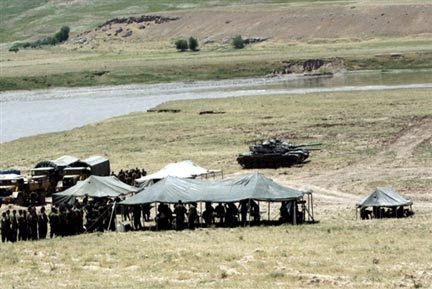
A Turkish military camp in northern Iraq.
What was once no more than a series of sporadic cross-border operations has, over the years, become one of the largest foreign military deployments in the Middle East. In the mountains of northern Iraq, Turkey has gradually built up a vast network of bases, outposts and military roads that is profoundly altering the security and geopolitical balance of the region.
According to several investigations based on the analysis of satellite imagery, Ankara is now believed to have more than 130 permanent bases, outposts and military positions in Iraqi Kurdistan. Some sources put the figure at 139 installations spread across the Metina, Zap, Avasin-Basyan and Qandil regions and much of Dohuk province.
To link these positions, the Turkish army has built an extensive network of military roads through mountainous areas that are particularly difficult to reach. Local organisations and several independent observers say this work has been accompanied by forest clearance, large-scale earthworks and, in some sectors, the blasting of sections of terrain to ease the movement of troops and military equipment. Some estimates suggest that several thousand Turkish soldiers are deployed in the region, with a military presence stretching several dozen kilometres into Iraqi territory.
The fight against the PKK as the official justification
Ankara maintains that this military presence is aimed solely at fighting the Kurdistan Workers’ Party (PKK), an armed Kurdish movement that has been engaged in a conflict with the Turkish state since the 1980s.
The mountains of northern Iraq have long been one of the PKK’s main sanctuaries.
From 2019 onwards, Turkish operations intensified considerably through a series of offensives code-named “Claw”, combining air strikes, armed drones, artillery and commando operations.
For several years, clashes between the Turkish army and PKK fighters were particularly fierce in the Zap, Metina and Avasin-Basyan valleys. The fighting displaced civilian populations, led to villages being abandoned and caused significant economic disruption in the border areas.
The PKK’s announcement in 2025 that it was dissolving and intended to end its armed struggle marked a historic turning point. This development now raises a central question: will Turkey maintain its military deployment even as the threat that justified it is set to diminish?
Baghdad caught between protest and pragmatism
The Iraqi government regularly condemns Turkish military operations and regards the presence of foreign bases on its territory as a violation of national sovereignty.
On several occasions, the Iraqi authorities have summoned Turkish diplomatic representatives to protest against the air strikes and ground incursions carried out in the north of the country.
In practice, Baghdad has limited means of securing a withdrawal of Turkish forces. Turkey remains a major economic partner of Iraq, and the Iraqi authorities are also seeking to maintain security cooperation on border issues.
This situation has led the central government to strike a balancing act: officially condemning the violations of sovereignty while avoiding a direct confrontation with Ankara.
Iraqi Kurdistan in a delicate position
The Kurdistan Regional Government (KRG) takes a more pragmatic approach. Turkey is one of its main trading and energy partners. A large share of Kurdish oil exports and of the region’s trade passes through Turkish territory.
This interdependence explains the relatively close relations Ankara maintains with the Kurdish authorities, particularly those led by the Kurdistan Democratic Party (KDP).
Without officially endorsing all of the Turkish operations, the KRG also takes the view that the PKK’s presence in certain mountainous areas has contributed to regional instability. The Kurdish authorities are thus seeking to strike a balance between cooperation with Turkey and the protection of local populations affected by the fighting.
Many residents nevertheless denounce the consequences of this growing militarisation: deforestation, abandoned villages, restricted access to farmland and deteriorating living conditions in some rural areas.
Tensions with the Hashed al-Shaabi
The Turkish presence has also drawn hostility from part of the Hashed al-Shaabi (Popular Mobilisation Forces), a coalition of Iraqi armed groups formed during the war against the Islamic State group. These groups are predominantly Shia and pro-Iranian.
Several factions close to Iran regard the Turkish bases as a violation of Iraqi sovereignty and are demanding their withdrawal. Some have been linked to rocket attacks or threats against Turkish military positions in recent years.
Although there is currently no open conflict between the Turkish army and the Hashed al-Shaabi as a whole, tensions remain high, particularly in the strategic region of Sinjar.
Lying at the junction of the spheres of influence of the PKK, the Iraqi authorities, Kurdish forces and pro-Iranian militias, Sinjar has become one of the main flashpoints of rivalry in northern Iraq.
Iran watches Turkish expansion with concern
Turkey’s military presence is also being closely watched by Iran, which regards Iraq as one of the pillars of its regional strategic depth. Officially, Tehran upholds Iraq’s sovereignty and criticises any foreign military presence that is not directly controlled by Baghdad. But behind this diplomatic stance lies a more complex geopolitical reality.
Since the fall of Saddam Hussein’s regime in 2003, Iraq has become one of the main arenas of competition between Iran and Turkey. While Ankara has strengthened its economic and military influence in the north of the country, Tehran has relied on its political, religious and security networks to maintain its position throughout Iraqi territory.
Many Iranian officials see the expansion of Turkey’s network of bases as a potential threat to their influence in northern Iraq. This rivalry is particularly visible in strategic areas such as Sinjar and Mosul, where Iranian, Turkish, Kurdish and Iraqi interests intersect.
Iran retains significant influence within several factions of the Hashed al-Shaabi, some of which have taken an openly hostile stance towards the Turkish presence. However, neither Tehran nor Ankara appears to want a direct confrontation.
Paradoxically, the two countries also share certain security concerns. Iran is fighting its own Kurdish armed movements near its border, while Turkey continues its campaign against the PKK. This convergence explains why relations between the two powers regularly swing between tactical cooperation and strategic rivalry.
A new regional chessboard
Developments over the past several years show that the issue now goes beyond the fight against the PKK alone. Northern Iraq has become an arena where the sometimes convergent, sometimes conflicting interests of Turkey, Iraq, the Kurdistan Regional Government, Iran and the various components of the Hashed al-Chaabi intersect.
For many observers, the military infrastructure built by Ankara in recent years now represents far more than a mere counter-terrorism apparatus. It gives Turkey a lasting capacity for military projection in a region at the heart of Middle Eastern rivalries.
The announced dissolution of the PKK could mark a historic turning point in a conflict that has lasted more than forty years.
It does, however, raise a new question: will the bases, military roads and infrastructure built by Turkey disappear along with the threat they were meant to combat, or have they become a lasting instrument of Ankara’s regional strategy?
For many observers, the future of these installations will be one of the main geopolitical issues in northern Iraq in the years ahead.
Translated from French. The French original prevails.