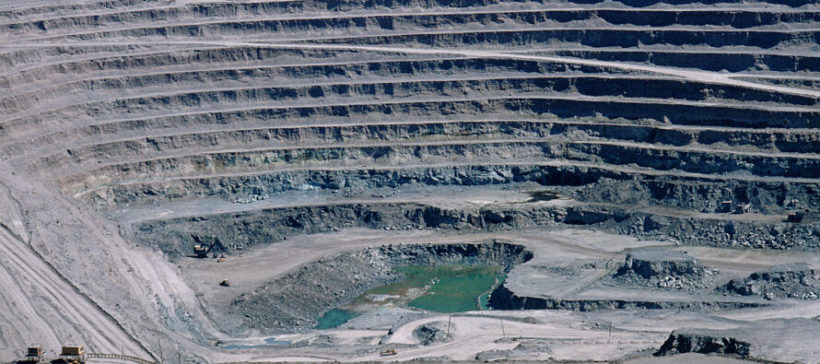
An open-pit lithium mine.
In partnership with Chines Magazine
China has introduced sweeping new regulations governing the entire life cycle of strategic minerals, according to the Chinese media outlet Caixin. The measure tightens control over these resources, which are increasingly regarded as essential to national security and industrial competitiveness.
The rules, which came into force on 15 June, cover every aspect of mining, from mineral exploration and extraction to storage, environmental restoration, regulatory oversight and legal liability. They serve as the implementing regulations for the revised Mineral Resources Law, which will come into force on 1 July 2025.
Under the new regime, certain strategic minerals will be subject to protective measures such as caps on total volumes and restrictions on which entities are authorised to mine them.
When granting exploration rights for strategic minerals that are very rare or subject to particular technical and environmental requirements, the government will favour a comprehensive tendering process over simply selecting the highest bidder.
China defends its measures following G7 meeting
The Ministry of Foreign Affairs said on 18 June that China had defended its export control measures on critical mineral supplies, and urged the Group of Seven (G7) countries to respect the principles of the market economy and the rules of international trade rather than favouring “small cliques”.
The remarks follow an agreement reached on Wednesday by G7 leaders to step up coordination in order to reduce their countries’ dependence on China for critical minerals.
“China’s efforts to standardise and improve its export control system are in line with international practice”, Lin Jian, a spokesperson for the Ministry of Foreign Affairs, told a regular press briefing.
“The aim is to better safeguard world peace and regional stability, and to fulfil international non-proliferation obligations”, he added, calling on G7 leaders to stop “imposing the rules of small cliques”, which undermine the international economic and trade order.
The G7 countries want to diversify their sources of supply for metals essential to defence, technology and renewable energy in order to reduce their dependence on China.
In 2025, export restrictions imposed by China on permanent magnets disrupted several industrial sectors and highlighted their vulnerability to a single supplier.
Without naming China directly, G7 leaders said they were seeking to reduce dependence on any single supplier outside the group and its partner countries for rare earths and permanent magnets to below 60% by 2030, with an ultimate target of 50% “as soon as possible”.
Translated from French. The French original prevails.