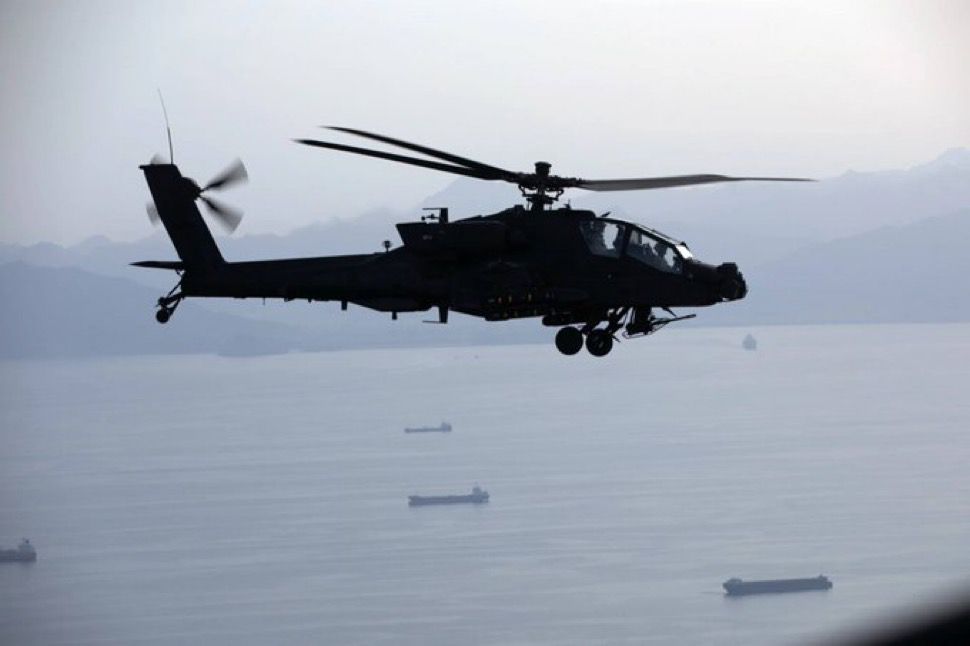
A US Apache attack helicopter of this type was destroyed by Iran.
The confrontation between the United States and Iran has entered a new phase after a series of US strikes on Iranian military installations, followed by retaliation from Tehran against several strategic positions allied with Washington in the region.
According to several security sources, US forces carried out targeted strikes on Iranian air defence systems and radar installations in response to the destruction of a US Apache attack helicopter. Around twenty sites are reported to have been hit, notably in Khuzestan province and in the strategic areas of Jask, Qeshm and Sirik, on Iran’s coastline.
The targets were: the naval base at Sirik; the naval base at Jask; an air defence site at Bandar Abbas; a coastal ballistic missile site at Qeshm.
In addition, US forces launched an attack on a defensive site in the town of Jam.
According to initial reports, explosions were heard in each of the following areas: Ahvaz, Borazjan, Bushehr, Zahedan and Bandar Abbas.
Unconfirmed reports also point to the destruction of an underground complex linked to missile production near Khorramabad. A strike also targeted the Kownish Canyon missile complex in Kermanshah.
Iran’s response
In response, Iran launched a major counter-offensive involving combat drones and ballistic missiles. Several military installations associated with the United States in the region are reported to have been targeted.
Targets reportedly included military infrastructure in the Gulf states as well as the headquarters of the US Fifth Fleet in Manama, Bahrain. Drones were said to have been launched towards the site, although no precise assessment of the damage was immediately available.
Jordan also affected
The escalation also spread to Jordan. Long-range solid-propellant missiles were reportedly fired at Azraq air base, a major military hub in the kingdom. Command centres and aircraft hangars were among the presumed targets. qqThe Jordanian authorities had not released an official assessment at the time of writing.
Fears of a regional conflagration
This latest round of military action is fuelling concerns that the conflict could spread across the whole of the Middle East. Several observers fear that the exchange of strikes between Washington and Tehran could lead to a wider regional confrontation drawing in other players in the Gulf and the Levant.
Western capitals are following developments with particular attention, as energy markets and the strategic shipping lanes of the Strait of Hormuz could be directly affected by an escalation of hostilities.
Several conclusions can be drawn from the exchange of strikes between Iran and the US:
1. Neither Washington nor Tehran appears to want all-out war
Both sides responded militarily to preserve their credibility and their deterrent capability, but their actions were presented as “proportionate” or “defensive”. Public statements from the US continue to refer to a diplomatic solution, while Iranian officials combine threats with openness to negotiation.
This suggests that the main aim is to manage escalation rather than to seek a large-scale direct confrontation.
2. The existing ceasefire is extremely fragile
The incident shows that a single military event can undermine the arrangements reached in recent months. The exchange of strikes has already revived fears of a return to a wider regional conflict.
The lesson is that the region has entered a phase in which de-escalation mechanisms exist but remain insufficient to prevent crises.
3. The Strait of Hormuz remains the world’s critical flashpoint
The incident occurred in or near one of the most strategic shipping lanes on the planet. Every rise in tensions in the area has an immediate impact on oil markets, shipping and insurance.
For investors and governments, the main practical consequence is that the geopolitical risk premium on energy remains high.
4. Iran retains a significant capacity to cause regional disruption
Even after its military losses and the previous months of conflict, Iran is demonstrating that it can still strike US bases or interests and disrupt the security environment in the Gulf.
This means that Iran’s ability to exert pressure has not been eliminated despite Western operations.
5. Regional allies are becoming more vulnerable
Gulf markets reacted negatively, and several states in the region fear being drawn into a confrontation they do not control.
In other words, even when the strikes directly involve Washington and Tehran, the strategic cost is largely borne by neighbouring countries.
6. The main risk is now miscalculation
The greatest danger may lie not in a deliberate decision to go to war but in a chain of incidents: a drone shot down, a ship hit, a case of mistaken identity or a high-profile casualty. Any one of these events could force leaders to respond more forcefully than they would have wished.
In brief
The most important conclusion is a paradoxical one: this exchange shows both that the two sides are determined to avoid all-out war and that they are unable to prevent dangerous bouts of escalation. The conflict appears to be shifting towards a pattern of limited but recurring confrontation, with the ever-present risk that a local incident could spiral into a major regional crisis.
Translated from French. The French original prevails.