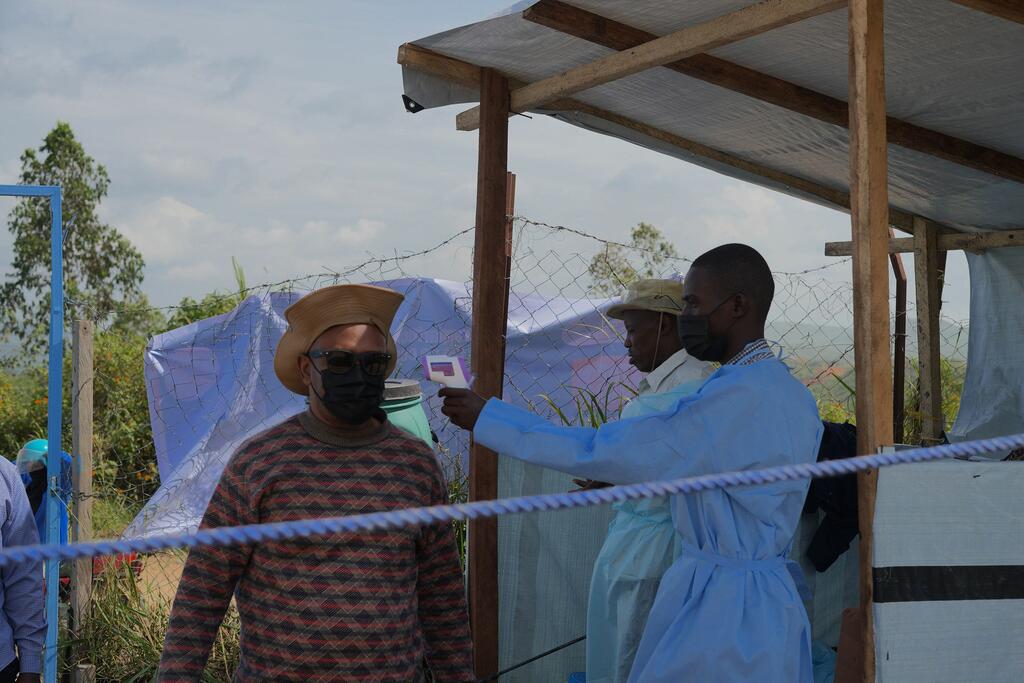
A health worker examines a man at the entrance to a health facility in Ituri province, Democratic Republic of the Congo. © WHO/Joël Lumbala
More tests, and therefore more cases detected. In the east of the Democratic Republic of the Congo (DRC), the UN’s global health agency (WHO) says the rise in confirmed Ebola infections chiefly reflects a scaling-up of testing, supported by new laboratories and stepped-up contact tracing.
Speaking from Bunia, in Ituri province, which accounts for 94% of the cases recorded in the country, the World Health Organization’s (WHO) director of emergency operations, Abdirahman Mahamud, explained that the increase in confirmed infections is due to the expansion of testing capacity.
According to the UN health agency, the opening of decentralised laboratories has made it possible to speed up the processing of suspect samples, notably thanks to a site in Mongbwalu that is now fully operational.
More than 5,000 contacts identified
Contact tracing is one of the new pillars of the response. According to a count carried out on 6 June, 5,040 contacts had been identified and were being followed up in the provinces of Ituri, North Kivu and South Kivu. Stepped-up contact tracing has so far enabled health workers to reach 62% of contacts, with the aim of reaching 90 to 95% “in the coming weeks”.
More broadly, stepped-up testing has led to a rise in the number of confirmed cases. On the ground, response teams now have a decentralised laboratory in Mongbwalu to carry out tests.
“We are making slow but steady progress, but we have not yet reached our goal. And that depends on the community’s trust and on working together with it,” Dr Mahamud said reassuringly.
Under the new arrangement, local health workers play a vital role in identifying cases early and referring them to treatment centres. He described the current arrangement as “an effective system, integrated from surveillance to contact tracing, through the treatment centre and the laboratory”.
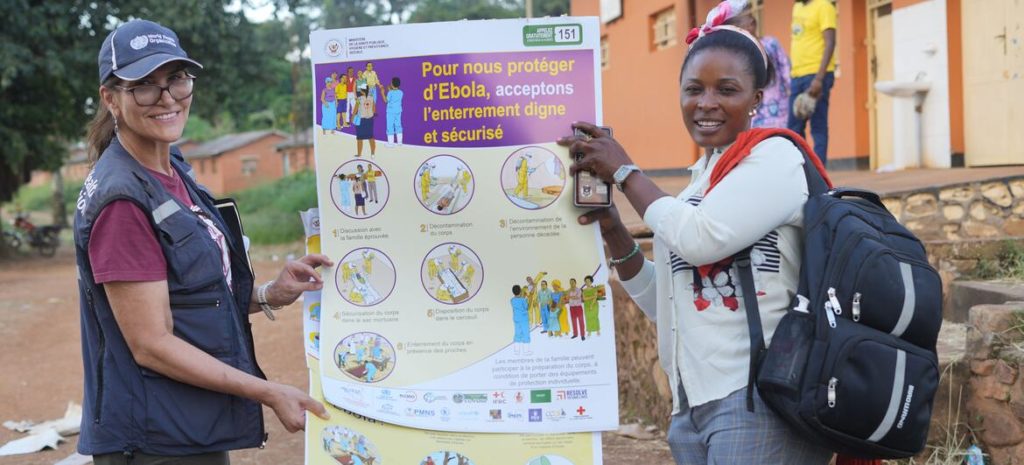
In the face of the mistrust that is still hampering the response to Bundibugyo Ebola, health authorities are mobilising community leaders, religious leaders, mining companies and other local intermediaries to raise awareness among the population and build trust. © WHO/Joël Lumbala
550 confirmed cases, including 101 deaths
“So it is an end-to-end data system with data sharing,” he explained, while noting that there are places where internet access is limited. “So that is another challenge.”
These latest developments come as the DRC now has 550 confirmed cases, including at least 101 deaths. “The good news is that we now have 19 recovered patients in total, so early detection and treatment are saving lives,” the WHO official said. The outbreak is concentrated in the eastern province of Ituri, which accounts for 94% of cases.
In neighbouring Uganda, 19 cases have been confirmed, including two deaths, and a third death is also thought to be linked to Ebola, he added at the press conference.
More broadly, however, major challenges remain, particularly in remote areas with limited connectivity, from where samples can take eight hours to reach a laboratory.
Decentralising laboratories
“Ituri is as big as France. That is what we are dealing with. In places like this, if you are in Bunia, you can get your result in one or two hours. In more remote places, you can get it within 24 hours,” Dr Mahamud stressed.
With the decentralisation of laboratories, the one in Aru is the furthest from here. It takes between seven and ten hours by road. “So by Friday, we will have a laboratory there,” he added. But overall, thanks to the decentralisation of laboratories and the scaling-up of efforts, WHO remains confident “that testing and confirmation will be as fast as possible”.
To enable testing to take place closer to the epicentre of the outbreak, WHO has already opened several field laboratories in five affected zones
Alongside testing, the agency has stepped up the delivery of supplies and the strengthening of care facilities, delivering 40 tonnes of supplies and helping to set up Ebola treatment centres.
To support these efforts, more than 100 experts, including epidemiologists and vaccine experts, have been deployed to the eastern provinces of Ituri, North Kivu and South Kivu.
Translated from French. The French original prevails.