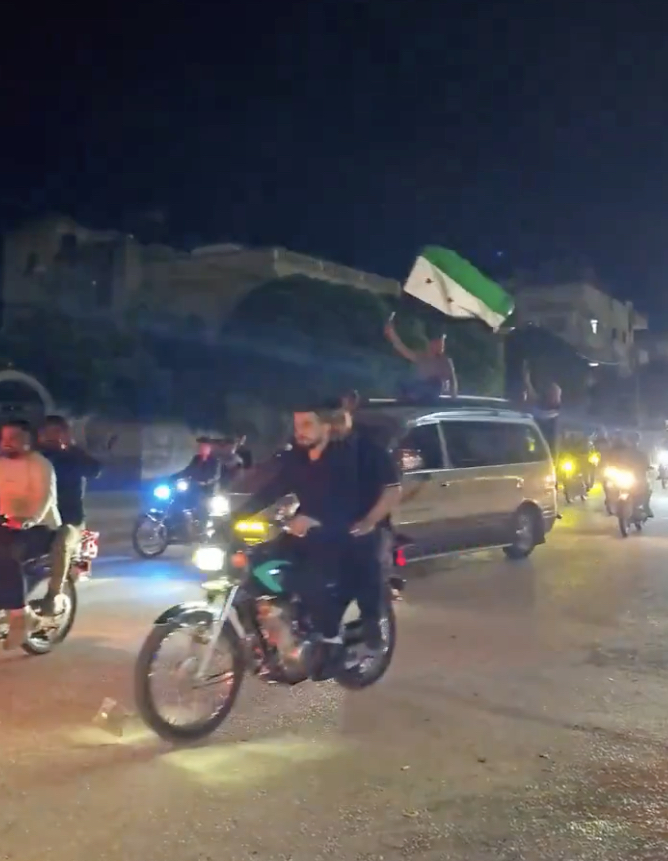
Several hundred residents gathered on Tuesday in the Mezzeh 86 district, in western Damascus, to demand the arrest and trial of former members of the pro-regime militias known as the “Shabiha”. The protest is part of a wave of mobilisation seen in recent weeks in several parts of Syria over issues of transitional justice and accountability for crimes committed during the war years.
The “Shabiha” (“ghosts” in Arabic)
The “Shabiha” were paramilitary groups and informal networks loyal to the regime of Bashar al-Assad. Having emerged well before the 2011 uprising, these structures were initially associated with smuggling networks and influential figures close to those in power. With the outbreak of the popular revolt and then the civil war, they played a major role in suppressing protests and supporting the security forces. Numerous human rights organisations have accused them of taking part in arbitrary arrests, torture, enforced disappearances and attacks on civilians. As the conflict wore on, some of these groups were absorbed into more formal state-backed paramilitary structures.
The protesters denounced what they regard as the slow pace of judicial proceedings against those allegedly responsible for human rights violations under the former regime. Slogans calling for an end to impunity, for accountability and for prosecutions to be speeded up were chanted in the streets of the district.
The Mezzeh 86 district
The choice of Mezzeh 86 is no accident. The area, historically home to many families with ties to the army and the security services, was long seen as one of the fallen regime’s social strongholds. For many Syrians, it symbolises the security apparatus that dominated the country for several decades.
The neighbourhood is also associated with the former Mezzeh military prison, one of the most feared detention centres in Syria under the regimes of Hafez and then Bashar al-Assad. For decades, thousands of political opponents, activists, intellectuals and prisoners of conscience were held there. Former detainees and several human rights organisations have documented numerous cases of torture, ill-treatment and arbitrary detention at the facility, which became one of the symbols of the repression carried out by the Syrian authorities. That memory remains deeply rooted in the collective consciousness and heightens the symbolic significance of the current protests in this part of the capital.
According to several observers, the mobilisation reflects a growing sense of frustration among victims and their families, who believe that some former members of paramilitary networks continue to move about freely despite the accusations levelled against them. Their demands centre chiefly on the effective implementation of transitional justice and the definitive dismantling of the structures inherited from the former regime.
The question of property lost or seized by the Shabiha
Beyond the demands targeting former members of the Shabiha, some participants also raised the issue of land and property lost during the decades of the Assad regime and the years of war. Several protesters said that families displaced from Damascus and its outskirts wanted to recover land, homes or businesses of which they believe they were deprived as a result of expropriations, forced displacement or disputed administrative decisions.
This land issue, which is particularly sensitive in several neighbourhoods of the capital and its suburbs, has gradually become one of the most complex matters of the post-conflict period. Many families are now demanding the return of their property or compensation, while other occupants say they acquired or occupied these properties amid the upheaval caused by fifteen years of war.
In response to these demands, local officials and civil society organisations are calling for the disputes to be handled within a legal and institutional framework, so that tensions over property do not turn into intercommunal clashes. They stress that responsibility must be examined on a case-by-case basis and that restitution procedures will have to rely on transparent judicial mechanisms.
For its part, the Syrian Commission for Transitional Justice reiterated that prosecutions of alleged perpetrators of crimes, as well as the settlement of land disputes, must respect the rule of law. The institution warned against any form of collective revenge or summary justice that could further undermine the national reconciliation process.
More than 15 years after the Syrian uprising began, the question of accountability for alleged perpetrators of crimes remains one of the main challenges facing the country’s political and social reconstruction. For many victims’ families, there can be no lasting reconciliation without truth, justice and reparations. Conversely, several civil society actors warn of the risks of an approach based on collective reprisals, stressing that Syria’s future stability will depend on the ability of its institutions to guarantee fair and transparent proceedings.
Between revolution and reconciliation
How can the demands of the revolution be squared with the need to reconcile Syria? That is one of the main questions facing Ahmad al-Sharah today. Caught between the expectations of victims calling for justice, claims for the restitution of lost or confiscated property and the need to preserve national cohesion, the transitional authorities must strike a delicate balance. For many observers, the success of the reconciliation process will depend on the state’s ability to uphold the rule of law while preventing the divisions inherited from the conflict from turning into new, lasting rifts.
Although the demonstration passed off without major incident, it illustrates the challenges Syria still faces in the post-war period. Between the quest for justice, the restoration of rights, reparation for harm suffered and national reconciliation, the authorities will have to meet considerable expectations in a society still deeply scarred by more than 15 years of conflict.
Translated from French. The French original prevails.