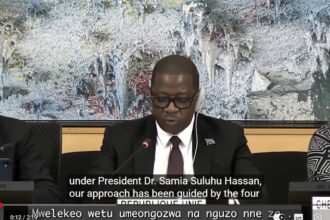
As the 62nd session of the Human Rights Council continues at the Palais des Nations, diplomats, experts and civil society representatives gathered for a side event on access to education in Africa. Organised by the Permanent Mission of the Democratic Republic of the Congo to the United Nations, in partnership with several international organisations and NGOs, the meeting highlighted the persistent obstacles that still prevent millions of African children from receiving a quality education.
In his opening address, Ambassador Paul Empole Losoko Efambe, Permanent Representative of the DRC in Geneva, recalled that education is a fundamental human right enshrined in the main international instruments. Yet despite the commitments made under the Sustainable Development Goals, Africa still faces major structural challenges: inadequate school infrastructure, a shortage of qualified teachers, regional inequalities, poverty and the impact of security crises.

One of the most striking findings of the conference concerns the persistent mismatch between training and employment. Invited to present the Swiss experience, Dr Olesya Meskina, head of academic programmes at the Swiss School of Business and Management, called for closer alignment between the education system and the needs of the labour market. She outlined the Swiss dual vocational training model, which combines theoretical teaching with in-company apprenticeships.
“Switzerland did not reduce youth unemployment by artificially creating jobs, but by building an education system that removes the gap between school and the labour market,” she explained. In her view, this approach allows young people to gain valuable work experience at a very early stage and helps to keep youth unemployment low.
Beyond questions of employability, the speakers stressed the growing importance of digital technology and artificial intelligence in education systems. But several voices warned against a technological vision presented as a miracle cure.
Representing the Women’s Federation for World Peace International, Caroline Elkins-Mother, who presented the statement prepared by Sandra Aboagye Brenyah, stressed the limits of an approach based solely on digital tools. “Technology alone cannot guarantee education,” she noted, pointing out that access to electricity, the internet, school infrastructure and trained teachers remains an essential prerequisite.
The speaker also drew attention to the deep inequalities that persist in sub-Saharan Africa, where tens of millions of children remain excluded from formal education. She stressed the need to invest simultaneously in digital skills, teacher training and the sustainable financing of education systems so that the technological revolution does not further widen existing gaps.
The discussion from the floor took this reflection further, highlighting the close link between education, social stability and development. Several participants pointed out that a lack of access to education exacerbates the economic and security fragilities affecting certain regions of the African continent.
Ultimately, despite the diversity of approaches presented, a consensus emerged: Africa has tremendous demographic potential, but its ability to turn it into a driver of development will depend largely on its capacity to invest massively in education. With five years to go until the deadline set by the United Nations 2030 Agenda, the speakers called on states, international organisations, NGOs and the private sector to strengthen their cooperation so that the right to education ceases to be a promise and becomes a reality for all.
For beyond the figures and strategies, it was the same ambition that ran through all the debates in Geneva: ensuring that no African child is left by the wayside.
Translated from French. The French original prevails.