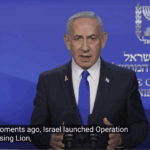
As the sound of marching boots echoes once again and the planet’s fragile balances totter, the Middle East has become the focal point of the tensions of a world in flux. Between nuclear ambitions, asymmetric clashes and diplomatic paralysis, history seems to be stammering. But this time, the shift could be irreversible.
Looking back at history as we were taught it, a sense of unease sets in: the great world wars often emerged from a tangle of tensions similar to those we are witnessing today. The First World War, triggered by the assassination of Archduke Franz Ferdinand, laid bare the devastation wrought by ethnic nationalism and territorial ambition. Twenty-five years later, the rise of dictatorships and the impotence of the League of Nations would plunge the world into a second cataclysm.
Today, history is not repeating itself — it is transforming. Russia’s invasion of Ukraine in February 2022 and the attack on Israel on 7 October 2023 brutally exposed a reality: global geopolitics is no longer fragmented, it is interdependent. These two crises, though distinct, are symptoms of an international system already undermined by the aftermath of the war in Syria, Shia–Sunni antagonisms and the Sino-American rivalry. What seemed to belong to the past is now reassembling before our eyes into a jigsaw of tensions in which every piece threatens to set off the irreparable.
In Engrenages, Pierre Lellouche paints a chilling picture. The UN, once a pillar of multilateralism, appears paralysed, powerless to contain major conflicts. Europe, undermined by its internal divisions, is struggling to adopt a common line in the face of strategic challenges. Meanwhile, the arms race is resuming with renewed vigour, authoritarian doctrines are gaining ground and liberal democracy is faltering. The United States itself, torn between isolationism and a duty to intervene, appears to be on the brink of an inevitable global military engagement.
The Middle East, as so often in history, is becoming the epicentre of this realignment. The “balkanisation” of this key region is now a reality, fuelled by sectarian divides and competing ambitions. Iran, ruled by the mullahs since 1979, has patiently extended its influence along a “Shia arc” stretching from Tehran to Beirut by way of Baghdad and Damascus. Its strategy, founded on a combination of revolutionary ideology and geopolitical pragmatism, has proved formidably effective.
Unlike the unfounded accusations once levelled against Saddam Hussein, the Iranian nuclear programme rests on established facts. The International Atomic Energy Agency (IAEA) speaks of a critical threshold of fissile material. Iran, which possesses the largest ballistic arsenal in the region, could turn a local clash into a regional conflagration. Israel, though technologically superior, faces strategic and human exhaustion: engaged on several fronts, isolated on the diplomatic stage and riven by deep internal divisions. A weakened Benjamin Netanyahu appears to be gambling his political survival along with that of the Jewish state.
For the Gulf monarchies, the situation is not without irony. Behind the scenes, a potential weakening of Iran looks like a strategic opportunity. Saudi Arabia in particular sees a chance to secure its regional ambitions while maintaining a posture of cautious neutrality.
Europe, for its part, is torn between its humanitarian principles and its strategic realities. Long critical of Israeli policy in Gaza, it is now lining up more clearly behind Tel Aviv in its confrontation with Tehran. It is a pragmatic shift that reflects an era in which values often give way to realpolitik.
China, true to its cautious stance, will never back Iran militarily. But it will continue to play the role of a self-interested mediator, intent on securing its energy supplies. Russia, absorbed by its conflict in Ukraine, is nonetheless exploiting the tensions to maintain its influence in the Levant and divert attention from its quagmire.
At the heart of this sweeping strategic realignment, some burning questions remain. Will Iran’s network activate its proxies in the region to target Israel or American interests? Can the regime of the Revolutionary Guards be toppled from within by a popular uprising? Will Iran’s educated, connected young people one day be able to force a democratic turn on the theocracy?
The current crisis is not merely a violent interlude but a pivotal moment. Beyond the military conflict, it is the future of the global balance of power that is at stake. A potential conflagration in the region threatens global energy supplies, market stability and global security. With every escalation in tensions, the risk of an irreversible strategic error grows.
And all the while, the human tragedies mount. Gaza, Israeli hostages, Palestinian civilians, the peoples of Lebanon, the Kurds, Syrians and Iranians: all are paying the price of a geopolitics that has lost its humanity. Faced with the deadlock, the powers play for time, back down or prepare themselves — but what of the peoples?
“I am the friend of humanity (…) I do not rule through fear but through justice,” said Cyrus the Great. Recalling this founding figure of an empire built on tolerance and the rule of law raises a fundamental question: will the Middle East be capable of producing a new, enlightened leadership, or will it remain the stage for the destructive passions of a world that has lost its bearings?
Perhaps, in this dark hour, we should remember that civilisations do not die under bombs alone: they die when they no longer believe in themselves. The challenge is therefore not only military; it is also moral, civilisational and human.
Translated from French. The French original prevails.