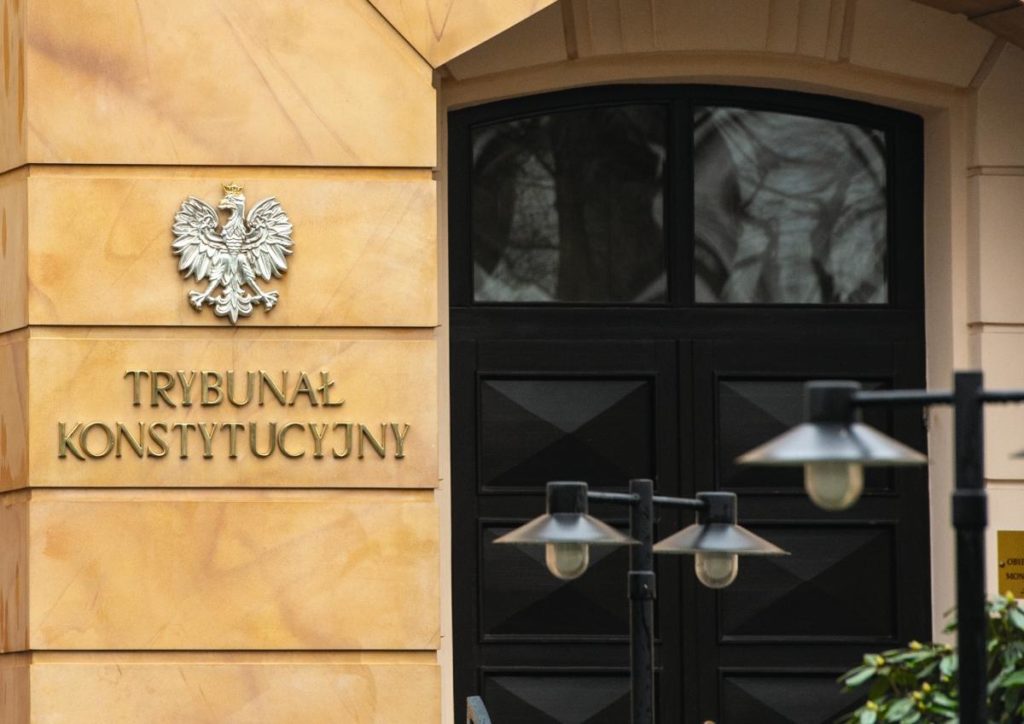
Poland’s controversy over judicial independence has turned into an open confrontation between Donald Tusk’s government and President Karol Nawrocki. On 30 October, Constitutional Tribunal judge Anna Korwin-Piotrowska announced the temporary suspension of its president, Bogdan Święczkowski, and its vice-president, Bartłomiej Sochański. She declared that she was taking charge of the institution. President Nawrocki, who was travelling to Senegal, cut short his trip and returned to Poland. He described the events as an illegal takeover of the Tribunal. The government, for its part, presents them as part of efforts to restore the normal functioning of the judicial institution. Behind this heated controversy lies a conflict that has lasted for more than a decade.
The unfinished legacy of 2015
The crisis began after the change of power in 2015. At the time, the new parliamentary majority of the Law and Justice party (PiS) challenged the appointments of judges made by the previous Parliament and went on to make its own. The Constitutional Tribunal recognised the legality of three of the five earlier appointments, but the political battle over its composition did not end there.
During the years of PiS government, the judicial system underwent sweeping changes. The Polish authorities described them as reform, while European institutions repeatedly voiced concerns about political influence over the courts and respect for the rule of law.
After the victory of Donald Tusk’s coalition in 2023, the new government pledged to restore the independence of the judiciary. However, the change in parliamentary majority did not end the conflict: presidential powers, judicial appointments and the legitimacy of some judges have remained at the heart of the controversy.
Judges, oaths and powers
At the centre of the current crisis are the appointments of new judges to the Constitutional Tribunal. In March 2026, the Sejm elected new members of the institution, but President Nawrocki did not swear in some of them. For his part, the President of the Tribunal did not allow them to take up their duties. Four of the elected judges brought their case before the European Court of Human Rights (ECHR). Among them was also Anna Korwin-Piotrowska. In May, the ECHR adopted interim measures, asking the Polish authorities not to prevent the applicants from exercising their judicial functions.
However, this decision did not resolve all the legal disputes. The ECHR has not delivered a final judgment on the lawfulness of the appointments, nor has it determined whether Korwin-Piotrowska had the power to suspend the Tribunal’s leadership. It is precisely the legal basis for her decision that has now become one of the central questions in the conflict.
The dispute, then, is not only about who should head the institution. It concerns the limits of the powers of Parliament and the President, as well as the question of who is entitled to guarantee the very independence of the Constitutional Tribunal.
This situation reveals a paradox: the attempt to restore the rule of law itself demands impeccable respect for legal procedure. The Tusk government justifies its actions by the need to remedy the consequences of earlier political interference in the judiciary. Yet even this objective does not release those in power from the obligation to act within the law. Otherwise, the change of political majority risks becoming merely a change in who controls the judiciary, rather than leading to the restoration of its independence.
Europe calls for the rules to be respected
On 1 November, the European Commission stated that the appointment of new members of the Constitutional Tribunal fell within the constitutional powers of the Sejm. It stressed, however, that the Polish authorities must ensure that the institution functions in accordance with the country’s Constitution and the case law of the Court of Justice of the European Union. Brussels’ position reminds all sides of the need to respect constitutional procedures and European standards on judicial independence.
For Europe, the Polish crisis carries a broader significance. It raises a complex question: how can a state be helped to restore the independence of its courts without giving the impression that a new political majority can decide for itself which institutions are legitimate?
Citizens are also feeling the consequences of this conflict. In 2020, a ruling by the Constitutional Tribunal on abortion sparked large-scale protests and profoundly altered the legal position of women in the country. In October 2026, the Sejm backed the partial decriminalisation of assisting with the termination of pregnancy, but the legislative process has not yet been completed. Future court rulings will continue to determine the limits of rights and freedoms.
A crisis with no easy way out
The Tusk government insists on the need to remedy the consequences of the previous reforms. President Nawrocki maintains that he is defending the constitutional order against unlawful acts. Both sides invoke legality, but neither recognises the legitimacy of its opponent’s actions.
Poland’s problem lies not only in the disagreement between the various political camps over the composition of the Constitutional Tribunal. The deeper problem is the absence of a shared recognition of the rules under which state institutions should be constituted and function. When each side regards its own interpretation of the Constitution as the only lawful one, the court ceases to be an arbiter and itself becomes a party to the political conflict.
The outcome of this situation will depend not only on political agreements but also on the ability of Polish institutions to restore clear rules on the appointment of judges and the functioning of the Tribunal. For Poland, it is a question of confidence in its own democracy. For Europe, it is a test: whether a member state is capable of overcoming a rule-of-law crisis without creating a new one.
Translated from French. The French original prevails.