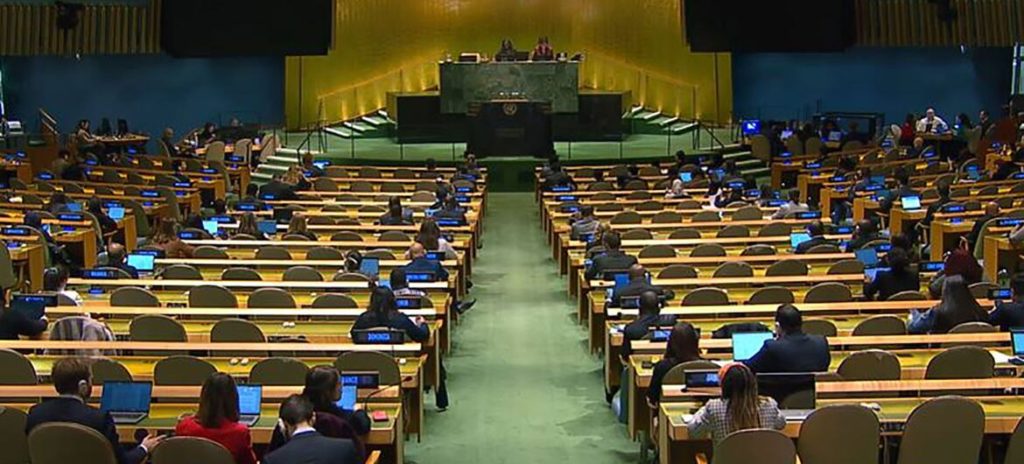
The United Nations General Assembly and its Fifth Committee meet to finalise negotiations and vote on the UN regular budget for 2026. UN Photo
António Guterres has presented his last proposed budget as head of the UN : $3.3 billion, a slight decrease on 2026. Behind this reduction lies a reorganisation of the institution, which faces cash-flow difficulties that the cuts alone will not resolve.
It is an austerity budget, but also a warning. The UN Secretary-General, António Guterres, has presented to the Fifth Committee of the General Assembly, which deals with budgetary matters, proposed expenditure of $3.302 billion for 2027, a decrease of $40.8 million (1.2 %) on the 2026 budget – which was itself down by more than 7 % on the previous year. This budget, which mainly funds the Secretariat and certain United Nations missions, does not include the budgets of the UN specialised agencies, such as UNICEF, UNESCO or the World Health Organization (WHO), nor those for peacekeeping and humanitarian operations.
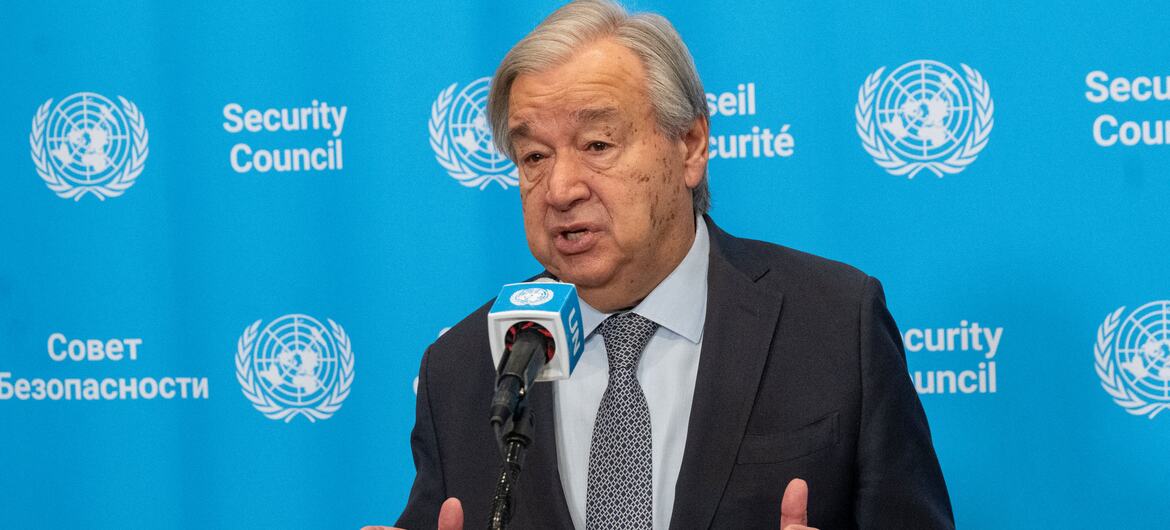
For the Portuguese-born diplomat, whose term ends at the close of the year, this final budget presentation comes at a particularly difficult time. With conflicts multiplying, humanitarian needs soaring and the Sustainable Development Goals slipping further out of reach, the UN must pursue its missions with ever tighter means.
The contradiction runs through the entire speech. On the one hand, an organisation ordered to become more efficient and cut its spending. On the other, states that keep entrusting it with new responsibilities without always guaranteeing it the necessary resources. “Efficiency alone cannot compensate for the instability of the Organization’s financial foundations,” Mr Guterres warned. It was a way of pointing out that administrative reforms, however ambitious, cannot resolve the difficulties caused by irregular contributions from member states.
Reform also reaches senior officials
The draft budget builds on the UN80 Initiative, launched in 2025 to streamline the workings of the United Nations. This reform, which covers both the administrative structures and the mandates entrusted to the institution, has already led to the elimination of 3,116 posts.
To limit the social consequences, the UN Secretariat has, among other things, arranged early voluntary departures and internal reassignments. Mr Guterres said these measures had considerably reduced the number of staff directly affected. The reorganisation continues in 2027, when a further 44 functions are due to be relocated to duty stations considered less costly, mainly Nairobi, Kenya. Administrative services that are currently dispersed will also be consolidated in Geneva, Nairobi, Vienna and Addis Ababa, in order to reduce duplication and achieve economies of scale.
This time, the upper echelons of the hierarchy are also affected. The Secretary-General is proposing to abolish or downgrade 14 senior posts, including several at the level of Under-Secretary-General or Assistant Secretary-General. The resulting savings would be reinvested in the activities of the departments concerned.
This initial shift is expected to be stepped up in 2028, following a more in-depth review. It nonetheless marks a change in a reform whose consequences have so far been felt mainly in the form of staff cuts and administrative reorganisation.
Special political missions scaled back
The draft budget provides for 11,150 posts, with 116 further cuts, mainly in special political missions, the operations tasked with preventing conflict and supporting peace processes without, however, being accompanied by military contingents, as peacekeeping operations are. The abolished posts would be almost entirely offset by 84 new posts and 25 conversions, amounting to a net reduction of seven posts.
The United Nations Assistance Mission in Afghanistan (UNAMA) would thus lose 60 posts, while the United Nations Integrated Office in Haiti (BINUH) would lose 44. The closure of missions in Somalia, Yemen and Iraq, meanwhile, would reduce the planned resources by $113.5 million compared with those budgeted for part of 2026.
These savings do not rule out some investment. The Secretary-General proposes, among other things, to strengthen technical cooperation and development programmes, to allocate an additional $3.2 million to the investigative mechanism on Afghanistan and to release $3.7 million to improve the inclusion of persons with disabilities.
He is also calling for more stable funding for the resident coordinator system, which is responsible for coordinating UN development activities in countries. This system, overhauled during his tenure, still had a shortfall of $45.7 million in 2025.
The question of unpaid contributions
But the main problem remains cash flow. Despite the savings under way, the UN remains dependent on national contributions that are paid late, or even left unpaid.
The United States, the largest contributor to the regular budget, made a payment of $725 million in September. According to press reports, Washington nevertheless still owed $1.312 billion to the budget after that payment.
On 7 October, the UN’s head of management, Catherine Pollard, had already warned that uncertainty surrounding payments had forced the organisation to draw on its financial reserves from the middle of the year.
António Guterres welcomed a recent decision by the General Assembly aimed at better aligning the return of unspent funds with the cash actually available. Above all, however, he reminded member states of their obligation to pay their contributions in full and on time.
The 2027 budget has yet to be negotiated and adopted by the General Assembly. For his successor, the challenge will be twofold: pursuing a reform that reduces the institution’s resources while persuading states to fund the mandates they entrust to it.
Translated from French. The French original prevails.