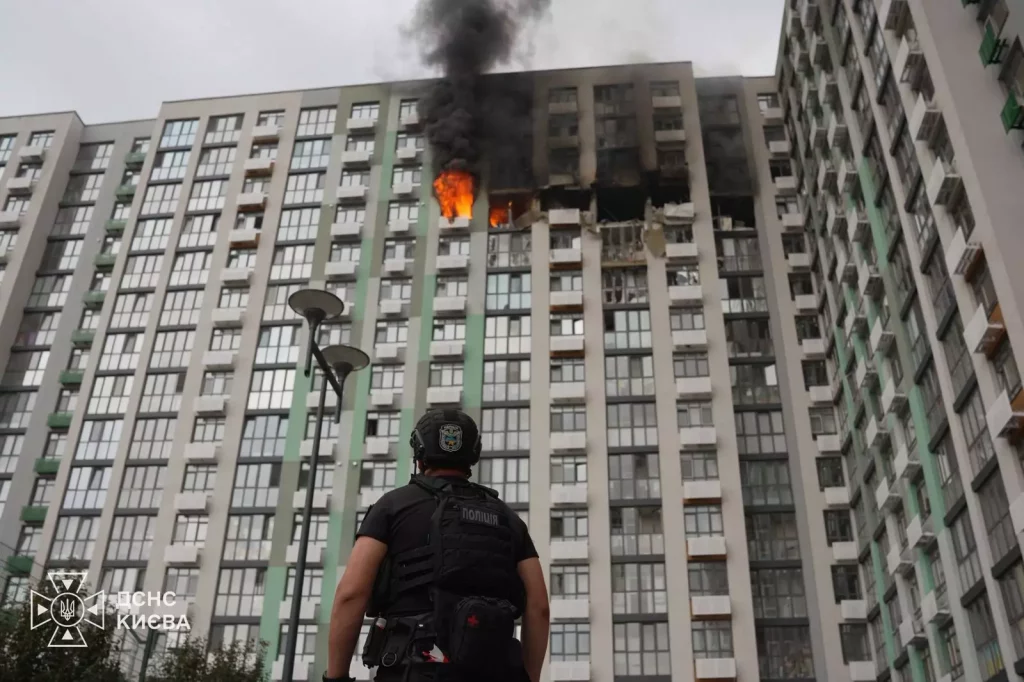
Russia is bombing civilian buildings and the toll from the attacks is mounting. This campaign of terror aims to demoralise and destabilise society, making daily life ever harder for the people of Kyiv. Photo taken on 2 September 2026.
Since 27 August, Russia has been attacking Kyiv and other Ukrainian cities every day in waves of bombardment. Over this period, the air campaign has changed less in the scale of each strike than in its pace and composition.
On the night of 2 September, Russia launched 174 drones and missiles. The following night, it deployed 163 drones, around half of which, according to the Ukrainian Air Force, were jet-powered. In the attack of 3 September, a 21-storey residential building was damaged in Odesa and 17 people were injured, including three children. Jet-powered drones reached regions in central and western Ukraine.
This pressure is no longer confined to military sites or strategic infrastructure. In Kyiv, repeated alerts now disrupt the city’s day-to-day functioning: businesses, transport, schools and shops regularly have to suspend their activities. Air defence is thus becoming not only a military issue, but an economic and social one as well.
This is no longer a series of isolated massive strikes. Since the end of August, the attacks have tended to form part of a regime of almost constant aerial pressure, in which Ukraine’s air defences must simultaneously repel fresh attacks, replenish their stocks and allocate limited munitions. The nature of these attacks suggests that the aim is to test not only Ukraine’s ability to intercept individual targets, but also the resilience of its entire air defence system under sustained pressure.
Mass and speed
Russia is not abandoning its usual model of combined attacks: it is gradually changing their make-up. Alongside Shahed/Geran drones, decoy drones and missiles, jet-powered drones are being used increasingly. According to Ukrainian data, Russia deployed more than 2,800 jet-powered drones in August. Their main advantage is that they reduce the time available to respond. According to various estimates, the jet-powered versions exceed 300 to 400 km/h, while some variants are said to reach 500 to 600 km/h.
This development is reshaping the division of roles within Ukraine’s air defences. The slower Shaheds can be intercepted by a wide range of means. Faster targets narrow the reaction window for mobile fire groups and increase the importance of fighter aircraft and anti-aircraft systems. According to estimates cited by the Financial Times, the interception rate for jet-powered drones is around 60%, lower than that for conventional drones.
Russia is altering the profile of some of its targets without needing to turn every drone into a sophisticated precision weapon: it is enough to increase the speed of some of the aircraft and launch them simultaneously alongside a mass of cheaper targets.
A mission that is expanding geographically
Jet-powered drones are changing not only the speed of attacks but also the geography of the mission assigned to air defence. The attack of 3 September showed that it was no longer just about Kyiv: targets appeared simultaneously in the south, centre and west of Ukraine. In total, strikes were recorded at 15 targeted locations that night.
This situation forces Ukraine to spread its defensive assets over a very large territory. This is particularly significant for the aerial component of air defence. A fighter jet cannot cover several directions at once, and its missile load is limited. As the range and speed of Russian drones increase, another problem emerges: Ukraine must protect not only its capital but also an extensive network of cities, energy infrastructure, logistics hubs and military facilities. Air defence is increasingly becoming a question of allocating a limited resource across several directions.
The most precious resource: munitions
At another level, Russia is using ballistic missiles. According to Ukrainian data, Russia launched 195 ballistic missiles in July, 29 of which were intercepted. These targets require specialised systems, notably Patriots equipped with PAC-3 interceptor missiles. This is where one of the most severe constraints on Ukraine’s defence lies: munitions for the most complex targets cannot be produced quickly at scale.
Ukraine is asking the European Union to allocate several billion euros from a €90 billion loan to the purchase of Patriot missiles. But PAC-3s are made in the United States, and both global stocks and production capacity remain limited. Even a favourable decision on funding would therefore not immediately solve the problem of deliveries.
Russia can increase the number of cheap aerial targets relatively quickly. The production of technologically advanced interceptors follows a much longer cycle.
Shortage affects entire air defence system
The constraints are not limited to missile defence. Ukraine’s F-16s are also facing a shortage of air-to-air missiles. According to several Ukrainian media outlets, pilots have had to use the onboard cannon on some combat sorties because of the lack of missiles. The main problem concerns AIM-120 AMRAAM missiles, which are used both by fighter aircraft and by NASAMS systems. This creates competition for the same resource between different components of air defence. The missile an F-16 needs to intercept an aerial target is also a munition used by a ground-based system tasked, among other things, with protecting Kyiv.
Ukraine’s air defence shortage is no longer a problem confined to any one system. It runs through the entire defence architecture, from F-16s and NASAMS to Patriots.
The economics of the war in the skies
The economic asymmetry of the Russian campaign is becoming ever more apparent. Russia is not merely stepping up production of attack drones: it is also systematically seeking to cut the cost of making them. Localising production, simplifying designs and increasing volumes have brought the cost of a standard Shahed/Geran down from around $200,000 in 2022 to some $70,000 in 2025.
The same cost-cutting logic now applies to the jet-powered versions. Russia is using 3D printing to manufacture some components of their turbines. This method has reportedly already brought the cost of these drones down to around $50,000 to $70,000, and a further increase in production could reduce it still more.
The challenge is therefore no longer purely technological. It is becoming economic: the air war is gradually turning into a race not only over capabilities but also over the cost of interception. In response, Ukraine is developing a distinct category of interceptor drones designed to counter mass drone attacks. Such systems are already being used against Shahed-type targets, while new models are being designed specifically for jet-powered drones. The idea is to create a cheaper means of interception that can be produced on a scale comparable to that of the growing threat posed by Russian drones.
In 2026, Ukraine also stepped up deliveries of interceptor systems, while Germany is funding the purchase of 15,000 Strila interceptors designed to counter Shahed-type drones. One example is SkyFall’s P1-SUN, an interceptor built to take on attack drones. For jet-powered targets, the company has developed a separate version, the P1-SUN JetKiller, capable of reaching 370 km/h.
This adds an extra layer to Ukraine’s air defences, between traditional short-range interception assets and costly surface-to-air missile systems. If the approach can be scaled up, it could change the very economics of air defence: the number of interceptors could rise in line with the number of attacking drones, without defence against mass attacks depending solely on limited stocks of expensive missiles.
Ukraine’s response is thus taking shape around a multi-layered system with differing interception costs: low-cost assets against mass targets, fighter aircraft and surface-to-air missiles against faster and more sophisticated drones, and Patriots against ballistic missiles.
The air campaign as a war of resources
The consequences of this campaign now reach far beyond the military sphere. In August, Ukrainian businesses lost, during certain periods, up to 41% of their working time because of air-raid alerts and strikes on logistics infrastructure. Attacks on warehouses and distribution centres are disrupting usual supply routes and forcing companies to reorganise how they operate.
The scale of the problem is illustrated by an estimate from Ukraine’s Minister of Agrarian Policy and Food, Taras Vysotsky: Russian strikes have reportedly destroyed around 90% of the food logistics capacity used by the major retail chains. At the same time, no systemic food shortages are expected: the market is reorganising supply chains, notably through direct deliveries from producers to shops.
Russia is gradually shifting its air campaign towards a strategy of permanent attrition. What makes this threat distinctive is not only the number of assets deployed, but also the constant changes in their combination, speed and lines of attack. Ukraine is being forced to respond by transforming its entire defence system.
The decisive question, therefore, is no longer simply whether Ukraine can repel any given massive strike, but whether it can withstand such attacks for months on end while maintaining the effectiveness of its air defences, keeping its economy running and rapidly replacing lost resources. The government has just begun differentiating public alerts according to the type of threat, so as to distinguish between drones, jet-powered drones and ballistic missiles.
It is precisely this capacity to adapt – this ability to withstand repeated strikes – rather than the outcome of any single attack, that will increasingly determine how the air war plays out.
Translated from French. The French original prevails.