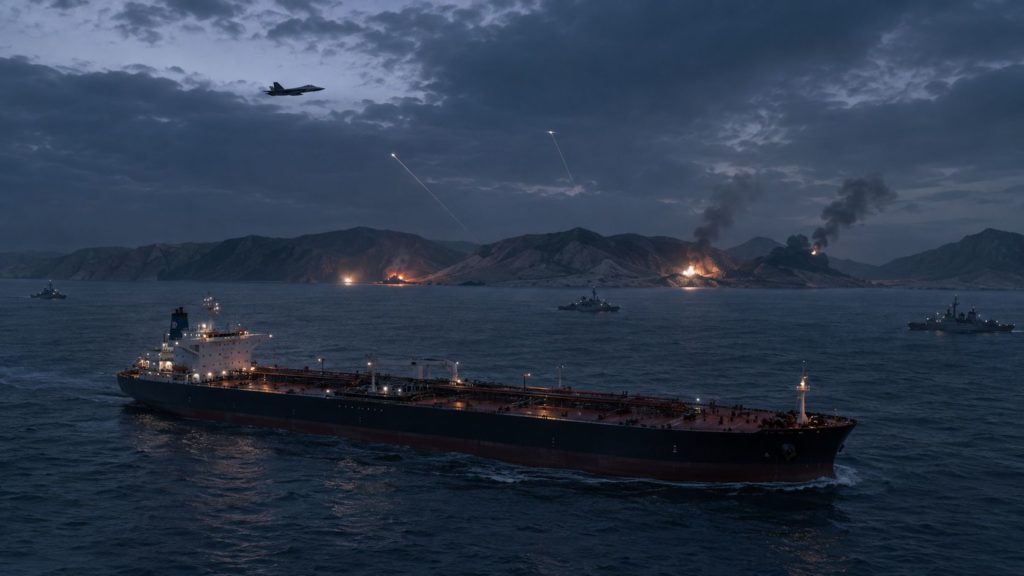
Illustration produced with AI.
The US strikes of 1 September and the Iranian retaliation that followed amount to the largest military exchange between Washington and Tehran since July. On the night of 2 to 3 September, no new US raid was announced, while Kuwait intercepted a fresh salvo of Iranian missiles and drones. This asymmetry confirms, for now, an escalation that remains calibrated: Washington strikes hard and then pauses; Tehran drags out its response without reaching saturation point. But the attacks on the two supertankers (Very Large Crude Carriers) in the Omani corridor and the collapse in traffic are a reminder of how fragile this calculation remains.
The sequence of events from 1 to 2 September brought to an end several weeks during which the United States and Iran had avoided a large-scale direct confrontation. Reuters described it as their largest exchange of fire since July. Yet it would be premature to see it as a return to the massive air campaign of the early stages of the war. On the contrary, the choice of US targets suggests a limited operation.
US Central Command (CENTCOM) says it struck facilities belonging to the Islamic Revolutionary Guard Corps, including air defence sites, radar systems, maritime assets and facilities, mine-laying capabilities and communication sites. The US military justified the operation by citing Iranian attacks on commercial shipping in the Strait of Hormuz and threats to American service personnel.
The targeting has nonetheless been stepped up a notch. US drones also struck two Iranian state-owned oil tankers. Axios, drawing on statements by US officials, puts the wave at around a hundred targets and describes a new “tanker for tanker” logic: when a commercial tanker is attacked in Hormuz, an Iranian tanker may be struck in retaliation. This extension remains targeted, but it brings Iranian state economic assets within the scope of US retaliation.
New information sheds light on the possible rationale behind this targeting. According to a US source quoted on 2 September by Al Hadath, the strikes were reportedly pre-emptive and intended to thwart an Iranian plan to target undersea cables in the Strait of Hormuz area. This account has not been confirmed by CENTCOM. It is consistent with a report published on 19 August by the “Financial Times”: two sources close to the Iranian regime said at the time that Iranian forces had examined the possibility of striking the strait’s undersea cables in the event of a further US escalation. Hormuz thus emerges not only as an energy and maritime chokepoint, but also as a digital one.
If this account is accurate, the American targeting takes on added coherence. Washington has not announced a new general campaign against nuclear infrastructure, political centres, Iranian industry or the energy system as a whole. Its first aim is to degrade the capabilities that allow the IRGC to monitor, mine, control or attack the shipping lanes around Hormuz. In other words, the immediate objective appears to be less to topple the regime than to neutralise or degrade the capabilities that allow the IRGC to threaten simultaneously the shipping, the maritime infrastructure and, perhaps, the undersea communications of Hormuz, while preventing it from restoring the maritime balance of power it has gained since February.
Iran retaliates on several fronts
Iran responded swiftly. Tehran says it struck American or US-linked targets in Bahrain, Jordan, Kuwait and Iraqi Kurdistan. This dispersal is politically spectacular: it is a reminder that a strike on Iranian territory can trigger a response across the entire network of American bases in the Middle East. Militarily, however, the toll appears far more limited. In Jordan, the armed forces said they had dealt with thirteen missiles, ten of which were reportedly intercepted and three of which reportedly fell in isolated areas. Iran claimed to have killed American service personnel, but the initial American assessments cited by Reuters reported no casualties.
In Kuwait, Iran says it targeted, among other sites, the US base at Ali Al Salem. An Iranian drone did indeed strike a residential compound, causing a fire and material damage, but no casualties were reported. Bahrain announced that it had intercepted Iranian drones. In Erbil, the IRGC says it struck US bases and killed several soldiers, but neither Washington nor Baghdad had confirmed this toll at the time of writing.
Iran therefore retains the capacity to open several strike trajectories simultaneously. But this should not be confused with a saturation capacity equivalent to that seen during the most violent phases of the war. The visible volume of fire, the limited number of impacts and above all the absence, at this stage, of confirmed US losses suggest a response intended as much to preserve Iranian credibility as to inflict massive military destruction.
Overnight from 2 to 3 September, however, Tehran had not entirely brought its response to a close. Shortly before 5am, the Kuwaiti general staff announced that its air defences were engaging fresh missiles and drones attributed to Iran. Kuwait, which hosts US forces, was thus once again a target of the regional response. No casualties or material damage were reported in the first few hours.
The most significant point lies elsewhere: no new wave of US strikes against Iran was announced during the same night. The sequence is therefore becoming slightly asymmetrical. Tehran is drawing out its response over several salvoes, albeit with effects that remain limited; Washington, after its heavy wave of 1 September, is pausing. It is no longer quite a simple tit-for-tat exchange, without yet being a new, sustained campaign.
US restraint remains visible
Herein lies the paradox. Donald Trump had warned that any Iranian retaliation for the strikes of 1 September would trigger an attack “much harder and at a higher level”, adding that “the biggest attack of all” was being held in reserve. Iran retaliated, then fired towards Kuwait again the following night. The promised US strike did not follow. The gap between the presidential threat and Washington’s actual, limited response amounts to a signal of restraint.
The United States has the means to strike much deeper into Iran’s military and political apparatus. It did not do so during this sequence of events. CENTCOM announced that it had completed the series of strikes of 1 September and did not report, the following night, any return to a full-scale air campaign. This restraint is now documented by the internal US debate.
Reuters reports, citing four people familiar with the discussions, that several senior White House officials want to keep the war at a relatively low level until the elections on 3 November. Vice-President JD Vance and Secretary of State Marco Rubio are reportedly among the officials in favour of this approach. Only 31% of Americans approve of the war, against 63% who disapprove, according to a Reuters/Ipsos poll from late August. A tactical pause would also give US forces time to replenish heavily depleted stocks of munitions. Heavier strikes after the elections remain under consideration, but no decision has been taken.
Iran, for its part, is threatening “heavier”, “broader” and “devastating” responses. It kept up its fire for a second night, but without launching the massive salvoes capable of overwhelming American and Arab defences. This restraint may reflect the attrition of six months of war — launch sites destroyed, radars neutralised, chains of command struck and stockpiles depleted — as much as political calculation. An Iranian salvo killing several dozen Americans could hand Donald Trump the justification for a new large-scale campaign. But Washington, too, must reckon with the expenditure of munitions, the fatigue of its forces, the vulnerability of its regional bases and the domestic political cost of an unpopular war.
Another factor could abruptly raise the level of the confrontation. In Kuhestak, near Sirik, Iranian state media report four people killed — two women and two children — and more than sixty injured after a strike hit a house where a wedding was taking place. The Associated Press had fragments photographed at the scene examined by two weapons specialists: the most likely identification is now an American JSOW, though a SLAM-ER cannot be entirely ruled out. CENTCOM says it is examining the reports of civilian casualties. These findings lend credibility to the incident without yet establishing the original intended target or the exact circumstances of the strike. The escalation therefore remains calibrated. But its level has just risen.
This military pause does not mean any easing of coercion. On 2 September, Scott Bessent said that Washington was considering extending the pressure further to airlines, the maritime sector and digital assets, on top of new banking sanctions. The American strategy is coming into sharper focus: contain military escalation for now while seeking to strangle the regime economically.
Hormuz: attack on southern corridor turns the hourglass
Until 31 August, Washington could believe it had found the beginnings of a solution in Hormuz. According to US officials quoted by Axios on 28 August, twenty to thirty tankers were using the southern corridor every night, carrying some 9 to 10 million barrels of oil a day. The US Secretary of Energy, Chris Wright, even claimed that more than 17 million barrels had passed through the strait on Monday 31 August, the highest daily volume since the start of the war. If flows could be restored sufficiently to avert a global shock, the United States had time to let the naval blockade and financial sanctions weigh on the Iranian economy. The hourglass then seemed to be running mainly against Tehran.
The maritime dimension is probably the most worrying. On 31 August, this calculation was directly shaken: two VLCCs carrying Saudi oil were attacked minutes apart as they were leaving the Gulf via the southern corridor of Hormuz, off Khasab. The Saudi-flagged Sidr and the Liberian-flagged Senegal Prosperity had each loaded around two million barrels of crude at the Saudi terminal of Juaymah.
The toll from the Sidr incident then rose. On 2 September, the Saudi national shipping company Bahri confirmed the deaths of two Filipino sailors in the incident of 31 August. UKMTO had reported that a tanker had been struck by three unknown projectiles. The attack is therefore no longer merely a warning against the exit route: it has now claimed lives. The significance of the incident goes beyond the damage sustained by two tankers. The southern corridor had become the condition that allowed Washington to separate the battle for Hormuz from the economic strangulation of Iran: as long as Gulf oil could get out in sufficient volumes, the United States could limit the global energy shock while letting the blockade and sanctions take their toll on Tehran.
The near-simultaneous strikes on two supertankers in this area force a rethink of that calculation. They do not close the corridor, but they show that it is no sanctuary. Above all, Kpler data on Tuesday showed that only four commodity vessels had passed through Hormuz, compared with ten the previous day and an average of around thirteen over the preceding ten days. These figures remain incomplete, as some vessels sail with their transponders switched off, but the visible drop in traffic underlines the fragility of the arrangement: the corridor can allow peaks in throughput without restoring lasting normality. If shipowners slow down again or insurance premiums rise sharply, the American timetable comes back into play. The hourglass is no longer running against Iran alone.
A war that widens without becoming all-out again
This is precisely what sets the current phase apart from those before it. In February and March, Washington was still seeking a swift decision: decapitating the regime, destroying its nuclear programme, neutralising its missiles and bringing about its political collapse. By the summer, the war had become a succession of negotiations, fragile ceasefires, sporadic strikes and economic pressure. Since 1 September, a third configuration has emerged: heavier but brief American strikes, followed by a military pause and sustained economic pressure.
Iran, by contrast, is seeking to make this containment strategy costly without crossing the threshold into all-out saturation. Its fire on Bahrain, Kuwait, Jordan and Iraq serves as a reminder that regional bases and infrastructure remain exposed. The second night of strikes also shows that Tehran can draw out its retaliation without waiting for a fresh American strike. Its room for manoeuvre is narrow: striking too little undermines its credibility; striking too hard could hand Washington the pretext for a far more destructive campaign.
The situation remains highly unstable. Calibrated escalation assumes that both adversaries correctly gauge each other’s limits. A single mistake could cause that control to vanish: an American strike causing heavy civilian casualties, an Iranian attack killing several dozen American service personnel, a tanker destroyed along with its crew, or a failed interception against a strategic Gulf installation.
Restraint, then, does not amount to de-escalation. It has become a method of escalation. The sequence of events from 1 to 3 September shows as much: Washington accepts heavier strikes but breaks the cycle; Tehran broadens and prolongs its response while remaining, so far, below the saturation threshold. The balance remains deliberate, but it is increasingly unstable. The war has not returned to its spring intensity. But the gap separating it from that level has narrowed once again.
Read more in La Tribune des Nations
- Hormuz: Iran holds the strait, Trump holds the purse strings — The maritime and financial balance of power around the strait.
- Iran–UAE: behind the missile launches, the battle over the rules of Hormuz — The confrontation over navigation rules and the role of the Emirates.
- After Hormuz, Bab el-Mandeb: the new front in the energy war — The logic of extending the conflict to other chokepoints.
- Iran: fuel red alert threatens the army, the economy and the street — The economic and domestic dimension of Iran’s attrition.
Sources
- Reuters — Largest US–Iran military exchange since July
- CENTCOM — 1 September strikes on IRGC targets
- Reuters — Two VLCCs loaded with Saudi crude attacked in Hormuz
- Reuters — Bahri confirms two sailors killed aboard the Sidr
- Reuters — White House seeks to contain the war until November’s elections
- Axios — The US southern corridor through Hormuz and the partial return of oil flows
- Reuters — Hormuz traffic: four commodity vessels on Tuesday, below the recent average
- Reuters — Bessent considers extending sanctions to airlines, shipping and digital assets
- Al Hadath — US source: pre-emptive strikes against a plan targeting Hormuz undersea cables
- Financial Times — Iran had considered strikes on Hormuz undersea cables
- Reuters — CENTCOM announces completion of the 1 September wave
- Axios — “Tanker for tanker”: Iranian tankers targeted in retaliation
- KUNA / Kuwait Times — Iranian missiles and drones intercepted overnight on 2–3 September
- Associated Press — The Kuhestak/Sirik strike and analysis of munition fragments
Translated from French. The French original prevails.