By Yessine Mhiri – Analyst at the Geneva Geostrategic Observatory
Africa and the Middle East have always attracted the interest of the major powers because of their wealth of natural resources, which offer numerous opportunities for exploitation, particularly for Western nations. This wealth, combined with the chronic instability of these regions, has encouraged large-scale external interventionism, especially in states ravaged by civil war or confronted with terrorist movements, such as Mali, the Central African Republic and Sudan. This was notably the case in Syria, where Bashar al-Assad’s regime was backed by Russia and Iran, and the rebel groups by the United States. On top of this came interventions by other actors such as Turkey, as well as Western countries such as France, the United Kingdom and Australia.
The fall of Bashar al-Assad’s regime in Syria, following the decisive advance of the Hayat Tahrir al-Sham (HTS) brigades, could profoundly transform the military dynamics in the Mediterranean. The evacuation of Russian bases in Syria, together with the withdrawal of 4,000 Iranian fighters at Tehran’s request, would force Moscow to reassess its strategy in the region. This potential reorganisation is causing deep concern in Libya, where the Government of National Unity fears a significant build-up of the Russian presence on its territory. The situation is considerably intensifying the conflict between the two rival authorities that have been vying for power since the fall of Gaddafi in 2011: in the west, the UN-recognised Government of National Unity led by Abdelhamid Dbeibah and based in Tripoli, and in the east, the administration of Marshal Haftar, based in Benghazi and backed by Moscow.

However, one may ask whether the fall of Bashar al-Assad’s regime might not be partly linked to the decline in Russian support, weakened by the war in Ukraine and the redirection of resources towards that conflict. From this perspective, although the fall of the Syrian regime could lead to an increase in Russian support for Marshal Haftar, it seems unlikely that this support would be sufficient to bring about a significant shift in the balance of power between the two rival authorities in Libya.
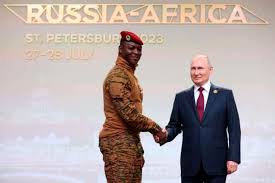
In any event, there is no doubt that Russia is among the states that have most strengthened their influence in Africa in recent years. Its actions have resulted in deeper relations with the countries of the Maghreb and sub-Saharan Africa, as well as a revitalisation of the ties established during the Cold War with the countries of southern Africa.
Russia’s strategic ambitions in Africa and the Middle East: between geopolitical expansion and the struggle against Western influence
For several years, Russia has stepped up its presence in Africa and the Middle East, with clear strategic objectives and an approach driven by both economic and geopolitical considerations. Rich in natural resources, these regions offer Moscow a unique opportunity to strengthen its influence while challenging the Western powers. Russia’s strategy rests in particular on a transactional model of exchanging arms deliveries for the exploitation of natural resources.
Another major objective for Russia is to gain access to strategic territory, particularly in North Africa and along the Red Sea, in order to establish a lasting military presence and control key points on the world’s shipping routes. In Libya, Moscow is actively backing Khalifa Haftar, who is based in the east of the country, in an attempt to secure naval or military bases in strategic ports such as Tobruk or Sirte. Such a presence would pose a direct threat to NATO forces in the Mediterranean and would make it possible to secure shipping routes vital to international trade. In the same vein, in Sudan, Russia is negotiating the establishment of a naval base at Port Sudan, on the Red Sea, which would allow it to control crucial passages such as the Suez Canal and the Bab el-Mandeb Strait, through which nearly 30% of global maritime trade passes. Although these negotiations were put on hold after the fall of al-Bashir’s regime, they remain on the agenda, since they have not been officially abandoned. These strategic advances are intended to give Moscow major economic and military leverage over the Western powers, which rely heavily on these trade routes.
At the same time, Russia is seeking to supplant Western influence, particularly in African countries facing security vulnerabilities or disengagement by the traditional powers. In the Central African Republic, for instance, the Kremlin supplies weapons and deploys paramilitary companies such as the Wagner Group (Africa Corps) to shore up the incumbent regime, in exchange for mining concessions and growing political influence.

In West Africa, Mali, marked by the withdrawal of French forces under Operation Barkhane, has become fertile ground for Russia. By filling the security vacuum left by France, Moscow swiftly forged partnerships with Mali’s military junta, offering substantial military support, notably through the private military company Wagner, which is also present in several other African states, in exchange for political alignment and a break with Western alliances. Russia is capitalising on growing anti-Western sentiment in these countries to present itself as an alternative to the former colonial powers, denouncing neocolonialism.
In addition to the countries where its military and economic interventionism is plain and overt, the Kremlin has in recent years focused its efforts on strengthening its influence in the countries of the Maghreb. These include Algeria, with which Russia has enjoyed close ties since independence in 1962, and Egypt, a long-standing partner since the 1950s. Added to these are Tunisia and Morocco, where Moscow is also seeking to build closer relations in order to extend its presence in the region.
The tools of Russian influence in Africa and the Middle East: military, economic and cultural pragmatism
Russia’s strategy for gaining influence in Africa and the Middle East relies on distinctive and often unconventional methods, combining military intervention, economic cooperation and cultural propaganda. This approach, low-cost compared with Western or Chinese investment, nonetheless proves effective in extending Russian influence in settings frequently marked by political and economic instability.
What sets Moscow apart is its flexible approach, blending official and irregular means to establish itself in these regions. These methods include the deployment of mercenaries, disinformation, electoral interference, support for coups d’état and pragmatic economic deals, such as trading arms for natural resources. Russia therefore favours a transactional relationship with partner states, built on their immediate security and economic needs, which is what makes it attractive.
In military terms, Russia has established itself as a leading player in arms sales. Between 2018 and 2022, it became the largest arms exporter to Africa, accounting for 40% of the continent’s total arms imports. Countries such as Algeria, Egypt and Libya in North Africa, as well as Mali, Niger and Angola in sub-Saharan Africa, are among its main customers. These sales include a wide range of equipment, such as tanks, helicopters and air defence systems, often accompanied by military training and technology transfers. These contracts strengthen the military autonomy of African states while consolidating Russian influence in strategic regions. They also bring Russia economic benefits, as it obtains natural resources in exchange for arms sales.
Likewise, in economic terms, although Russia accounts for less than 1% of foreign direct investment in Africa, it is expanding its commercial presence, particularly since the Western sanctions imposed in 2014 and stepped up in 2022 following the invasion of Ukraine. Grain exports, wheat in particular, are a pillar of this cooperation. Indeed, 80% of the wheat exported by Russia goes to African countries such as Egypt, Morocco, Algeria, Tunisia, Nigeria and Ethiopia, meeting growing needs on a continent whose food dependency is increasing with population growth.
In addition, private military companies (PMCs), notably the Wagner Group, play a central role in this strategy. Present in at least six African states (and suspected of operating in four others), these paramilitary firms act under a veneer of independence, although their links with the Russian government are well established. They are deployed to protect mining sites, prop up weakened regimes or take an active part in armed conflicts. This approach allows Moscow to keep a certain official distance while exerting direct influence on the ground.

At the same time, Russia is investing in cultural and media influence to shape public opinion and bolster its image. Scholarships are awarded to African elites to study in Russia, and academic and cultural partnerships are being developed. Moreover, Moscow supports pro-Russian local media and runs disinformation campaigns, often via social media, aimed at discrediting Western governments and promoting its own model. This narrative relies heavily on anti-colonial rhetoric, presenting Russia as an alternative partner to the legacy of the former colonial powers.
This combined strategy partly explains why, in the United Nations General Assembly vote in March 2022, 25 of the 54 African countries abstained or chose not to condemn Russia’s invasion of Ukraine. This stance illustrates the effectiveness of the Russian approach in these regions.
Russia’s growing influence in the Maghreb and Africa: between strategic alliances and alternatives to the Western powers :
In recent years, Russia has stepped up its efforts to strengthen its relations with the countries of North Africa, a region of major strategic importance. While its involvement in Libya is paramount, particularly since the fall of Bashar al-Assad’s regime, Moscow is also working to deepen its ties with the Maghreb states. This was officially reaffirmed by Anton Kobyakov, adviser to the Russian President, at the Russia-Africa Partnership Forum in Sochi on 9 and 10 November 2024. On that occasion, he expressed Russia’s wish to create a free trade area with the Maghreb countries, thereby consolidating a concerted economic and geopolitical approach.
Diplomatic relations between Russia and the Maghreb countries rest on already well-established foundations. Morocco is a case in point: Rabat and Moscow have been bound by a strategic partnership since 2002. This rapprochement intensified in 2016 during King Mohammed VI’s visit to Russia, which culminated in the signing of a Declaration on an In-Depth Strategic Partnership. Moreover, Moscow has signalled its intention to act as a mediator in the Western Sahara conflict, a notable development for a diplomacy traditionally aligned with Algeria. This shift reflects a desire to deepen cooperation with Morocco, seen as a strategic gateway to the African continent, while challenging American influence in the region. This diplomatic shift has not, to date, undermined the close relations between Moscow and Algiers.
In this respect, the partnership between Russia and Algeria is also flourishing, marked by strategic continuity. On 15 June 2023, the Algerian President, Abdelmadjid Tebboune, and Vladimir Putin signed a “declaration on an in-depth strategic partnership”, continuing a cooperation that began as early as 2001.

The agreement covers in particular the hydrocarbons and defence sectors, two areas crucial to Algeria’s interests. On the military front, the partnership takes the form of joint manoeuvres, technology transfers and co-production projects. These commitments were illustrated by the naval exercise conducted in the Mediterranean in November 2023, which reflects a shared determination to guarantee maritime security and to strengthen their military cooperation in the region. Moreover, Algeria’s planned accession to the BRICS forum heightens the strategic importance of its relations with Russia, whose support is essential to realising this ambition.
Tunisia, for its part, is at a turning point in its relations with Moscow. Historically close to the Western powers, notably the United States and the European Union, it has held the status of major non-NATO ally since 2015, which reflects its military dependence on the West. However, a rapprochement with Russia has begun to take shape, as shown by the meeting between Mohamed Ali Nafti, Tunisia’s Minister of Foreign Affairs, and Sergei Lavrov on 9 November 2024. The meeting provided an opportunity to discuss broader cooperation in the commercial, scientific, medical, pharmacological and academic fields.
Despite these historically close ties with the West, recent reports have pointed to movements of Russian military aircraft on the Tunisian island of Djerba. Although denied by Moscow and not officially confirmed by the Tunisian government, these allegations reflect a possible Tunisian desire to diversify its strategic partnerships, which is likely to weaken its traditional relations with the United States and the European Union. On the economic front, meanwhile, Russia has considerably increased its exports to Tunisia, particularly in the energy and agricultural sectors. Since 2022, Tunis has tripled its imports of “coal, oil and derivatives” compared with 2022. It has also imported more Russian oil than over the previous nine years. This rapprochement has also extended to the political sphere, with the signing of a memorandum of cooperation between Tunisia’s Independent High Authority for Elections (ISIE) and the Russian electoral commission.
Against this backdrop, Egypt has also positioned itself as a key partner of Russia since 1950, particularly since joining the BRICS forum. Economic and military cooperation between the two countries has grown significantly, strengthening their strategic alignment. Indeed, it was revealed back in 2023 that an agreement providing for the delivery of 40,000 rockets from Egypt to Russia was being prepared. In response, the United States and Ukraine successfully put pressure on Egypt to reconsider its position.
Thus, for countries such as Algeria, which aspires to join BRICS, or for states such as Morocco and Tunisia, which are seeking to diversify their alliances, Russia acts as a privileged interlocutor. In this respect, the benefits that other BRICS countries, such as China, could bring encourage a stance of this kind that favours cooperation. China, indeed, occupies a central place in African development projects. Although Chinese investment does not generally create local jobs, it provides essential infrastructure and contributes to the economic expansion of the countries concerned.
Finally, the current and growing trend among African countries to reduce their dependence on Western powers must also be taken into account. The withdrawal of French troops from several states (Mali, Niger, Chad, etc.) illustrates this drive for emancipation. In this context, Russia, with its anti-colonial rhetoric and its no-strings-attached partnerships, appears to be an attractive alternative. Unlike Western countries, which often tie their aid and agreements to respect for democratic principles and human rights, Moscow favours pragmatic, transactional relationships. This model, albeit ambiguous, is part of a Russian strategy aimed at establishing itself as an indispensable player on the African continent, in the Maghreb and in the Middle East.
Translated from French. The French original prevails.