by Iyed Mejri
“Hydrocarbon discoveries are intensifying rivalries, placing Essequibo at the heart of the Sino-Russian versus American duel, with Brazil standing back,” says the expert Raphael Padula, who highlights the geo-economic escalation between Venezuela and Guyana.
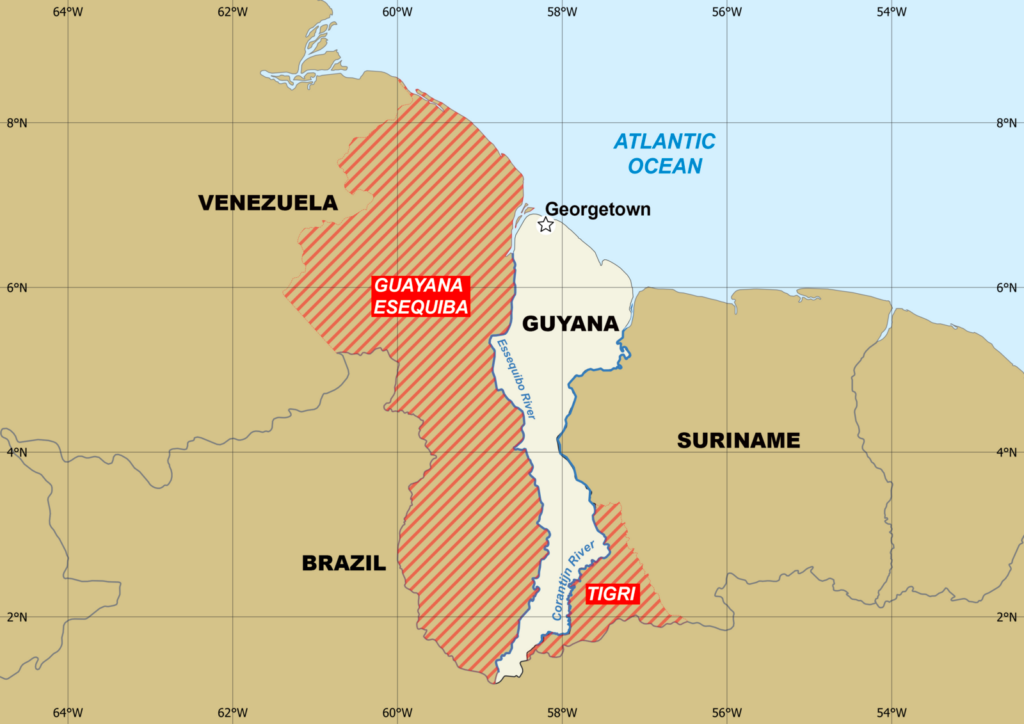
In Georgetown in early May, strategic tension flared when Venezuela held symbolic elections in the disputed region of Essequibo, even invoking a 2023 referendum to justify the move. Initially presented in Caracas as the expression of a historic right, the polls were nonetheless condemned as a head-on “assault” on Guyanese sovereignty by President Ifraan Ali, who denounced a threat to regional peace.
A territory under intense energy pressure
It was in 2015 that the American firm ExxonMobil discovered vast offshore oil reserves in the Stabroek block, changing the game entirely. Guyana, until then seen as a small, marginalised English-speaking state, has become one of the centres of gravity of the new black gold. The deposits are estimated at more than 11 billion barrels, a potential windfall that already accounts for almost half of the country’s GDP.
It is against this backdrop that Caracas has revived, with great fervour, its historic claim to Essequibo, a territory that makes up almost 70% of Guyana’s land area. At the end of 2023, the Venezuelan government held a disputed referendum, approved by 98%, calling for Essequibo to be incorporated into Venezuela. The move was hailed by the authorities as “an act of sovereignty” but regarded by Georgetown as an attempt at symbolic annexation.
Opposing narratives but mirrored mistrust
On the Guyanese side, the tensions are compounded by growing mistrust of the country’s main oil partner, ExxonMobil. The contract signed in 2026 with the American firm has drawn persistent criticism in the national press because of clauses deemed unbalanced, or even unconstitutional. Several voices are calling for a renegotiation to restore the country’s economic sovereignty.
Venezuela, for its part, is wielding patriotic rhetoric. Far from confining itself to historical arguments, the Chavista government has turned the Essequibo into a lever for popular mobilisation. From the appointment of a “Governor of Essequibo” to the creation of fictitious constituencies, the exploitation of public sentiment is plain to see.
A battle for influence with regional repercussions
International courts are watching closely, and the International Court of Justice continues to weigh on decisions: Guyana has already brought the case before the ICJ, which has ordered Venezuela to suspend all action. Caracas’s repeated failure to comply with these measures exposes it to a breach of international law, as Naziba Mustabshira observes: “the discovery of nearly 11 billion barrels of oil has revived Venezuelan claims, fuelled by deep-seated colonial grievances”, in “The Essequibo Conundrum”, Journal of Peace and Diplomacy, December 2014.
On the military front, Venezuela’s manoeuvres are stepping up a notch. According to a March 2025 CSIS report, the naval deployment near offshore oil platforms is intended precisely to force Guyana into talks from a position of strength. Georgetown was quick to respond: President Ali urged the population, whether coerced or not, to reject the event, threatening participants with treason charges. Venezuelan President Nicolás Maduro, for his part, continues to insist that the region is part of Bolívar’s legacy, pursuing a policy of persistence despite diplomatic pressure.
Faced with this escalation, North America and the wider region are responding. US Secretary of State Marco Rubio has pledged increased security support to Guyana, including joint naval exercises and stronger defence guarantees. At the same time, Brazil has stepped up patrols along its border, stating that it will tolerate no breach of its sovereignty. This stance draws its strength from the doctrine of regional balance, which seeks to prevent the growing militarisation of the area.
A test for continental diplomacy
Beyond international law, the dispute is testing South America’s capacity for mediation. The 1966 Geneva Agreement, intended to serve as a basis for dialogue, remains legally valid but politically obsolete. The Essequibo is not a theatre of war, but it is already a disputed, militarised and highly volatile territory.
Translated from French. The French original prevails.