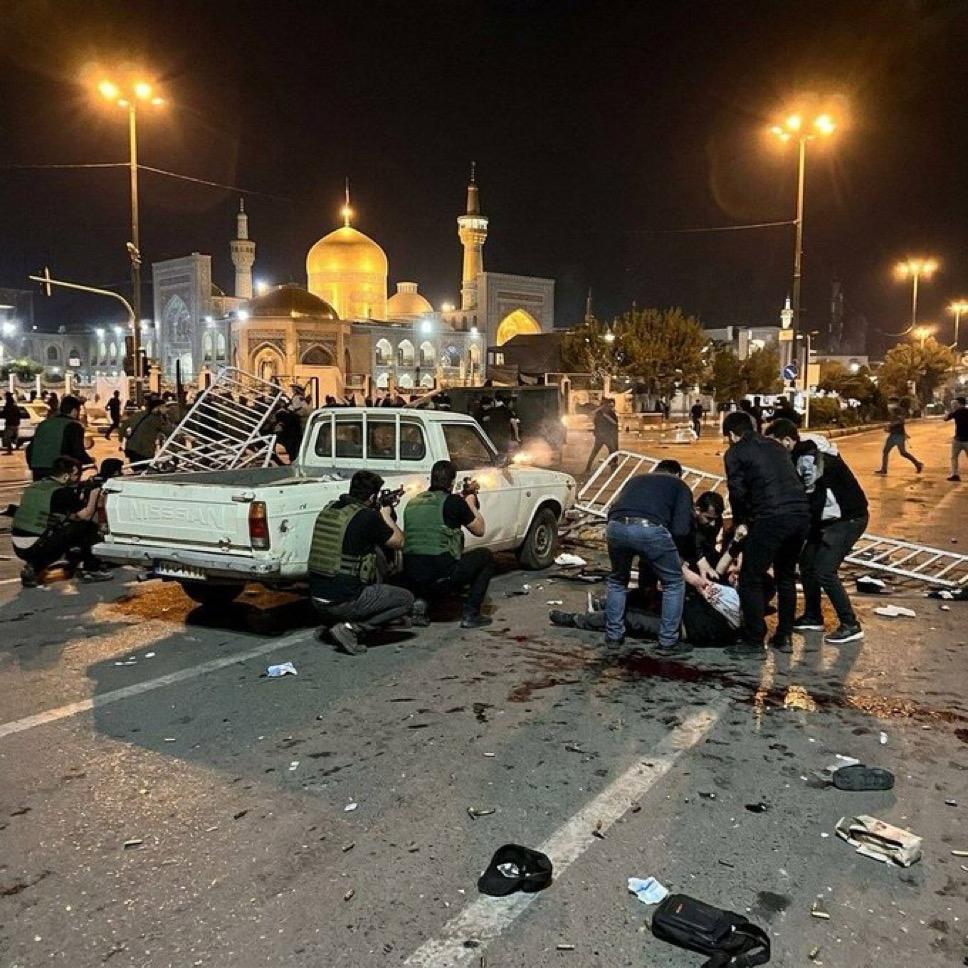
On the evening of 9 July 2026, two members of the Basij were shot dead in Mashhad by armed men.
The recent clashes in Iranian Kurdistan, the attack on members of the Basij in Mashhad and the persistent tensions in Baluchistan and Khuzestan do not yet amount to a national insurrection. But at a time when the Islamic Republic is fighting a high-intensity external war, the fact that they are happening simultaneously raises a new question: can the authorities continue to isolate and suppress these challenges to their power separately without them eventually converging?
While international attention remains focused on the war between the United States and Iran, Iran’s nuclear programme and security in the Gulf, another threat is taking shape within the Islamic Republic itself. On the evening of 9 July, two members of the Basij were shot dead in Mashhad by armed men. A few days earlier, the Revolutionary Guards had clashed with Kurdish fighters in the north-west of the country, near the Iraqi border. In Baluchistan, as in Arab Khuzestan, attacks, military operations and repression have been going on for years. Taken separately, these events stem from different local situations. Taken together, they raise a broader question: could the external war accelerate the internal weakening of the Islamic Republic?
Why the Islamic Republic has held firm so far
Since the 1979 revolution, the Islamic Republic has shown far more than a mere ability to weather crises. It has managed to rally very different populations around a mixture of national defence, revolutionary fervour, coercion and religious zeal.
When Iraq invaded Iran in September 1980, Khomeini’s regime was still young and deeply contested. Insurgencies were shaking several regions, notably Kurdistan, and purges had weakened the army. Saddam Hussein believed he could exploit these fault lines. He hoped in particular that the Arabs of Khuzestan would turn against Tehran and welcome Iraqi troops as liberators.
That calculation failed. Most Iranian Arabs did not side with the invader. They defended their towns, their families and their land. This response did not necessarily signal support for the new Islamic regime. Rather, it revealed the strength of an Iranian sense of belonging that, at the moment of invasion, was able to override ethnic divisions and grievances against the central government.
Shia Islam nonetheless played a decisive role. The regime portrayed the war as a continuation of Imam Hussein’s struggle against oppression. Sacrifice, martyrdom and religious obedience were turned into instruments of military mobilisation. The enthusiasm born of the Shah’s fall further heightened this fervour during the early years of the war.
Yet this mobilisation was never uniform. Some Iranian Kurds continued to fight the Islamic Republic, while others served in the army, sometimes out of patriotism, sometimes through conscription or to defend their own regions against Iraq.
The regime’s strength therefore lay in fusing several distinct drivers: Iranian patriotism, fear of invasion, Shiism, revolutionary fervour, the cult of martyrdom and coercion by the state. It was this combination, more than mere “resilience”, that enabled it to impose eight years of war and considerable loss of life on society. At every stage, the authorities succeeded in preserving what mattered most: the cohesion of their security apparatus and control of the territory.
This capacity for survival does not rest on military force alone. It stems from a system that combines ideology, surveillance, repression, religious supervision, patronage and control of information. The regime has learnt to isolate pockets of dissent, to prevent them from converging and to portray any domestic opposition as a threat to national unity or as the instrument of a foreign power.
This also explains why so many predictions of the Islamic Republic’s swift collapse have proved wrong. Yet the current sequence of events presents a different configuration. For the first time in a long while, Tehran could be forced to manage simultaneously a high-intensity external military confrontation, the protection of its strategic infrastructure and a proliferation of flashpoints on its own soil.
Mashhad: an attack at the heart of a symbolic city
This is not yet a national uprising. Nor is it a civil war. The question now is whether the regime can continue to contain, one by one, crises that could perhaps converge. The latest warning came from Mashhad. The city is no ordinary place. It is home to the shrine of Imam Reza, one of the main centres of Shia pilgrimage in Iran, and counts among the regime’s religious strongholds. On the evening of 9 July 2026, two members of the Basij were shot dead by gunmen. When an armed attack targets Basij members in such an urban centre, the event is more than a mere news item.
According to media close to the regime, two men wearing military uniforms and armed with pistols opened fire on several members of the Basij in Fakouri Street. One of the militiamen reportedly died at the scene, while the second is said to have succumbed to his injuries after being taken to hospital. The attackers managed to escape. No organisation has claimed responsibility for the attack and there is as yet nothing to establish the perpetrators’ motives.
The political significance of the incident lies first of all in its location. The city played a central role in the funeral ceremonies held after the death of Ali Khamenei. The regime wanted to turn the funeral into a display of political continuity and national cohesion. Yet the popular turnout observed did not necessarily match the image of a country wholly united behind the former Supreme Leader.
A few days later, the deaths of two members of the Basij in the same city served as a reminder that a show of institutional continuity is not enough to dispel questions about the strength of the regime. The incident is all the more significant because the Basijis are no ordinary security force. The militia, which operates under the authority of the Revolutionary Guards, plays a central role in monitoring society, suppressing protests and controlling universities, neighbourhoods and workplaces. To attack the Basijis is therefore to target one of the most visible instruments of the regime’s presence in Iranians’ daily lives.
Fighting in Iranian Kurdistan
A few hours earlier, fierce clashes had broken out in north-western Iran. The fighting took place around Piranshahr and Sardasht, two towns in the province of West Azerbaijan, right on the border with Iraqi Kurdistan. For decades this mountainous region has been one of the main flashpoints between Tehran and Iranian Kurdish movements, several of which have bases, networks or fallback areas on the other side of the border.
According to Kurdish human rights organisations, five members of the Democratic Party of Iranian Kurdistan were killed in an ambush laid by forces of the Islamic Revolutionary Guard Corps. The death toll remains difficult to confirm independently. But there is no doubt that the clashes took place: they have been acknowledged both by Kurdish organisations and by the Revolutionary Guard Corps’ Hamzeh Sayyid al-Shuhada headquarters.
Since the fighting, Iranian forces have significantly stepped up their presence in the region. Additional troops, units of the IRGC (Islamic Revolutionary Guard Corps) and heavy equipment have been deployed to several border areas of Iranian Kurdistan. The build-up shows that Tehran does not regard the clashes in Piranshahr and Sardasht as mere isolated incidents, but as a threat that could drag on or spread.
Further fighting is also reported to have pitted government forces against fighters linked to the Party of Free Life of Kurdistan, PJAK, in the Sardasht area. Here too, the toll has yet to be independently established, but the key point lies elsewhere: the regime itself acknowledges that it must once again commit its forces against armed groups in one of its most sensitive peripheral regions.
These clashes are not entirely new. For decades, Iranian Kurdistan has gone through periods of calm followed by renewed violence. But the current context gives them a different significance. They come at a time when Tehran is already having to devote a large share of its resources to the external war and to protecting its nuclear sites, its energy infrastructure and its main command centres.
A regional power built on a fragile domestic balance
Seen from outside, the Islamic Republic appears to be a highly centralised state, with robust institutions and a powerful security apparatus. That image is not wrong. But it conceals a more complex internal balance. Iran is a vast state at the crossroads of the Middle East, the Caucasus, Central Asia and the Indian subcontinent. This position gives it considerable weight in the regional balance of power, but it also obliges it to govern a territory criss-crossed by numerous ethnic, linguistic, religious and tribal realities.
Persians make up the largest population group, but they coexist with sizeable Azeri, Kurdish, Baluch, Arab, Turkmen and Lur communities. The overwhelming majority of these populations take part in Iranian national life and are not involved in separatist movements. But several peripheral regions have long experienced tensions fuelled by identity-based demands, economic inequality, discrimination, environmental difficulties, cross-border trafficking or the presence of armed groups.
For decades, the Islamic Republic managed to prevent these flashpoints from converging. Its strategy was to deal with each flashpoint separately, alternating between dialogue with local leaders, political pressure, military presence, intelligence, economic control, arrests and repression. This approach enabled the Islamic regime to achieve its main objective: no regional challenge has succeeded in lastingly calling into question the state’s control over the whole of the national territory.
The question today is a different one. The problem is not that these fault lines exist. They are long-standing and well known to the authorities. What is at stake is whether several of them could flare up at the same time, just as the security apparatus is heavily stretched by the war abroad.
The Islamic Republic’s three belts of vulnerability
Iran’s most sensitive peripheries share neither the same demands nor the same risks. In the north-west, Iranian Kurdistan is first and foremost a territorial and border vulnerability. The presence of armed Kurdish movements on both sides of the border with Iraq forces the regime to maintain a large military presence in a mountainous area that is difficult to control. Tehran regularly accuses these organisations of receiving support from foreign intelligence services and of using the territory of Iraqi Kurdistan as a rear base. The Kurdish groups, for their part, condemn political repression, discrimination and the lack of recognition of their cultural and political rights.
In the south-east, Sistan and Baluchestan represents a vulnerability of a different kind. The region, which borders Pakistan and Afghanistan, is one of the poorest in the country. Its population is largely made up of Sunni Baluch, in a state dominated by the Shia clergy. Poverty, unemployment, cross-border trafficking, religious tensions and the presence of armed groups combine to create a particularly unstable environment. The authorities there regularly face attacks on the security forces, border posts and military installations.
Khuzestan: the Arab question and the energy heartland of Iran
The third sensitive area is Khuzestan, which many Arab activists call Ahwaz. Located in south-western Iran, the province is home to a large Iranian Arab community. It also accounts for a major share of the country’s oil resources, petrochemical facilities and energy infrastructure. The Arab question there is therefore directly linked to the economic security of the Islamic Republic.
Khuzestan also holds a particular place in Iran’s contemporary history. When he launched his offensive in September 1980, Saddam Hussein believed that the Ahwazi Arabs would welcome Iraqi troops as liberators and rise up against Tehran. His calculation rested on the idea that ethnic and linguistic solidarity would prevail over allegiance to the Iranian state.
Events proved him wrong. Opposition to the central government did not turn into a general uprising in favour of Baghdad. A large part of the local population defended its territory against the Iraqi invasion, while many Iranian Arabs fought in the ranks of the Iranian forces. This episode is a reminder that Iran’s internal divisions cannot be reduced to ethnic or communal antagonisms. An Arab from Khuzestan can challenge the central government without accepting foreign domination or wishing to see the country dismembered.
This loyalty to Iran has not, however, made the grievances disappear. Part of the local population has long denounced marginalisation, unemployment, difficulties in accessing water, pollution and the meagre local benefits of the region’s oil wealth.
Since the outbreak of the war between Iran and the United States, some Ahwazi movements have adapted their rhetoric to the new regional context. First, they stress the contrast between the poverty of part of Khuzestan’s Arab population and the affluence of the Arab societies on the other side of the Gulf. In their view, the inhabitants of a province that supplies a significant share of Iran’s oil continue to suffer from unemployment, environmental degradation and inadequate public investment, while hydrocarbon wealth has transformed the neighbouring monarchies.
This economic argument is now compounded by a strategic one. Some separatist movements claim that an Ahwazi territory detached from Iran could deprive Tehran of part of its access to the Gulf and help restore freedom of navigation. This claim, however, rests on a very broad definition of Ahwaz. The demands of some groups are not confined to present-day Khuzestan: they also take in coastal areas further east, as far as the approaches to the Strait of Hormuz.
These movements are thus seeking to convince Arab and Western states that their cause is not merely a matter of identity, but could also serve a broader geopolitical aim: reducing Tehran’s capacity to threaten shipping in the Gulf. For now, this argument has more to do with courting foreign support than with any real balance of power. It nonetheless shows how the regional war is turning old domestic fault lines into potential instruments of confrontation with the Islamic Republic.
Several Ahwazi Arab organisations, some of which have resorted to armed struggle, remain active inside or outside the country. Their real influence is still hard to gauge, and there is nothing to suggest that they currently have the capacity for a widespread insurgency. But Khuzestan is a major vulnerability. A lasting deterioration of the security situation in the province would strike directly at the energy heartland of the Islamic Republic.
These three regions therefore represent three distinct forms of fragility:
• Kurdistan threatens the security of the western borders
• Baluchistan tests control over the south-east
• Arab Khuzestan directly affects the country’s energy and economic resources
What worries the authorities is not merely the existence of each of these crises. It is the possibility that they might unfold at the same time.
The other front: Iran’s major cities
The peripheral regions are not the only source of concern for the Iranian authorities. For more than twenty years, the main challenges to the Islamic Republic have also come from the major urban centres. The student demonstrations of 1999, the Green Movement of 2009, the 2019 protests against fuel price rises and then the “Woman, Life, Freedom” movement sparked in 2022 by the death of Mahsa Amini showed that the country’s demographic heartland could also defy those in power.
Yet of all the signs of urban discontent, there is one that Iran’s rulers have always feared more than any other: that of the Tehran Bazaar. The Grand Bazaar is not merely a shopping centre. For generations it has been an economic, social and religious network capable of funding movements, organising strikes and spreading protest far beyond its own walls.
The bazaaris played a major role in the fall of the Shah in 1979. Their shop closures, their financial backing for opponents and their ties to the clergy helped turn a succession of demonstrations into a revolutionary movement. After the establishment of the Islamic Republic, they were long regarded as one of the new regime’s natural supporters.
It is precisely for this reason that their discontent so alarms the authorities. When the merchants of the Bazaar stop protesting solely against taxes, inflation or the collapse of the currency and begin taking up political slogans, the signal goes far beyond the economic crisis alone.
A shutdown of the Bazaar can paralyse part of economic activity, but above all it can give the protest movement organisation, networks and resources that spontaneous movements often lack. The Islamic Republic knows that a student mobilisation can be crushed, that a revolt on the periphery can be isolated and that an urban demonstration can be dispersed. What it fears more is the moment when the street, the universities, the working classes and the Bazaar begin to act in the same direction.
The recent protests by merchants show that this long-standing alliance between the clerical establishment and the bazaaris has weakened. Some of them now denounce the collapse of the rial, inflation, corruption and the place the Revolutionary Guards have taken in the economy. The regime is not merely losing economic support: it risks seeing one of the milieus that helped bring it into being break away. (Financial Times)
Each time, the regime’s response was extremely harsh. The Revolutionary Guards, the Basij and the security forces carried out mass arrests, fired on protesters, held summary trials, carried out executions and tightened control of the internet and social media. This crackdown prevented the regime from falling, but it did not remove the root causes of discontent.
It is precisely this memory of the great urban protest movements that gives the incidents in Mashhad particular significance. For the first time in several years, an armed attack targeting the Basij has taken place in a major city at a time when clashes are also resuming in several outlying regions. Should the periphery one day find an echo in Iran’s major cities, the Islamic Republic would face a security equation on an altogether different scale from anything it has known so far.
What is changing now
The tensions in Kurdistan, Baluchistan, Khuzestan and Iran’s major cities are nothing new. The Islamic Republic has faced them for decades and, until now, it has always managed to prevent these various hotbeds of protest from converging.
For the first time in a long while, the regime must simultaneously manage a high-intensity military confrontation beyond its borders and a growing number of security incidents on its own soil. The Revolutionary Guards, the Basij, the internal security forces and the intelligence services retain considerable capabilities. But they must now protect the leadership and their own structures, nuclear facilities, energy infrastructure, ports, logistics routes, the borders and the country’s main cities.
The question, then, is not whether the Islamic Republic is still capable of crushing protest. It is whether it can go on containing several crises of different kinds at once without them ending up reinforcing one another.
Also read in La Tribune des Nations
• Iran: Khamenei’s funeral becomes a regional show of strength for the pro-Iranian axis
• Balochistan: why this province has become one of the new centres of gravity of global geopolitics
• The strategic lessons of 40 days of war between the United States, Israel and Iran
Further reading
• Financial Times — The historic bazaar where Iran’s protests began
• Human Rights Watch — Iran: Authorities’ Renewed Cycle of Protest Bloodshed
• Human Rights Watch — Iran: Deadly Repression of Khuzestan Protests
Translated from French. The French original prevails.