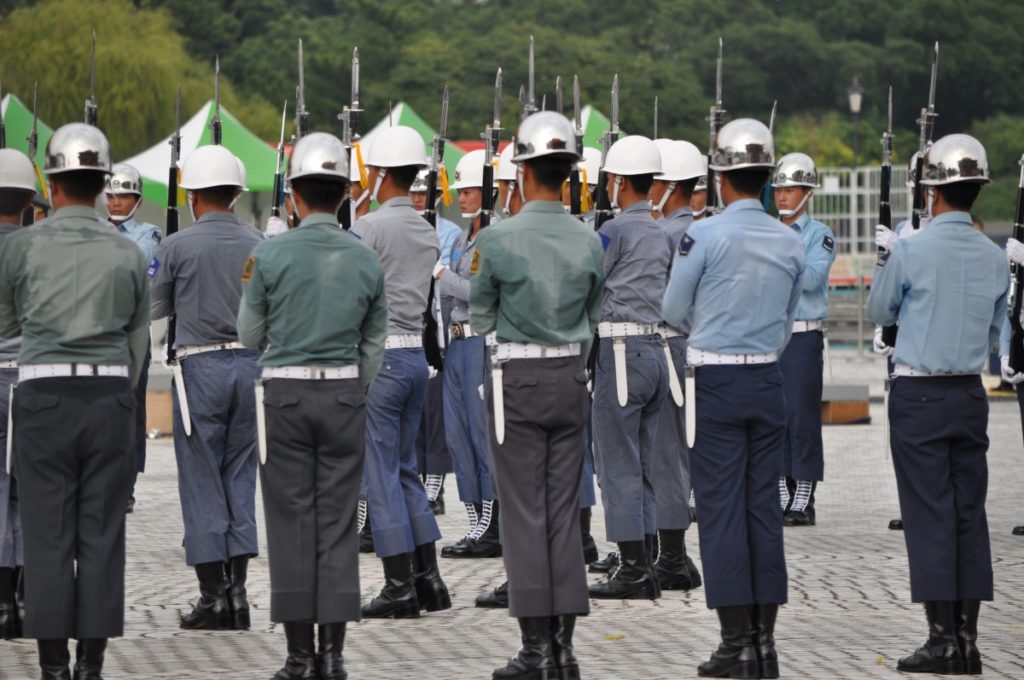
Taiwanese soldiers on parade.
The publication of the Trump administration’s National Security Strategy and remarks by Japan’s prime minister have put Taiwan back in the spotlight of global diplomacy. In the White House document, Taiwan appears in a subsection entitled “Deterring Military Threats”. It could hardly be clearer.
Taiwan also featured among the strategic priorities of the Biden administration, and it is instructive to compare the two approaches in order to highlight their differences. For the Democrats, defending Taiwan was a question of values. The 2022 National Security Strategy stated that it did “not support Taiwan independence” and adhered to the One China principle. The 2025 National Security Strategy repeats neither of these formulations. It merely reaffirms that “the United States does not support any unilateral change to the status quo in the Taiwan Strait”.
In a pragmatic approach consistent with the “America First” doctrine, Taiwan is viewed in a more pragmatic and less ideological way than in the Biden document of 2022. Taiwan is presented as a “justified” priority, partly because of its leadership in semiconductor production. The island’s position is also considered from a geostrategic standpoint.
For the Trump administration, the aim is to deter a conflict over Taiwan by preserving military superiority
It gives access to the second island chain, also referred to as the “second cloud of islands” by Earl Hancock Ellis, namely Japan’s Bonin Islands and Volcano Islands, as well as the Mariana Islands, which divide North-East and South-East Asia into two distinct zones of influence. This strategy, formulated by John Foster Dulles in 1951, aims to contain China militarily by controlling key sea lanes in the Pacific. The first island chain runs from the Kuril Islands to Borneo, taking in Korea, Japan (the Ryukyu Islands), Taiwan and the north-west of the Philippines.
The new US strategy also highlights the vulnerability of maritime trade, noting that a quarter of global maritime traffic passes through the South China Sea. “A potentially hostile power could thus impose a toll system on one of the world’s most vital shipping lanes or, worse still, close it and reopen it at will. Either of these outcomes would be detrimental to the US economy,” the White House document states.
Securing it is therefore a national interest for the Americans. The rest follows from this: the aim is to deter “a conflict over Taiwan, ideally by preserving military superiority”. The Trump administration has even made it a priority.
“Preserving this military advantage will require not only greater investment in our military capabilities, particularly naval ones, but also close cooperation with every nation that stands to suffer, from India to Japan and beyond,” the document states. And, as with NATO countries, Trump is asking his allies in the Indo-Pacific region to increase their defence spending and also to make it easier to host US forces. This concerns South Korea, Australia and Japan.
/ “An attack on this democratically governed island could be considered an existential threat to Japan,” said Sanae Takaichi, Prime Minister of Japan.
Regarding the latter country, one paragraph takes note of recent statements by the Japanese Prime Minister, Sanae Takaichi. “Faced with China’s stated determination to reunify Taiwan, whether by diplomatic or military means, the Indo-Pacific region and the West fear that a major war would have global repercussions. Japan, aware that its economy and its sea lanes would be threatened in the event of a Chinese naval blockade of Taiwan, is clarifying its hitherto ambiguous position towards China,” the US document points out.
Indeed, Japan’s new head of government has been particularly clear about Taiwan. “An attack on this democratically governed island could be considered an existential threat to Japan,” she declared shortly after taking office. China reacted immediately and demanded that the Japanese Prime Minister retract her remarks. Beijing also deployed more than a hundred warships, backed by aircraft, across a vast area stretching from the Yellow Sea to the South China Sea. A clear message to Taipei, Tokyo and Washington.
The Prime Minister knows Taiwan well. Her party, the LDP, has long-standing and close ties with the Democratic Progressive Party (DPP), which governs Taiwan. She has also come out in favour of revising Article 9 of Japan’s post-war Constitution, which limits the use of force to self-defence alone, and advocates a broad security alliance including Australia, India and Europe against possible Chinese aggression.
The Trump administration, for its part, recently approved the largest arms deal for Taipei in 24 years, worth $11 billion. “China urges the United States to immediately stop its dangerous actions of arming Taiwan ,” said Guo Jiakun, spokesperson for the Chinese Ministry of Foreign Affairs. Taiwanese President Lai Ching-te announced last month that his government would propose $40 billion in additional defence spending, with a target of military spending of 5% of GDP by 2030.
This rise in tensions in the Indo-Pacific region must also be seen against the historical backdrop of Russia’s aggression against Ukraine. Just as Moscow considers that Ukraine has no existence of its own and is part of Russia, Beijing holds that Taiwan has no existence of its own and is part of China.
Translated from French. The French original prevails.