A few days ago, a reader wrote to me after my opinion piece on the opening of the Arctic route. His question was simple, almost innocuous: would the Emiratis of DP World, the Dubai port giant, take an interest in the infrastructure of this new northern corridor? I started digging to answer him. And the more I dug, the more I realised that his question, for all its technical appearance, touched a nerve that nobody in Canada really wants to probe.
The short answer: DP World is not going to take an interest. It is already there. On both sides at once. And it is precisely this balancing act that should give us pause.
One foot in Moscow
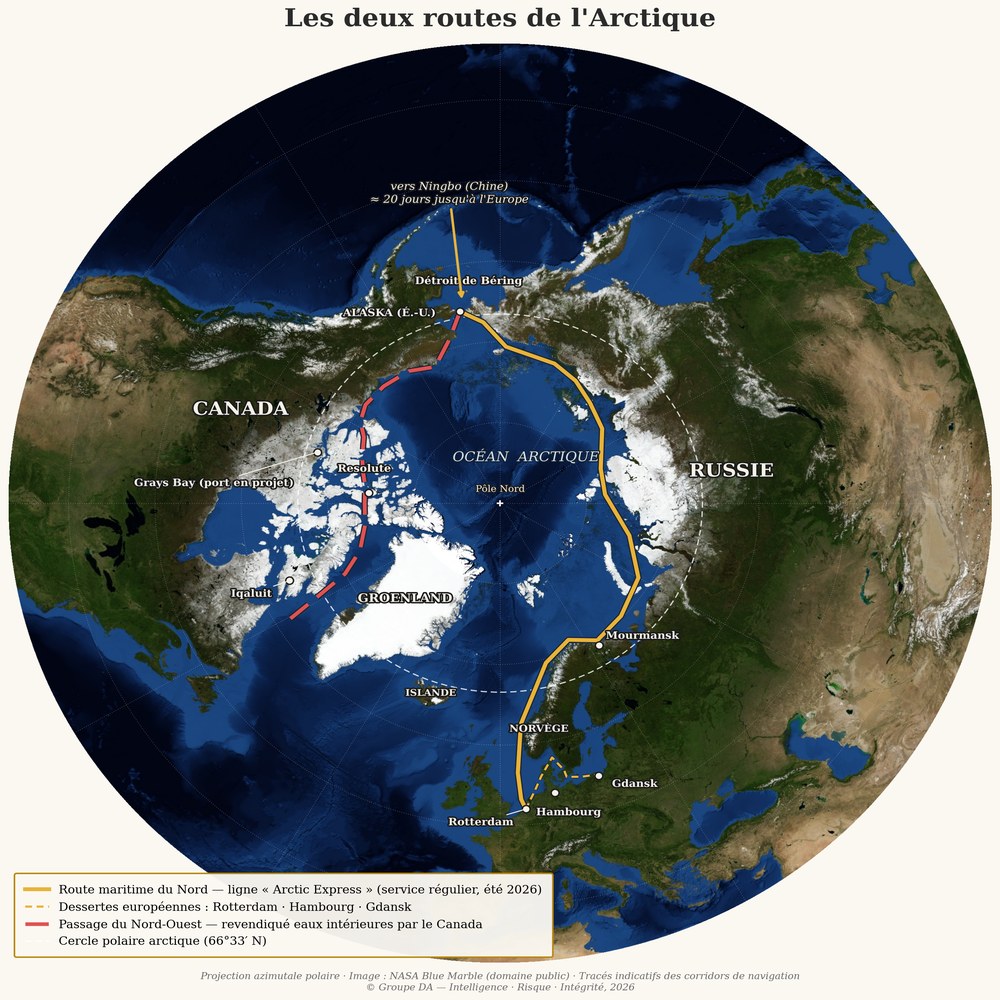
Let us start with the East. As early as July 2021, DP World signed an agreement with Rosatom, the Russian state nuclear corporation that administers the Northern Sea Route, to jointly develop container shipping across the Arctic. In October 2023, the two partners made it concrete: a joint venture was registered in Moscow to organise this transit. And last March, barely three months ago, they announced plans to build together an “international logistics giant”, backed by DP World’s global network.
To grasp how bold this positioning is, one has to measure the void around it. Maersk, CMA CGM, Hapag-Lloyd: the largest Western carriers have withdrawn from this route, for fear of sanctions, insurance costs and reputational risk. Even COSCO, the Chinese giant, has not used it since 2022. Operating there means dealing directly with Rosatom and exposing oneself to US secondary sanctions. Almost everyone has pulled back. DP World, for its part, has pressed ahead.
This choice has not gone unnoticed. In July 2024, Ukraine’s anti-corruption agency added DP World to its list of “international sponsors of war”, citing its stepped-up cooperation with Russia. In the United Kingdom, where the company operates a strategic freeport on the Thames, parliamentary voices are calling for ties to be cut. The debate exists elsewhere. It simply has not yet crossed the Atlantic.
A foothold in Contrecœur
For while it weaves its ties in Moscow, DP World is settling in here at home. The company already operates five Canadian terminals : Vancouver, Fraser Surrey, Nanaimo, Prince Rupert and Saint John. In January, it completed the modernisation of Saint John, a $178 million project. And on 10 April, it began construction of its sixth: the Contrecœur terminal, which it will operate for forty years in a joint venture with La Caisse de dépôt et placement du Québec. In other words, with the retirement savings of Quebecers.
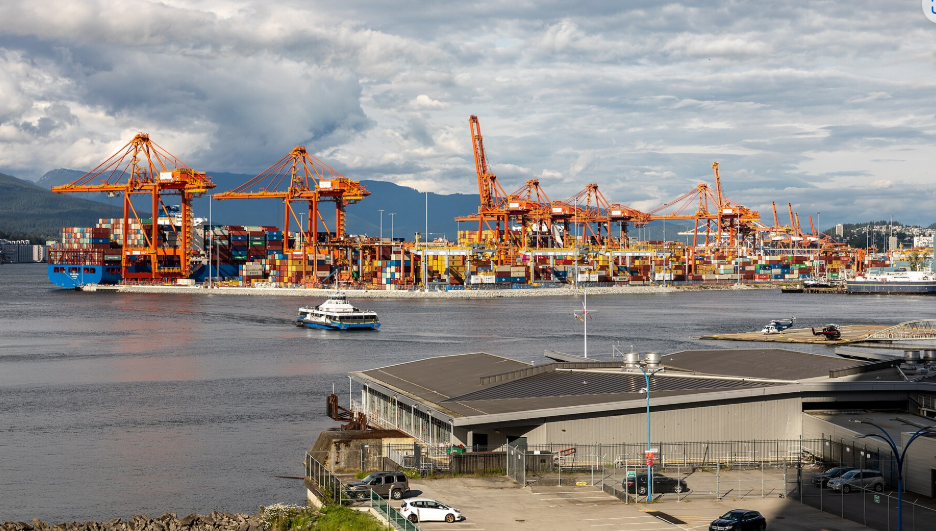
The Centerm terminal in Vancouver, operated by DP World since 2006. Photo: Wikimedia Commons, CC BY-SA.
A clarification is needed here, because it is far from trivial. People often speak of the “Port of Montreal terminal”, because the project is being led by the Montreal Port Authority. But the terminal itself will not be on the island of Montreal: it is rising at Contrecœur, a South Shore municipality some 50 kilometres downstream along the St Lawrence. The distinction matters. It is not the old urban port that is being entrusted to DP World; it is a brand-new deep-water gateway, designed to handle the largest container ships, at the entrance to the St Lawrence corridor that feeds the entire east of the continent.
Let us pause for a moment and let the two images overlap. At one end of the Arctic route, DP World is building Russia’s logistics future alongside an arm of a state corporation whose military nuclear subsidiaries and several executives Canada has sanctioned. At the other end, the same DP World is building, with Quebec public capital, a major commercial gateway for Canada over 40 years.
I should be precise, because rigour demands it: Canada has not sanctioned Rosatom as a whole. It has targeted the hard core — the entities linked to nuclear weapons, the atomic technology export agency, members of its management boards. The logistics branch, the one partnering with Dubai, still escapes the list. The fault line does not separate Canada from Rosatom; it runs through Rosatom itself. And DP World has planted a foot on either side of that line.
The strategy of the straits, applied to the ice
There is nothing inconsistent about this behaviour. For Dubai, it is in fact entirely logical. The Emirates have built their power on a single idea: never depend on one strait, one ally or one route. Make themselves indispensable to every side, so as to be at the mercy of none. Partner of Rosatom on the Russian route, partner of Quebec capital on Canada’s Atlantic seaboard: whichever Arctic route eventually prevails, the Siberian one today or Canada’s Northwest Passage tomorrow, Dubai will collect the toll. It is a bet with no losers, made possible by a rare position: close enough to the West to operate in North America, neutral enough to shake hands with Moscow.
To be fair, DP World rejects any suggestion of ambiguity. The company says it has no “active operations” in Russia and describes itself as focused on keeping global trade flowing. That is an acceptable answer; not every signed agreement amounts to an ongoing operation. But a signatory is no passing stranger, and the question remains: can a company develop the logistics route of a strategic adversary and operate the commercial gateways of its rival without either side having to account for it?
What Canada should be asking itself
So is this Emirati presence good or bad for Canada? Honestly, both — and that is why it deserves more than a press release of welcome.
The upside is real, tangible and quantifiable. Billions invested, thousands of jobs during the construction of Contrecœur, a 60 per cent increase in port capacity in the East: exactly the trade diversification the Carney government is calling for in the face of American unpredictability. A world-class operator betting on Canada is good economic news. It would be dishonest to deny it.
The downside is less conspicuous but runs deeper, and here it is, plainly put: a country cannot loudly assert its sovereignty in the Arctic — forty billion announced, “we are taking full responsibility for our security”, a deep-water port to be built at Grays Bay — while handing the keys to its commercial infrastructure to the operator that holds the other end of the polar route alongside the very Russian partner it claims to be containing. Sovereignty cannot be sliced up. It cannot be fierce in the North and absent-minded on the St Lawrence.
And here is the question that no one in Ottawa has yet asked out loud, the one my reader brushed against without realising it. The day Canada looks for an operator for its future Arctic port at Grays Bay, DP World will be a natural candidate: it has polar experience, six Canadian terminals and the capital of La Caisse behind it. Will Canada then entrust its Arctic gateway — the very symbol of the sovereignty it proclaims — to the company building Russia’s Arctic route? And if it refuses, on what principle, when it has already welcomed it from Vancouver to Contrecœur, from one ocean to the other?
I do not have the answer. But I do know that a sovereignty which does not ask itself the question will not deserve the name for long. In my line of work, one learns one thing quickly: it is never the partner who betrays you who does the most damage. It is the one whose other friendships you never cared to examine.
Didier Aubrais is President and Founder of Groupe DA Détection-Action, a business intelligence and specialised investigations firm (Laval, Quebec — Geneva), and President and Founder of the Cercle Canadien Francophone d’Analyse Géostratégique (CCFAG).
Sources and references
1. Gcaptain / Reuters — “Russia’s Rosatom and DP World Team Up to Develop Arctic Shipping Route”, July 2021. Initial DP World–Rosatom agreement to develop container shipping on the Northern Sea Route; $2 billion investment commitment with the Russian fund RDIF; “Northern Transit Corridor”.
2. Énergies de la Mer / Reuters / Interfax — “DP World et Rosatom concrétisent leur accord pour la route de l’Arctique” (DP World and Rosatom finalise their agreement on the Arctic route), October 2023. Creation of the joint venture International Container Logistics, registered in Moscow, for container transit on the NSR.
3. Infomédiaire — “Russie: Rosatom et DP World veulent créer un géant logistique international” (Russia: Rosatom and DP World seek to create an international logistics giant), March 2026. Plan for a joint logistics company backed by DP World’s network (more than 60 terminals, capacity exceeding 90 million TEU); Emirati control of DP World.
Source: infomediaire.net (Rosatom and DP World, March 2026
4. The Diplomat — “Asia Is Racing to the Arctic, But It’s Not Easy”, July 2026. Withdrawal of Maersk, CMA CGM, Hapag-Lloyd and COSCO from the NSR for fear of sanctions; Sealegend Shipping and New New Shipping as the main non-Russian operators (14 container voyages in 2025); Rosatom–DP World and Rosatom–India agreements; Allianz Commercial (Safety and Shipping Review 2026) on the risks.
5. Democracy for Sale / KSE Institute — “Starmer urged to cut ties with P&O Ferries owner over links to Russia”, October 2024. Listing of DP World by Ukraine’s anti-corruption agency (NACP) as an “international sponsor of war” (July 2024); British debate over the Thames Freeport; DP World’s position (“no active operations” in Russia).
6. RazomUA Media — “DP World and Rosatom: joint venture gives Russia access to global port network”, April 2026. Analysis of the risks of sanctions evasion; DP World’s exit from the Ukrainian “Yuzhny” terminal (March 2026, sold to TIS); a network of more than 78 terminals in 45 countries, ~10% of global freight.
7. Global Affairs Canada — “Canada announces additional sanctions against Russia’s military and nuclear sectors”, 23 August 2023. Sanctions against 4 individuals and 29 entities, including Rosatom subsidiaries (nuclear weapons complex, nuclear technology export agency); members of Rosatom’s supervisory and management boards already listed previously.
8. Canada Gazette, Part II — Regulations Amending the Special Economic Measures (Russia) Regulations, March 2026. Since 2014, more than 3,300 individuals and entities sanctioned (Russia, Belarus, Ukraine, Moldova); more than 400 vessels listed; 100 “shadow fleet” vessels added.
9. DP World Marks New Milestone in Canada (GlobeNewswire) — “Contrecoeur Expansion Groundbreaking”, 10 April 2026. Construction begins on the Contrecœur terminal (Port of Montreal); +1.15 million TEU (~60% additional capacity); DP World’s sixth Canadian terminal; joint venture with La Caisse.
10. FreightWaves — “Canada port, DP World complete $178M modernization”, 14 January 2026. Completion of the modernisation project for the west side of the Port of Saint John (C$178m, including more than C$54m from DP World, 2022–2025); Canada’s Trade Diversification Corridors Fund (C$3.6bn).
11. High North News / Bellona — “Russia’s Arctic Shipping Route Turns Into ‘Dark Fleet’ Corridor”, December 2025. Around a hundred sanctioned vessels on the NSR; repeated reflagging and AIS shutdowns; Rosatom has stopped publishing vessel positions and incident records.
12. Port of Montreal — Press release, “DP World in Canada and the MPA Sign Joint Development Agreement”, September 2025. Structure of the Contrecœur project; DP World responsible for the landside works and operations for 40 years; entry into service scheduled for 2030; “Canadian economic sovereignty” angle cited by the Port Authority.
Translated from French. The French original prevails.