A pro-Iranian network inspired by the Islamic Revolution faces a fragmented Sunni Arab camp
The capture of Mokha, the arrival of the Houthis in Dhubab and on Perim Island, in the immediate vicinity of the Bab el-Mandeb Strait, the attack on the Saudi East–West pipeline and hostile actions by pro-Iranian militias in Iraq show that the war launched against Iran at the end of February is changing in nature. Faced with a pro-Iranian network that is geographically fragmented yet able to bring its resources to bear together, Saudi Arabia must coordinate a far more divided anti-Houthi camp. Washington, which started the conflict alongside Israel, is for now refusing to add direct military intervention in Yemen. Behind the battle for the straits, an old regional fault line is thus re-emerging: the one pitting the Islamic Republic and its armed partners against the Sunni Arab monarchies.
The war spills beyond its original bounds
On 28 February, US and Israeli strikes on Iran opened a war whose centre of gravity still lay in the Gulf. Six months on, the conflict is spilling ever more clearly beyond those bounds. Iran continues to use the Strait of Hormuz as military, economic and political leverage. But pressure is now also being exerted from Iraq and Yemen, while Saudi Arabia is discovering that the routes designed to bypass Hormuz can themselves become targets.
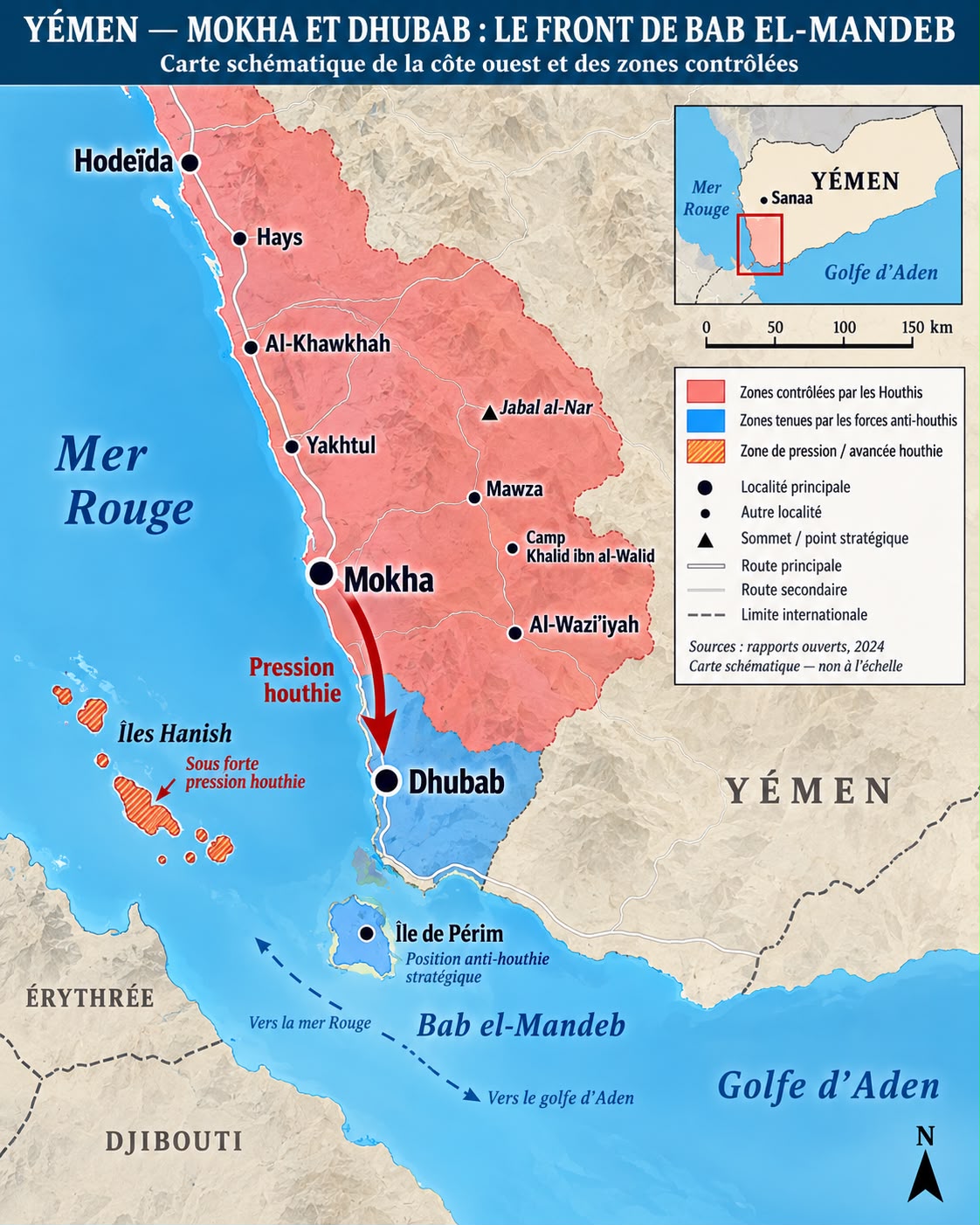
In this respect, the events of 10 and 11 September mark a turning point. After taking Mokha, the Houthis reached Dhubab and the island of Perim — known as Mayyun to Yemenis — at the heart of the Bab el-Mandeb. Their advance does not mean that the Yemeni movement can simply close the strait. It does, however, give it new depth on land and at sea, in direct contact with one of the world’s most important shipping routes.
Meanwhile, Saudi Arabia has suspended operations on its East–West pipeline as a precaution, following several reported attacks in the Riyadh and Medina regions. The pipeline links the oilfields in the east of the Kingdom to the port of Yanbu, on the Red Sea. It is precisely one of the main solutions devised by Riyadh to export its crude without passing through Hormuz.
Pipeline built to bypass Hormuz becomes a front line
The symbolism is particularly striking. Since the start of the war, several million barrels a day have been diverted to Yanbu through the East–West pipeline. In April, the Saudi Ministry of Energy said that its full capacity stood at around seven million barrels a day. At a time when shipping in the Gulf had become far more dangerous, the pipeline had taken on the value of a strategic artery.
Yet that artery is now exposed. On 11 September, the Saudi Ministry of Energy confirmed the precautionary suspension of the pipeline following several attacks that left people injured. CNN, citing two US officials, reports that a preliminary assessment suggests that drones which struck pumping stations may have been launched from Iraq. At this stage, neither the identity of the group responsible nor the exact extent of the damage has been established.
This caution is essential: it would be premature to attribute the attack directly to Tehran or to the Houthis. But geography alone is already enough to change how the conflict is read. Saudi Arabia is no longer threatened only to the south by the Houthis and to the east by the Hormuz crisis. Its strategic depth to the north, on the Iraqi side, is now also becoming an area of vulnerability.
A pro-Iranian front: fragmented, but increasingly coherent
This is where the notion of a “front” takes on its meaning. There is no continuous line linking Iran to the Houthis by way of Iraq, nor any publicly demonstrated single operational command. The actors involved each have their own histories, social bases and interests. But they are capable of exerting converging pressure on the same adversaries and the same infrastructure.
The drone attack on Saudi Arabia’s East–West pipeline is a concrete illustration of this expansion. Riyadh says the drones were launched from Iraq; Baghdad has confirmed that they were fired from Maysan province, while seeking to identify those responsible. The Iraqi state is therefore not fighting alongside Tehran: on the contrary, it is trying to prevent armed groups from turning its territory into a rear base for a regional war. But the mere fact that drones can take off from Iraq to strike Saudi Arabia’s energy corridor shows that this theatre can no longer be treated as peripheral.
The Iraqi authorities have closed three border crossings with Iran — Shalamcheh, Al-Shib and Mandali — while drone launch platforms were discovered near the border in Maysan province. Iraqi sources are now raising the possibility that equipment used in the attacks on Saudi Arabia passed through from Iran, a hypothesis that has yet to be confirmed.
Iraq is thus becoming a battleground in spite of itself. The government is striving to bring powerful Shia militias linked to Iran under state authority. Some refuse to disarm and retain their own drones, missiles, economic structures and chains of command. The existence of armed groups capable of striking beyond the country’s borders nonetheless gives Tehran a regional strategic depth that Riyadh must take into account.
According to Reuters, the Houthi offensive on Mokha benefited from direct strategic advice from officials of the Islamic Revolutionary Guard Corps. Iranian, Yemeni and regional sources interviewed by the agency describe a desire to open an additional front against the United States. Tehran has traditionally denied directly commanding its partners’ operations, and the Houthis insist on their autonomy in decision-making. But the episode demonstrates, at the very least, an Iranian capacity to provide support, transfer expertise and offer strategic direction.
Another factor could shed light on the extent of Iranian involvement. According to several Yemeni government military sources, Abdul Reza Shahlai, a senior Quds Force official, is personally overseeing Houthi operations on the west coast and in western Taiz. His role was reportedly identified from intercepted communications and the accounts of captured fighters. This claim has not, however, been independently confirmed.
Shahlai is no stranger. Washington accuses him of organising attacks on US forces in Iraq and is offering up to $15 million for any information that would help disrupt his activities and the financial networks of both him and his associates. Involved in the Yemeni file for several years, he is regarded as one of the IRGC’s main covert conduits to the Houthis.
If his involvement in the current offensive were confirmed, it would considerably strengthen the hypothesis of an operation extending beyond Yemen alone. The advance towards Mokha, Dhubab and Bab el-Mandeb would then appear to be a manoeuvre overseen at the highest level of the Quds Force, intended to extend to the Red Sea the maritime leverage Tehran already wields in the Strait of Hormuz
Wilayat al-Faqih: a centre of gravity, not a universal chain of command
This coherence is partly explained by the political architecture built since the 1979 Islamic Revolution. Wilayat al-Faqih — the “guardianship of the Islamic jurist” — places Iran’s Supreme Leader at the summit of the political and military system. The Islamic Revolutionary Guard Corps and its Quds Force then developed a method: supporting allied organisations by providing them with weapons, training, intelligence, funding and expertise, while leaving them a degree of local autonomy.
Yet it would be an overstatement to describe every Shia actor in the region as automatically obeying a single leader. Lebanon’s Hezbollah has built a particularly strong ideological and organic relationship with the Islamic Republic. Some Iraqi factions are also very close to Tehran. The Houthis, by contrast, belong to Yemen’s Zaydi branch of Shia Islam and do not, doctrinally, stem from the same tradition as Iran’s Twelver Shiism.
The strength of the Iranian system therefore lies less in uniform obedience than in the existence of a centre of gravity capable of linking disparate actors. They can act separately, at times pursuing their own objectives, while converging whenever their interests coincide with Tehran’s.
Facing them, a Sunni, anti-Houthi camp with no single command
The contrast with the opposing camp is striking. Saudi Arabia enjoys considerable financial, aerial and technological superiority. But it does not command a comparable politico-military bloc.
In Yemen, the internationally recognised government has to contend with a patchwork of forces. The Nation’s Shield is closely tied to Riyadh. Tareq Saleh’s National Resistance champions a unitary Yemeni project. The Giants Brigades have their own history and their own networks. The tribes of Marib and Al-Jawf retain a high degree of autonomy. The southern movement, whose main political and military expression has long been the Southern Transitional Council, is pursuing a different project altogether: the restoration of a South with its own sovereignty.
The United Arab Emirates has backed several factions in the south and along the west coast. Riyadh and Abu Dhabi share a hostility towards the Houthis and Iranian expansion, but their priorities do not always coincide. It would nonetheless be too simplistic to reduce all the tensions within the anti-Houthi camp to a rivalry between the two monarchies. South Yemeni irredentism has its own dynamic, rooted in the country’s history and in the disappearance of the former South Yemen in 1990.
This is one of the conflict’s major asymmetries: Tehran does not need all its partners to obey the same general staff at all times. It is enough for them to be steered towards a common strategic objective. Riyadh, by contrast, must get forces that do not all share the same definition of victory to fight together.
Mocha and Bab el-Mandeb exposed this weakness
The swift fall of Mocha and the advance as far as Dhubab and Perim illustrate this difference. Yemeni officials have acknowledged a lack of coordination between the army and the many allied forces. While government forces and their partners were concentrating part of their efforts on other fronts, notably to the north, the Houthis found an operational window along the Red Sea coast.
This advance should not be read as a decisive victory. The Houthis have reached Bab el-Mandeb and gained a foothold in Dhubab and on Mayyun/Perim, but their presence in the area still appears too scattered and insufficiently consolidated to speak of permanent military control of the strait. Reports from the ground describe armed groups spread across several sectors rather than a fortified position. Anti-Houthi forces now appear to be preparing a clearance and security operation targeting, in particular, Mokha, Dhubab, the adjacent high ground, Qadam, Al-Lissan, Mayyun and Umm Nabiha. The terrain around Bab el-Mandeb is relatively open, Saudi forces have substantial air power at their disposal and anti-Houthi units can still regroup. A counter-offensive therefore remains possible. But the speed of the local collapse shows that material superiority is not enough when it is not matched by coherent political and operational leadership.
The rout at Mokha, Dhubab and Perim appears to have prompted a first attempt to bring anti-Houthi forces together operationally under a joint command and with coordinated strikes; its effectiveness has yet to be proven.
For Riyadh, the problem is now twofold: preventing the Houthis from turning their coastal gains into a lasting capacity for maritime coercion, and rebuilding a credible chain of command among the Yemeni forces confronting them.
Washington started the war but hesitates to open a new chapter
The American response adds a further paradox. According to Reuters, Crown Prince Mohammed bin Salman asked Donald Trump for direct US military assistance against the Houthis. The two leaders spoke on at least two occasions. Washington ultimately declined, for now, to carry out further strikes itself, while offering stepped-up intelligence sharing and targeting assistance. The commander of CENTCOM, Admiral Brad Cooper, travelled to Saudi Arabia for consultations.
This position is understandable: the United States is already engaged in a direct confrontation with Iran, the situation in Hormuz remains unstable and a fresh campaign in Yemen could widen the war still further. Politically, however, the picture is striking. Washington helped to trigger the conflict with Iran; now that it is spreading across the region and one of its main Arab allies is calling for more direct intervention, the US administration prefers, for the time being, not to raise its stake to see how the hand plays out.
American restraint cannot be explained solely by the overstretching of military resources around Hormuz. Donald Trump says the Houthis contacted his administration directly to avert a US intervention and that they would now let most ships through. Washington may therefore prefer to test this de-escalation rather than open a new campaign in Yemen. Another factor may weigh in the president’s calculations: Mohammed bin Salman had not responded favourably to American expectations when it came to doing more to help reopen Hormuz. While it would be going too far to speak of retaliation, Trump — whose diplomacy readily rests on immediate reciprocity — probably has no reason today to rush to the aid of a partner that had proved reticent when Washington sought its assistance.
The United States nevertheless remains indispensable — for intelligence, targeting, air defence and naval presence — while seeking to avoid becoming the stand-in army of a regional Sunni front that has yet to manage to organise itself.
A Sunni-Shia divide, but not a war of religion
The clashes between Iran and its armed proxies on one side and Saudi Arabia on the other might suggest that a conflict between Sunnis and Shias has broken out. Yet the phrase would be misleading if it claimed to explain the conflict by religion alone. National interests, power rivalries, energy routes and local ambitions remain decisive. Not all Shias identify with Tehran; not all Sunnis line up behind Riyadh. Oman follows a course of its own, Iraq is trying to rein in its armed factions, and Yemen’s divisions cannot be reduced to sect.
But the sectarian divide is once again becoming a political infrastructure of war. On one side, the Islamic Republic can rely on armed networks that are predominantly Shia or drawn from kindred traditions, built up or consolidated over four decades. On the other, the Sunni Arab monarchies have immense resources at their disposal, but they share neither a common politico-religious authority nor a single military command, nor even, always, the same definition of their interests.
The difference lies less in a “Shia discipline” set against a “Sunni indiscipline” than in two architectures of power. The Iranian system is organised around a revolutionary centre that knows how to work with autonomous peripheries. The Sunni camp is made up of sovereign states, rival monarchies, tribes, nationalist movements and local forces that are constantly negotiating their participation.
To paraphrase the character of Auda Abu Tayi, chief of the Howeitat, in Lawrence of Arabia: “I make war because it pleases me, not because I am ordered to.” The line is cinematic, but it captures an essential difference: in the Sunni Arab camp, alliance erases neither the autonomy of the players nor their reluctance to submit for any length of time to a single political authority.
Two straits, one regional war
The battle for Bab el-Mandeb thus offers a new reading of the war as a whole. Hormuz, Iraq, the East–West pipeline, Yanbu, Mocha and Perim Island are no longer separate issues. They are gradually forming a single strategic system.
To the east, Iran can disrupt Hormuz. To the north of Saudi Arabia, pro-Iranian militias based in Iraq have the means to threaten the Kingdom’s infrastructure. To the south, the Houthis now control Mocha, Dhubab and Perim; according to a government military official quoted by AFP, the government forces’ last positions on the Hanish Islands have also fallen, giving them unprecedented coastal and island depth around Bab el-Mandeb. In between, the East–West pipeline, built to shield part of Saudi exports from the risk posed by Hormuz, has itself become a target.
This set-up is not necessarily the product of a single plan controlled minute by minute from Tehran. Nothing at present allows us to say so. But the convergence of its effects is undeniable: Saudi Arabia must simultaneously defend its territory, its oil facilities, its overland export routes and its maritime outlets.
That is why the idea of a “Houthi Hormuz” at Bab el-Mandeb remains relevant, but it is no longer sufficient. The real issue now is the transformation of a war launched by the United States and Israel against Iran into a regional confrontation in which the Islamic Republic can count on a coherent network of armed partners, while the Sunni Arab monarchies are still searching for the political and military structure capable of responding to it.
The question, therefore, is no longer simply whether the Houthis can close Bab el-Mandeb. It is whether Riyadh and its allies will manage to build a sufficiently coherent front before the fragmentation of the anti-Iranian camp becomes, in turn, a strategic weapon in Tehran’s hands.
Where does the Mecca agreement stand?
The gulf between the agreement’s ambition and how far it has actually been put into practice is starkly apparent. Signed in August by Saudi Arabia, Pakistan and Turkey, the Mecca defence agreement stipulates that an armed attack on any one of the three countries will be considered an attack on the others. The Houthi strikes on Saudi cities and energy infrastructure therefore amount to its first real-world test.
Islamabad condemned the attacks and said it would honour its commitments “when the time comes”. But on 10 September, the spokesperson for Pakistan’s Ministry of Foreign Affairs made clear that no military response was under discussion at that stage. More revealing still, he acknowledged that the agreement remained a general framework: the mechanisms and procedures for activating it have yet to be defined. Turkey, for its part, has announced no direct military intervention.
The alliance therefore exists politically, but it is not yet an operational military coalition. This is a further weakness for the Sunni camp: faced with pro-Iranian partners that are already armed, deployed and able to act from several theatres, Riyadh’s allies have yet to turn their defence agreements into chains of command, rules of engagement and joint capabilities. The same question applies to the international arrangements meant to guarantee freedom of navigation around Hormuz: their diplomatic existence has not yet translated into any visible ability to reduce maritime risk.
The rest of the world looks on… and will pick up the bill
Meanwhile, much of the world looks on. China, India and the Asian, African and Latin American powers are avoiding, as far as possible, taking sides in a war whose outbreak and outcome are beyond their control. Even Washington’s traditional allies are cautiously weighing the cost of further involvement. But this political neutrality will not shield them from the economic consequences.
If Hormuz remains disrupted, if Saudi Arabia’s East–West pipeline becomes vulnerable and if Bab el-Mandeb in turn becomes a zone of permanent confrontation, the bill will be global: dearer oil and gas, higher shipping and insurance costs, longer trade routes, fresh inflationary pressures and weakened economies among those most dependent on energy imports. Many countries will be able to choose not to take part in the war. None will be able to choose entirely to escape its consequences. Ultimately, those who stay out of the conflict also risk having to pick up the pieces.
Further reading from La Tribune des Nations
• Yemen: is Riyadh preparing to prevent a “Houthi Hormuz” at Bab el-Mandeb?
• Saudi Arabia and the Houthis: a war of mutual encirclement
• Iraq: from disarmament to “arms management”, the emerging compromise with the militias
• After Hormuz, Bab el-Mandeb: the land front that could reshuffle the deck
• After Hormuz, Bab el-Mandeb: the new front in the energy war
• Yemen: a war on many fronts in which the Houthis remain the main beneficiaries
Main external sources
• Reuters — Iranian arms and advice helped Yemen’s Houthis seize key Red Sea city, 10 September 2026
• Reuters — Yemen’s Houthis reach strategic island at mouth of vital shipping lane, 11 September 2026
• Reuters — Saudi crown prince sought U.S. military help from Trump with Houthis, 11 September 2026
• Reuters — Saudi Arabia says drones launched from Iraq hit East-West pipeline, 11 September 2026 — link
• Reuters — Pakistan says no military response discussed under Mecca pact, 10 September 2026 — link
• Pakistani Ministry of Foreign Affairs — Briefing of 10 September 2026 on the Makkah Defence Agreement — link
• AFP — Yemen’s Houthis seize strategic Bab el-Mandeb Strait, 12 September 2026
Translated from French. The French original prevails.