22 March 2026
In partnership with Desk Russie
Before 2022, Europe preferred not to see. Since 2022, it has failed to understand the nature of the war Russia is waging, and is not doing everything it could to help Ukraine – which is what it owes it. Ukraine, resisting alone, is paying for this in blood, and our collective guilt grows heavier by the day. For a “Nuremgrad trial” to take place, the Putin system will first have to collapse. But such a trial could not then be confined to convicting the criminals: it would have to reopen what Putin has sealed shut – Russian society’s painful confrontation with the truth of its past.
Yes, see you in Nuremgrad – but don’t pack your suitcase. “Nuremgrad”, the Russian Nuremberg, does not yet exist. Neither after Stalin, nor after the collapse of the USSR, nor after Bucha, Izium or Mariupol, has Russian society been confronted with what was done in its name. No tribunal, nothing comparable to the German “work of remembrance1“. And this absence paves the way for the crime to be repeated.
Yet history is repeating itself. In 1932-33, Stalin orchestrated the destruction of the Ukrainian nation through famine, the Holodomor – what Lemkin called a “classic example of Soviet genocide2“. Ninety years on, a single letter has changed: from holod (hunger) to kholod (cold). The means differ, the aim remains: to destroy a people by choking off the conditions of its existence.
There was, however, a moment when a Nuremgrad seemed possible: in 1991, as the Soviet Union was collapsing. But no one had defeated it. No victor forced Russian society to confront its crimes. Sakharov, who could have told the Russians what Jaspers had told the Germans – you are not all criminals, but you are all responsible – had died two years earlier, worn out by his struggles.
We must therefore take a detour through Germany – not because the regimes are interchangeable, but because it was there, amid the ruins or from exile, that the words Russia still lacks were forged. Jaspers, Arendt, Rossellini, Remarque, Sirk: each tried to name what the law alone cannot grasp – the silence of those who let it happen, the responsibility of those who knew. What they forged was not meant for Nazism alone, but for every time it would happen again.
In 1946, in the immediate aftermath of the Nuremberg trials, Jaspers published Die Schuldfrage3. Banned from publishing since 1937 for refusing to separate from his Jewish wife, and informed that their deportation had been set for 14 April 1945, he had prepared cyanide pills with her. American troops entered their city, Heidelberg, on 1 April. The philosopher who stayed was addressing students, some of whom had worn uniform: it is from this experience from the inside that the book draws its strength. Hannah Arendt, whose Organized Guilt and Universal Responsibility4 appeared the same year, wrote from the opposite position: in exile in New York, stateless since the Nuremberg Laws had stripped her of her nationality.
Eighty years on, their clarity of vision still sheds light on our times. On 17 March 2023, the International Criminal Court issued arrest warrants for Putin and Lvova-Belova over the deportation of Ukrainian children – an extension of the Nuremberg legacy. But the accused has not been defeated. He governs; he receives visitors. And Russian society, trapped in a fog in which the state rejects any guilt, has little room for the work of differentiation that Jaspers described.
This fog does not envelop Russia alone. It also spreads over Europe. The title of Arendt’s essay spells it out: responsibility falls on anyone who knows and does not do everything in their power to prevent the crime. The concepts forged by Arendt and Jaspers for post-Auschwitz Germany apply to Russia at war – and turn against all those who witness the crime without acting.
In Karabash, in the Urals, a school videographer named Pavel Talankin filmed from the inside what the absence of a Nuremgrad produces day after day. His Oscar-winning documentary, Mr Nobody Against Putin5, shows a school turned into a war machine: children march in step, handle weapons and recite propaganda scripts that their teachers do not even understand – they stumble over the word “de-na-zi-fi-ca-tion”. Putin, quoted in the film, declares: “It is not soldiers who win wars, it is schoolteachers6.” A sad echo of his master Stalin, who proclaimed: “Writers are the engineers of the soul7.”
Solomon, a Russian-speaking Ukrainian fighter I met, put the question with a soldier’s bluntness: “How do you explain the silence of Russians? Fear of the FSB is not enough8… “ What Talankin’s film brings to light is older and deeper than fear: the habit of submission, handed down from generation to generation. The teachers in Karabash do not invent the propaganda; they submit to it and pass it on, killing in their pupils, as Olga Medvedkova writes, “everything that is spontaneous, free, joyful, alive9.”
The mirror and the drawer
In 1945, victors entered Berlin. They opened the camps and forced the Germans to look at the corpses. Then came Nuremberg – imperfect, but real – and the denazification tribunals before which millions of Germans had to answer for their conduct. The exercise was often sabotaged, at times grotesque. But a mirror was held up.
Impunity is not a void; it is a legacy. A system that is never judged settles into habits, institutions and narratives, into that capacity to tell oneself: “it wasn’t me”. What is then passed on is not only the ideology of the crime, but its know-how.
In 1991, the Soviet Union collapsed like a rotten vessel. But the ship’s keel – the KGB – remained intact10: on it, Putin rebuilt the state, repainted the hull and changed the flag. Same holds, same course, different initials. The executioners of the Gulag were never tried, and the archives, briefly half-opened, were swiftly closed again, like a drawer pulled out by mistake11.
For want of a Nuremgrad, post-Soviet Russia has never gone through that moment of inner rupture. Memorial was its first draft; Putin banned it in December 2021, two months before the invasion, thereby severing the thread that bound Russia to the truth of its past, just before the past began all over again.
Arendt had seen what was at stake in this void. Totalitarianism destroys the “neutral zone” of existence: the space in which one can live without one’s life depending on crime. When that zone disappears, everyone is ordered to fall into line: criminal, accomplice or suspect. Everyone is implicated, and no one knows any longer whom they are dealing with.
Impunity is not a void; it is a legacy. A system that is never judged settles into habits, institutions and narratives, into that capacity to tell oneself: “it wasn’t me”. What is then passed on is not only the ideology of the crime, but its know-how.
In 1932-1933, Stalin orchestrated the destruction of the Ukrainian nation through famine. Lemkin described its mechanics: four simultaneous blows – against the intelligentsia, the Churches, through hunger and through ethnic intermixing. Millions dead, no tribunal. And international law itself was later negotiated under Soviet pressure in such a way as to leave the crime unpunished12.
Ninety years on, much the same weapons are back: the denial of identity, rape, looting, the deportation of children, the destruction of energy infrastructure as winter approaches. In October 2022, the Russian army destroyed the Holodomor memorial in Mariupol – erasing the memory of the previous genocide the better to carry out the next.
Ukrainians – victims of two unpunished genocides ordered from Moscow, ninety years apart – have indisputable grounds for their anger.
Jaspers questioned the promise of Nuremberg. He saw in it “a fragile and ambiguous precursor of a world order”. The ICC arrest warrants against Putin and Lvova-Belova extend that gesture, but the accused has not been defeated. He governs, travels and receives visitors. Jaspers did not merely welcome the tribunal: he exposed its limits. “Restricting the trial to the leaders serves to exonerate the German people.” But he immediately added: “Not in such a way as to free it of all guilt – quite the contrary. The nature of our true guilt only emerges all the more clearly.“
The criminal trial draws a line: you are not all criminals. But that line reveals what lies on the other side – political, moral and metaphysical guilt, which each person must examine alone. Without this separation, the trap snaps shut: “Where all are guilty, no one is13.”
To declare that Russians, like the Germans before them, form a criminal bloc is to echo what the regime wants people to believe – that the people and those in power are one and the same – and, paradoxically, to exonerate the guilty by dissolving their responsibility into an undifferentiated ethnic collective, a mirror image of what totalitarianism has always sought: the fusion of people and power.
Ukrainians – victims of two unpunished genocides ordered from Moscow, ninety years apart – have indisputable grounds for their anger. It is an anger shared by anyone who looks at the facts. But it does not exempt anyone from drawing distinctions: “collective guilt” is an attribute of totalitarian regimes; “collective responsibility” is the lot of the citizens of a criminal state – a responsibility from which one can free oneself “only by acting against the war14“.
What is striking is the starkness of the facts. Bodies in the streets of Bucha, hands tied. A mass grave in Izium. In Mariupol, the word “CHILDREN” painted on the ground outside the Drama Theatre, legible from the sky – and then the bombs. Nothing clandestine: the crime is committed in the open, as if it no longer needed the shadows.
Talankin’s documentary shows that this shamelessness is no accident. In Karabash, Wagner mercenaries walk into a school the way one might invite in a firefighter who happens to be an arsonist. “Here is a very nice little mine, it lets you kill a lot of people in one go…” The scene is filmed, openly owned, and the crime, once taught, becomes a curriculum.
This is what Arendt brings to light15. Not a moral failing but a technique of government. Totalitarianism is not content merely to have crimes committed; it prepares for what comes after through confusion, scattering responsibility as one scatters ashes. It does not need everyone to kill. It needs many to stay silent, to repeat, to sign, to cheer, to teach – for complicity to become so ordinary that refusing to take part is what marks the anomaly.
On 1st October 1946, the Nuremberg tribunal delivered its verdicts. Twelve death sentences, a handful of prison terms, three acquittals. The criminal guilt of the leaders had been settled. Then five hundred denazification tribunals – the Spruchkammern – set about screening thirteen million Germans. Five categories, a questionnaire, a classification: major offender, incriminated, less incriminated, follower, exonerated. Germany was attempting to judge itself.
But the undertaking soon began to run on empty. The tribunals became what Lutz Niethammer would call a Mitläuferfabrik16 – a “follower factory” where the compromised were whitewashed on a production line. Staff were in short supply, the Cold War reshuffled priorities, and by March 1948, in the American zone, denazification had ceased to be a matter of urgency17. The Allies had set out to judge; they ended up recycling the men.
The poison and the schoolteacher
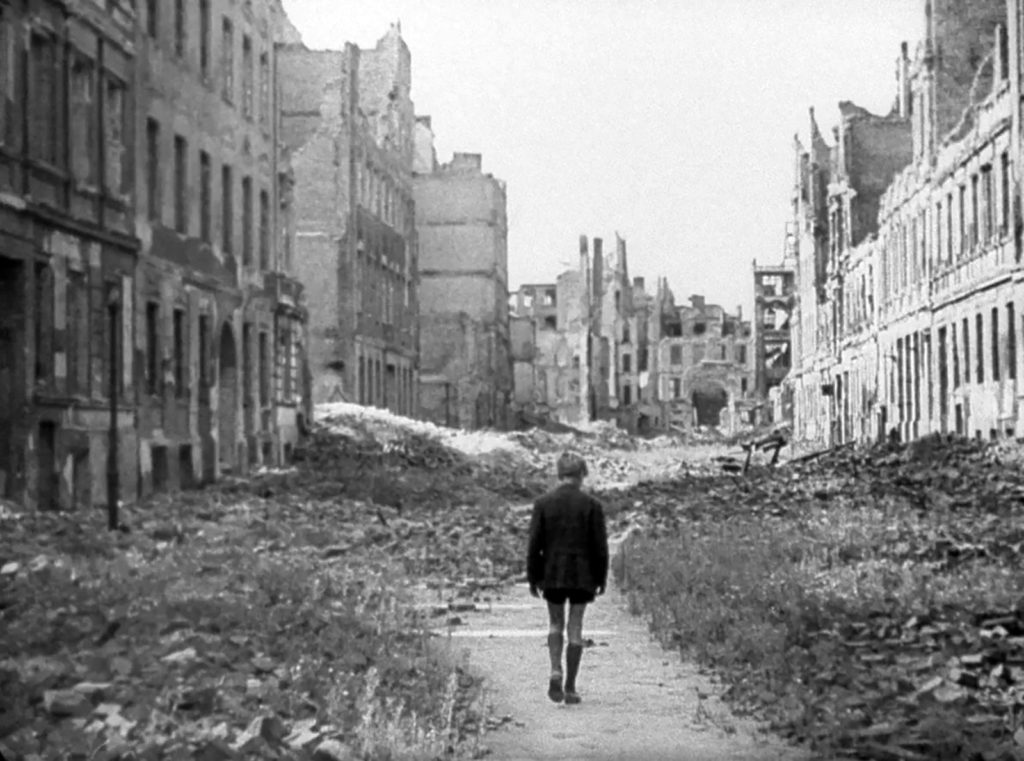
It was then that Roberto Rossellini, a guest of the French government, walked through the ruins of Berlin with a camera. Germany, Year Zero18 – shot in 1947 and released in 1948 – shows what the Spruchkammern failed to see: the mental structures of Nazism survive beneath the rubble, and the vehicle of that survival is the schoolteacher. The film gives tangible form to Arendt’s intuition.
Edmund Köhler is twelve years old. He wanders through the ruins, digs out whatever he can from the rubble and brings a few marks home to his family. His father is ill and bedridden; the family scrapes by in a shared flat, in cramped quarters and hunger.
One evening, by candlelight – an almost liturgical scene – the father speaks from his bed. The words fall slowly, addressed to his children: “Yet let us be aware of our faults… we are paying for our mistakes… We foresaw the disaster without preventing it.” And above all: “I should have rebelled, but I was weak, like many of my generation.” Jaspers’s categories are recognisable – moral, political and metaphysical guilt – but filtered through intimate confession, before Edmund, who listens without understanding everything. The father is not passing on a lesson – he is pronouncing a sentence upon himself. He declares himself weak. He declares himself guilty. He does not yet know that someone else, outside, will teach his son what is to be done with the weak.
For there is Henning, the former schoolteacher. A Nazi still intact, he speaks to the boy as one would speak to a soldier. What he teaches is no longer Nazism as an identifiable ideology, swept away by defeat. What survives is the bedrock on which it had been built: a crude social Darwinism, stripped of its ideology, reduced to its core. “Resign yourself to it, he’s old. You have to have the courage to eliminate the weak. The weak make way for the strong.” And then that gesture, amid the ruins, when he points to a tree behind a railing: “You’ll get over it, look at nature.” Parties can be dissolved; it is not so easy to dissolve the idea that weakness is a fault and that nature itself commands that it be eliminated. Between these two pieces of adult advice, Edmund arrives at a tragic synthesis: he kills the one who has declared himself weak and who has pronounced the sentence upon himself.
“Year zero” ought to have been a fresh start. But Rossellini films a continuity: the mental structures of the regime still survive in the rubble. Year zero never really happened, and it is of this absence that Edmund dies, throwing himself from the top of a dilapidated building.
While Rossellini was asking “What remains of Nazism in people’s minds once Nazism has lost the war?”, the Spruchkammern were being drained of their substance; certificates of good conduct circulated like paper money – they were called Persilscheine, washing-powder certificates. Reconstruction encouraged whitewashing all and sundry.
The mirror was there, but Adenauer’s Germany was learning to look away. It was amid this consensual amnesia that Erich Maria Remarque published A Time to Live and a Time to Die in 1954. The novel no longer asks Rossellini’s question – what does Nazism do to a child? – but the one that comes before it: what can a grown man do when he knows, and must return to the front in 1944? Rossellini looked at a child who had not yet reached moral awareness; Remarque scrutinises a soldier who is beyond excuses. Edmund dies of understanding too late what he has done; Ernst Gräber suffers from understanding what he goes on doing. Between the two works lie nine years – and the failure of the Spruchkammern to settle collectively what Jaspers had left to each individual’s conscience.
In 1958, Douglas Sirk adapted the novel under a different title, A Time to Love and a Time to Die19, of which Godard wrote: “I have never believed so much in wartime Germany as when watching this American film shot in peacetime20“, highlighting its darkness and the impossibility of shutting one’s eyes as tightly as one might wish.
Sirk – born Detlef Sierck in Hamburg – had left the Reich in 1937 because his second wife was Jewish. He had been separated from his son Klaus, who was placed in the care of his first wife, a Nazi sympathiser who had all contact banned. The boy became an actor in propaganda films before being sent to the Eastern Front. He died in 1944 near Novooleksandrivka, in Kherson Oblast21. Sirk could see his son only at the cinema, in films approved by Goebbels. To film A Time to Love and a Time to Die was to imagine the final weeks of a son whose story he would never know – and to give a fictional soldier the awareness that his own son had perhaps never had.
In the film, Remarque himself plays Professor Pohlmann – a character who refuses easy answers, in a scene that is the moral centre of the book.
Gräber returns from the Eastern Front on leave. He knows that the war is lost, that the camps exist, that the machinery keeps running “so that those responsible for it can stay in power a little longer”. He goes to see his former teacher – forcibly retired, holed up in a flat with a paraffin lamp as his only light and his books as his only company. Catacombs amid the ruins – the last refuge of what Pohlmann calls, without naming it, conscience.
Gräber puts to him the question that Jaspers would formalise into concepts but which Remarque brings to life as an inner drama: where does my complicity begin? Not “am I guilty?”, but something more demanding, which has already moved past the ordinary excuses – orders, propaganda, ignorance. He names the entire continuum: the lies, the oppression, the camps, the massacres of civilians.
Pohlmann refuses to answer. Neither absolution nor condemnation – he sends Gräber back to himself. He sets aside the answers of the Church, which can play both sides – “Thou shalt not kill” on the one hand, “Render unto Caesar…” on the other. It thus enjoys a certain “room for manoeuvre”. Then it is the old teacher who accuses himself: “But we, we who saw everything and let it happen! Why? Sloth of the heart? Indifference? Selfishness? Despair?” Nine years on, one hears the intertextual echo of Edmund’s father – “I was weak, I let it happen”. But where the father’s confession fell into the void, Pohlmann’s opens up a space: he includes himself in the guilt so that Gräber can reckon with his own. An inner Nuremberg.
In 1947, Rossellini filmed a poison that outlived the regime’s demise and spread through a child’s mind as it did through the tea served to his father. Ten years later, Remarque and Sirk posed the question of what comes next: what does one do with the poison once it has been identified – and one must still go back to the front? In Russia, the poison is state policy and guilt is manufactured at the pace of the crimes.
Karabash, seventy-five years on
Talankin’s documentary is the contemporary mirror of Rossellini’s film. Abdulmanov, Karabash’s Stalinist history teacher, teaches that “whoever does not love his homeland is a criminal” – he passes on a catechism of death through the Monday-morning lesson, the repetition of slogans and a gradual familiarity with violence that the children learn no longer to discern.
The teachers of Karabash do not question their complicity. When Talankin suggests to them that they stop, they acknowledge the absurdity – then fall silent. Conformity is the condition of normality, and the cost of refusal seems too high to them. Primo Levi called this space where complicity merges with survival the grey zone22; the teachers of Karabash inhabit it without knowing it.
There is no Pohlmann in Karabash. Abdulmanov, the history teacher and admirer of Beria, is like Rossellini’s Nazi schoolteacher, but his country is still undefeated. Nor is there a Graeber either: Remarque trapped his character in a moral topography with no way out – but Graeber named the trap. In Russia, the question can be framed only at the cost of exile or prison; silence ceases to be mere fear and becomes the very fabric of daily life.
If Varlam Shalamov said of the camp that it was a “negative school of life23“, the school in Karabash is a school of death disguised as a school, full stop. There, children learn to consent to not thinking. When mobilisation comes, former pupils leave, and some return in coffins. Edmund threw himself from a Berlin building in despair: the children of Karabash throw themselves, unknowingly, into the meat grinder of the Donbas. The path differs, the logic remains: indoctrination manufactures bodies for death.
Rossellini showed that the fall of a totalitarian regime does not undo the ideas it has implanted. Talankin reveals something worse: an undefeated totalitarianism can begin again indefinitely – with the same methods, the same masters, different children.
Is there no alternative to this silence? When Graeber obtains his leave, in the spring of 1944, a threshold has been crossed in Germany. Since Goebbels’s total war speech in February 1943, mobilisation has absorbed the whole of civilian life: there is no longer any neutral space where one might simply not take part. Remarque trapped his character in a society with no room to say no. Putin’s Russia is brutally repressive – but it has not reached that point. Gaps remain, which make possible the act of Mister Nobody and render the silence of others harder to excuse. By taking his rushes with him, Talankin strips silence of its alibi.
He tells us: “I would like to be as brave as those who protested. But I am not.” A clear-sighted self-examination – the kind Jaspers placed at the heart of moral guilt – carried out with a severity no one imposes on him.
The debts
All of the above lends us an illusion of comfort: the crime would be over there, in a foreign language, in Russian uniforms. Jaspers foresaw this evasion and distinguished four kinds of guilt – criminal, decided by the judge; political, imposed by the victor; moral, which only conscience can examine; and finally metaphysical, which Jaspers referred to God: one may ignore it, but one cannot shake it off. But what if one does not believe in God? Guilt – born of the mere fact of knowing and not acting – does not grow lighter: it loses its judge but not its grip. Does it become heavier to bear alone? At any rate, it leaves only one way out: to act.
Before 2022, Europe preferred not to see. Since 2022, it has failed to grasp the nature of the war Russia is waging. Ukraine, by resisting alone where abandoned Czechoslovakia could not in 1938, is buying Europe time26. But it is paying for it in blood.
It does not stop at the borders of the criminal state. It reaches anyone who knows of crimes committed not in some distant blur, but before their eyes or to their knowledge. And Jaspers goes all the way: whoever is present at the murder of another without risking their life to prevent it bears a guilt that neither law, nor politics, nor morality can grasp – “That I go on living after such a thing has happened weighs on me as an indelible guilt24.”
Europe knows. It has known since Bucha, since the ICC warrants. But it converts this knowledge into a timetable – summits, caution, processes. The fog does not shroud Moscow alone; it has spread to our capitals in the form of weariness, which passes itself off as fate.
What is happening in Europe is not merely a matter of metaphysical guilt. It is also a matter of political guilt – the guilt that falls on every citizen for the acts of the state under which they live. For Jaspers: “Failure to cooperate in organising power relations in the service of justice gives rise to political and moral guilt25. “ Yet European citizens do not live under a dictatorship. Their silence is a choice – and their support for Ukraine, which they know to be inadequate, is another.
What Ukraine is defending for Europe is not territory – it is the fragile idea of an order founded on law, the dawn that Jaspers saw in Nuremberg. If that idea still holds, it is because Ukrainians are dying for it. To speak of “aid” to Kyiv is therefore a misuse of words: it is a debt.
Before 2022, Europe preferred not to see. Since 2022, it has failed to grasp the nature of the war Russia is waging. By resisting alone, where an abandoned Czechoslovakia could not in 1938, Ukraine is buying Europe time26. But it is paying for it in blood. This is the most tangible form of the debt – one that turns into guilt and grows heavier with every day we delay.
A future Nuremgrad presupposes, first, the collapse of the Putin system – a Russia at year zero. It cannot be confined to criminal justice; it will have to reopen what Putin sealed shut – a society’s reckoning with the truth of its past. And it will concern not Russia alone but Europe too – not as judge, but as debtor.
And then there are the children. Those of Karabakh, whose path leads not to a diploma but to a uniform, and often to a coffin. Those of Ukraine, deported to centres where language, identity and memory are erased. If Nuremgrad does not come to pass, the former will be the soldiers of the next war. The latter will no longer know which war they were the victims of.
Pierre Raiman
PhD in History, specialist in totalitarianism and co-founder of the association Pour l’Ukraine, pour leur liberté et la nôtre !
Notes
- In German, Vergangenheitsbewältigung – a term coined in 1955 by the historian Hermann Heimpel – means “coming to terms with the past” and refers to denazification. Heimpel, who had initially compromised himself with the Nazi regime, acknowledged his political responsibility after the war.
- Raphael Lemkin, “Soviet Genocide in the Ukraine”, speech of 1953, in Raphael Lemkin Papers, The New York Public Library, Manuscripts and Archives Division.
- Karl Jaspers, Die Schuldfrage, Lambert Schneider, Heidelberg, 1946; French translation, La Culpabilité allemande, Paris, Minuit, 1948.
- Hannah Arendt, “Organized Guilt and Universal Responsibility”, published in Jewish Frontier under the title “German Guilt” in January 1945.
- Pavel Talankin, David Borenstein, Mr Nobody Against Putin, PINK, Copenhagen, 2025.
- Vladimir Putin, annual broadcast, “Results of the Year with Vladimir Putin”, TASS, 14 December 2023. Putin repeats a phrase he attributes to Bismarck.
- Joseph Stalin, 26 October 1932, at Maxim Gorky’s home. Quoted by Frank Westerman, Engineers of the Soul: In the Footsteps of Stalin’s Writers, Vintage, London, 2011.
- Pierre Raiman, “Éclats d’Ukraine – Journal de livraisons“, Desk Russie, January 2026.
- Olga Medvedkova, “Monsieur Personne au pays de Poutine“, Desk Russie, January 2026.
- Sanshiro Hosak, “Putin’s counterintelligence state. The FSB’s penetration of state and society and its implications for post-24 February Russia”, International Centre for Defence and Security, Estonian Foreign Policy Institute, December 2022. Quoted by Jean-Jacques Rosat, L’esprit du totalitarisme, George Orwell et 1984 face au XXIe siècle, Part III, “Les trois principes d’O’Brien”, Hors d’Atteinte, 2025.
- The archives of the Central Committee, seized by pro-Yeltsin forces in August 1991, were briefly opened at the instigation of the historian Rudolf Pikhoia (RosArkhiv). As early as 1992, a presidential decree reinstated Soviet secrecy regulations. See Amy Knight, “The Secret Files of the Soviet Union”, The New York Review of Books, 16 January 2020; Theodore Karasik, Soviet Archives after 1991, RAND Corporation, 1993.
- Norman M. Naimark, Les Génocides de Staline, Paris, L’Arche, 2026. Roman Serbyn, “Lemkin on Genocide of Nations”, Journal of International Criminal Justice, vol. 7, 2009.
- Hannah Arendt, “Organized Guilt and Universal Responsibility”, op. cit.
- Article 5 of the Charter of the association Pour l’Ukraine, pour leur liberté et la nôtre!
- “Organized Guilt and Universal Responsibility”, op. cit.
- Lutz Niethammer, Die Mitläuferfabrik, Die Entnazifizierung am Beispiel Bayerns, Dietz, Berlin, 1982. Published in 1972 under the title Entnazifizierung in Bayern.
- Department of State Policy Statement, “Completion of punishment of war criminals and major Nazi offenders as concluding stage in penal and denazification procedure”, Foreign Relations of the United States, 1948, Germany and Austria, Volume II, 26 August 1948.
- Roberto Rossellini, Germania anno zero, UGC, Tevere Film, Salvo D’Angelo Produzione, 1948.
- Douglas Sirk, A Time to Love and a Time to Die (Universal Pictures, 1958).
- Jean-Luc Godard, “Des larmes et de la vitesse”, Cahiers du cinéma, Paris, April 1959.
- Jon Halliday, “Conversations avec Douglas Sirk”, Cahiers du Cinéma, Paris, 1997.
- Primo Levi, The Drowned and the Saved. Forty Years After Auschwitz, Chapter II, “The Grey Zone”, Gallimard, Paris, 1989.
- Varlam Shalamov, On Prose. Quoted in Luba Jurgenson, Le semeur d’yeux. Sentiers de Varlam Chalamov, Verdier, 2022.
- Die Schuldfrage, op. cit., chapter “Scheme of Distinction”, section “Four Concepts of Guilt” in the English edition, Fordham University Press, 1947.
- Die Schuldfrage, op. cit., section “Methaphysical Guilt”.
- Timothy Snyder, “17th Lennart Meri Conference”, Tallinn, 19 May 2024.
Translated from French. The French original prevails.