As Switzerland confirms that Geneva will host a major international gathering on artificial intelligence on 21 and 22 June 2027, the international city is stepping up its efforts to position itself on AI governance. As part of this drive, the Geneva AI Governance Institute (GAIGI), a young Geneva-based foundation, intends to play its part by fostering dialogue between technology, diplomacy, international standards and the countries of the Global South.
After humanitarian action, global health, human rights and international trade, Geneva now wants to open a new chapter in its history: that of artificial intelligence diplomacy.
The message delivered by Switzerland this week at AI for Good is unambiguous. In the face of a technological revolution that is already transforming the economy, security, information and the balance of power between states, the challenge is no longer simply to develop the most powerful tools. It is now to build the conditions that allow societies to trust them.
In Geneva, the Swiss authorities have confirmed a long-awaited milestone: on 21 and 22 June 2027 the city will host a major new international gathering devoted to artificial intelligence. The announcement confirms the Confederation’s determination to position International Geneva as one of the places where researchers, technology companies, international organisations, governments and civil society can meet.
Switzerland does not claim to compete with the world’s great hubs of technological innovation. Its ambition is different: to offer a neutral space where the rules of the game can be discussed. In a world where artificial intelligence is becoming a new issue of sovereignty and strategic competition, this mediating role could become essential. For the central question is no longer simply: “What can artificial intelligence do?” It is becoming: “Under what conditions can we trust it?”
It is against this backdrop that the Geneva AI Governance Institute (GAIGI) is emerging in Geneva. Set up at the initiative of Axel Mazolo, this young Swiss foundation is part of this new momentum. Its ambition is not to take the place of the major international organisations already engaged in thinking about the future of AI, but to make a specific contribution: building bridges.
GAIGI defines itself first and foremost as a catalyst and a facilitator: a space capable of bringing together worlds that rub shoulders but do not always speak the same language – engineers, diplomats, researchers, public decision-makers, entrepreneurs and representatives of civil society.
This approach starts from a simple observation: trust in artificial intelligence cannot be imposed by decree. It will have to be built. It will require standards, certification mechanisms, principles of transparency and, above all, the ability to reconcile differing visions of regulation. That is the whole purpose of the Geneva AI Trust House 2026, organised by GAIGI on the sidelines of AI for Good.
Over several days, this international gathering brings together figures from very different backgrounds to reflect on the foundations of responsible and inclusive AI. The speakers include Muhammadou M. O. Kah, Priya Pansare, Touradj Ebrahimi, Vincent Subilia, Alexandre Vautravers and Caroline Vuillemin. The choice of these profiles reflects a conviction: the governance of artificial intelligence can no longer be considered from a purely technological standpoint.
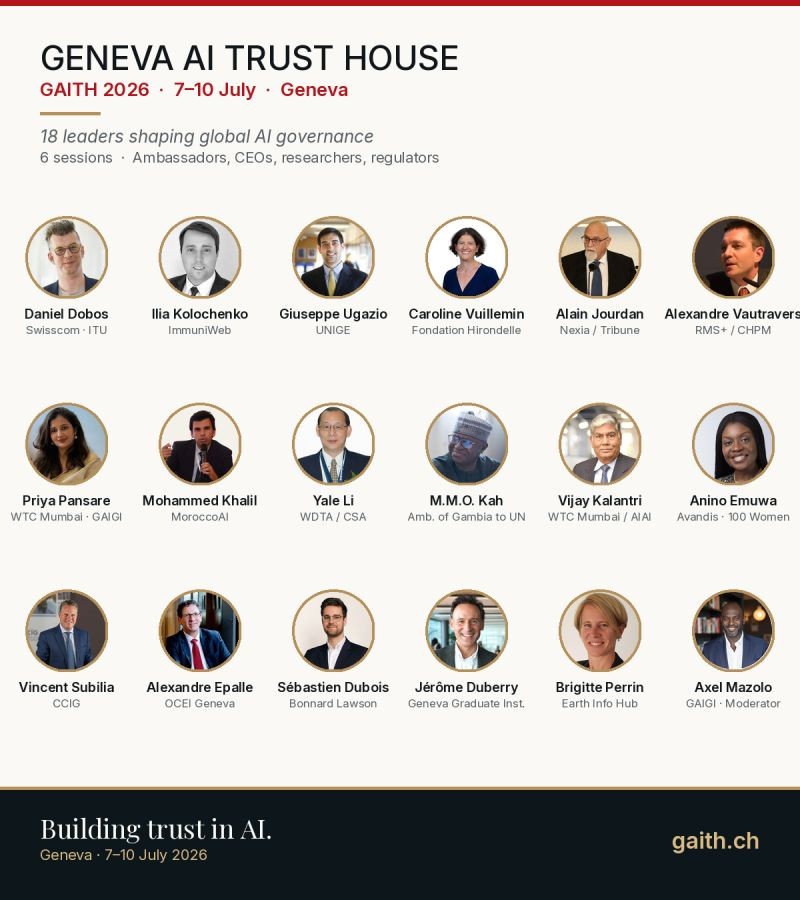
It has become an economic, geopolitical and societal issue. The discussions therefore tackle the major questions that will shape the coming years: how can trustworthy AI be certified? How can global fragmentation between several competing models be avoided? How can the interoperability of standards be ensured? How can citizens be protected while innovation is preserved?
Particular attention is also being paid to the countries of the Global South. For GAIGI, there is a major risk: that artificial intelligence will reproduce the divides already seen in previous industrial revolutions, with a handful of countries producing the technology and most states reduced to the role of dependent users. Global AI governance will therefore have to address training, access to infrastructure, digital sovereignty and the representation of emerging economies.
This concern is in keeping with Geneva’s historical DNA: bringing different actors into dialogue to forge international compromises. As the June 2027 meeting approaches, the emergence of initiatives such as GAIGI reflects a deeper shift in International Geneva. Alongside the established institutions, new, more agile actors are appearing, able to experiment, connect networks and support a global debate that is still taking shape.
The battle over artificial intelligence will not be fought solely in laboratories or data centres. It will also be fought over the international community’s ability to create a common language. From Geneva, GAIGI intends to contribute to this collective ambition: turning trust into architecture.
Behind the scenes at GAIGI: in Carouge, a start-up spirit in the service of artificial intelligence diplomacy
Just a few kilometres from the Palais des Nations, a small team in Carouge has spent several months working to launch a new initiative in Geneva’s artificial intelligence ecosystem.
Officially incorporated and recognised as a Swiss foundation, the Geneva AI Governance Institute (GAIGI) is moving forward with a deliberately agile structure: a small team, strong collective commitment and a culture close to that of a start-up.
Around its founder, Axel Mazolo, researchers, experts, entrepreneurs and governance specialists meet regularly to turn ideas into concrete projects. In premises that have become a genuine operational laboratory, strategy meetings follow one after another, partnerships take shape and the international network continues to grow.
This momentum also reflects a broader transformation of International Geneva. Alongside the long-established institutions, new players are now emerging that are able to experiment quickly, bring expertise together and offer complementary responses to the major global challenges.
GAIGI’s journey is a reminder that institutional innovation, too, can run on the energy of a start-up: a small team, a clear vision, a great deal of commitment and the determination to contribute to an issue that extends far beyond the realm of technology alone.
That of building trust in the age of artificial intelligence.
Translated from French. The French original prevails.