ByJean-François Bouthors in partnership with Desk Russie
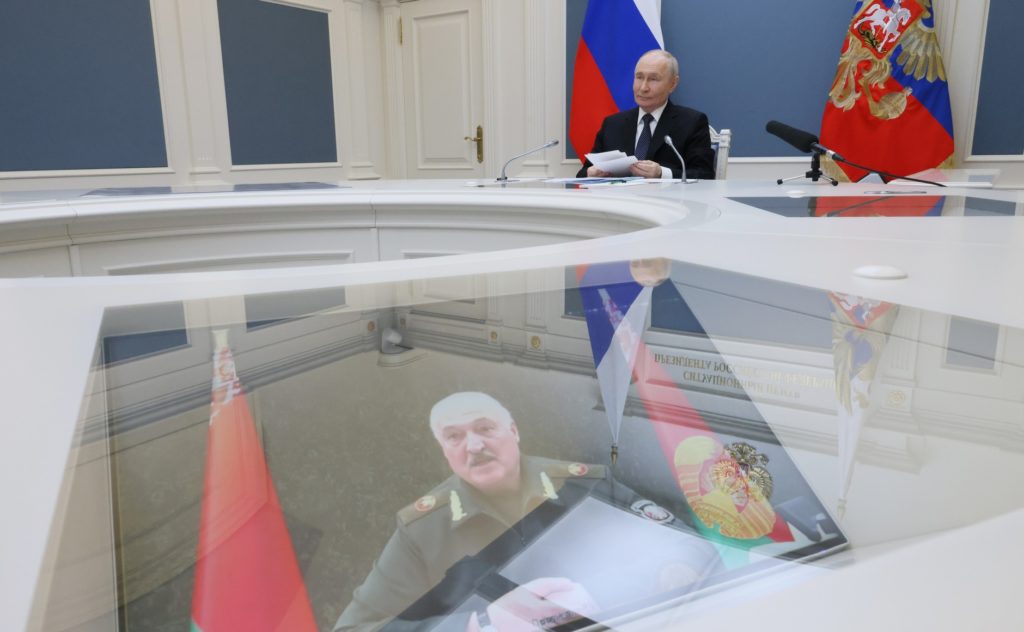
The West is surprised to see Ukraine regaining the initiative. Yet it was foreseeable that Putin would reach the end of the process, suicidal for Russia, that he set in motion with his “special military operation”. He no longer has any “good solutions” for breaking the deadlock, and he may fear a palace revolution. While it is impossible to know when he will fall, the question that arises is how to deter him effectively from resorting to nuclear weapons.
The situation is deteriorating seriously for Vladimir Putin. The war of attrition he sought to impose on Ukraine, after the failure of his attempt to take Kyiv within a few days and topple Volodymyr Zelensky’s legitimate government, is turning against him. The Kremlin is not alone in being taken by surprise. In Western countries, few had understood, from the very start of the “special military operation”, that Ukraine was lost to Russia simply by virtue of its decision to invade, and that the consequences would be devastating for the aggressor country. Apart from a handful of specialists and journalists with a good knowledge of Ukraine, its culture and its history, nobody thought so.
A flawed analytical framework
From the outset, the conflict was viewed essentially through the prism of the balance of military power inherited from the Cold War, against the backdrop of the memory of the two world wars, and of the Battle of Verdun in particular. Through this lens, it seemed logical to give Russia the advantage. As early as spring 2022, geopolitical analysts, military officers and diplomats could be heard explaining that Ukraine would have to give up Crimea and the Donbas. This mindset shaped the Western response, leading to cautious and limited support. The priority was above all to keep Ukraine from collapsing, without running the risk of crossing the “red lines” set out by Moscow or simply imagined by leaders and observers who did not realise the extent to which they had been targeted by Russian influence operations for years. That was to reckon without the courage and determination of the Ukrainians, who had decided to resist. Those who, like the authors of Desk Russie, tried to explain that Ukraine would not give in, that it would not give up and that it had solid moral and tactical resources were barely listened to.
It also meant misreading Russia’s political, social and military realities and clinging to old clichés – carefully cultivated by Moscow – about “the Russians” being “capable” of suffering without rebelling, about the Russian army that gives way first and wins afterwards, as in the days of Napoleon and Hitler, and so on. Many observers and diplomats confined themselves to the headline figures of the Russian economy, in particular GDP growth driven by the boom in the war industry, without distinguishing between the civilian and military sectors, and without analysing Russia’s dependencies and structural weaknesses. This amounted to adopting Putin’s own view of his country and allowing ourselves to be blinded by his propaganda.
Such a stance, widely shared, led people to believe, as the master of the Kremlin believed – as he still believes, or pretends to believe –, and as his sycophants at home and abroad kept repeating, that a Russian victory was inevitable. Thus this hypothesis, which had yet to be put to the test of reality and time, was taken for a quasi-scientific truth. When what was needed was to examine, week after week, what was happening in Russia in the spheres of power, the economy and the judiciary, in order gradually to identify their meaning and the changes under way, and to discern what this revealed about the state of Putin’s regime, people were content to declare that the Kremlin was an unfathomable black box. This justified a certain analytical laziness, it made it impossible to understand what was taking place, and it deprived Western public opinion of the information needed to grasp what was at stake in the conflict and how it was evolving.
Commentators have often preferred to invent a new register of discourse and of “journalism”: commentary on the imaginable future – a genre that has also been used and abused in relation to the US-Israeli war in Iran. Thus it was announced countless times that Kyiv’s troops were on the verge of collapse and that Ukrainian society could take no more. There was endless discussion ad nauseam of the highly improbable outcome of negotiations whose framework had not been carefully defined and whose American participants were conspicuous for their incompetence, and there was even speculation about a possible resignation by Zelensky under pressure from Donald Trump, when what mattered most for Ukraine was to find ways of buying time and of thwarting Putin’s attempt to exploit the U-turns of the erratic 47th President of the United States to his own advantage. Yet the Ukrainian retreat was kept under control, and the army’s leaders have never ceased drawing lessons from the front, seeking new responses to Russian attacks and inventing innovative ways of waging war.
Ukraine is defending NATO
It is worth noting in passing that the armed forces of NATO countries and their defence industries have been very slow to grasp that the art of war was being profoundly transformed by what the Ukrainians were doing. They are only just beginning to draw operational lessons from it. Should the Atlantic Alliance not, for example, build a “drone wall” along the border between the Baltic states and Russia or Belarus? What monitoring is there of organisations – mafia or otherwise – liable to trigger Russian-speaking “rebellions” on the model used in Transnistria from 1990 and in Donbas in 2014?
Since the start of the conflict, Europeans have discovered just how wrong they were to spend the “peace dividend” so carelessly after the end of the Cold War, deluding themselves about the strength and power of NATO. The intensity of the war on their doorstep has shown that the NATO shield is decidedly moth-eaten. There is an urgent need to restore it or to build a serious European defence without relying too heavily on the United States, but this will take time and a determination that is not yet fully in evidence. This state of affairs leaves us gravely weakened. So much so that one may wonder whether it is not now Ukraine that is defending the NATO countries, rather than NATO that is supporting Ukraine. Both, of course, but it must be acknowledged that the Ukrainians’ role has now become essential. Had they not held firm, we would be in a terribly difficult situation in the face of the threat posed by Putin.
The future of the war will be decided on the aggressor’s soil
In Kyiv, of course, people paid close attention to what was happening in Russia, having quickly understood that the future of the war would be decided on the aggressor’s soil, precisely because of the nature of the Russian political regime. This is what the West, and the Americans first and foremost, refused to see, for a very long time preventing Ukraine from acting inside Russia. Kyiv forced its way through, and that was the primary objective of the offensive in the Kursk region, launched exactly two years ago. The Ukrainians have shown that strikes on Russian oil infrastructure have a threefold effect: complicating Russia’s military operations, making the population, including in Moscow and St Petersburg, feel the weight of the war, and shaking the internal balance of Putin’s power.
Until then, the Western approach had been to try to limit the damage of Russia’s aggression in order to secure negotiations on terms as favourable as possible to Ukraine. Yet as long as the consequences of the war were not being felt inside Russia, the Kremlin had nothing to lose by pressing on with its “special operation”, apart from troops. But in the society that emerged from Soviet rule, human life is worth little, perhaps even less since the advent of the unbridled capitalism that flourished on the ruins of the USSR. All Putin had to do was symbolically link the losses to the glorious sacrifices of the Great Patriotic War (the Second World War) to flatter national pride, and offer hard cash in compensation. This “economy of death” worked well… The fuel shortages and recurrent internet outages that result, directly or otherwise, from Ukrainian strikes on Russian territory are far less well tolerated by society, because they deeply affect the economy.
Russia can no longer afford to sustain its war effort
With the “special military operation” now in its fifth year – already outlasting both the 1914-1918 war and the Great Patriotic War (1941-1945) – it is becoming clear that Russia, despite the “financial provisions” it had built up for the purpose, lacks the means to sustain its war effort for much longer. Its economy, though boosted by the military industry, remains too small – its GDP is lower than Italy’s. Its territory is far too vast to be defended against long-range drones. Its vulnerability is therefore at its peak. Yet it has no allies willing to support it in a way comparable to what Western countries are doing for Ukraine. Today we can see how illusory was the argument that Moscow could count on the support or indifference of the Global South, while the Western democracies were supposedly “isolated”. The partnership with Beijing, however “unshakeable” and “unprecedented” it may be according to Xi and Putin, is limited by the global ambitions of China, which has a vital need to preserve its economic exchanges with Europeans and Americans.
In Moscow, the deadlock is so evident that Putin has spoken out to show that he is aware of the difficulties and to try to reassure his fellow citizens. There is no doubt that this messaging fools no one. The regime is so accustomed to concealment that the mere fact of Putin speaking about what is going wrong shows how grave the moment is. But public opinion is not a real problem for the Russian president. He knows there will be no popular revolution. Those who could lead one are all under close surveillance, when they are not already in prison (the number of political prisoners is estimated at between 1,400 and 2,180, depending on the source). On the other hand, he has everything to fear from the oligarchs and the siloviki, two closely intertwined circles that are, moreover, intrinsically linked to organised crime: they will want to protect their interests.
For now, the Russian president has no solution for reviving the economy. The budget deficit is soaring – by mid-year it was already twice the annual forecast – and the government no longer has the means to cover it, all the more so as the price of crude has plunged again since Washington put the war in Iran on hold. At the same time, inflation is picking up again as fuel prices rise. While Herman Gref, the head of Sberbank, is calling for an urgent cut in interest rates, saying that “the economy simply cannot survive for long” at current rates, the Governor of the Central Bank is worried about public finances spiralling out of control and about the possibility of prices moving beyond any control. She has hinted that it would be very difficult to meet demands for an easing of the cost of borrowing.
Likewise, the problem of the army’s dwindling numbers, now that losses (1,000 men a day at present) outstrip the pace of recruitment, remains intractable. Against this backdrop, the idea of a general mobilisation, toyed with by some, could be the straw that breaks the camel’s back of popular discontent, all the more so as nobody really believes any longer that the Russian army is on the verge of winning. With no prospect of victory, sacrifice for the motherland no longer makes sense, when ending the war would be enough to stem the haemorrhage and bring Russia back to “normal”. State and regional finances cannot stretch to raising the already very high signing-on bonuses offered to new recruits : it is now known in Russia that their life expectancy does not exceed a few weeks after they arrive at training camp. It is also known that the newcomers’ “windfall” fuels appalling extortion: many commanders hold their men to ransom, offering them, in exchange for payment, a way to avoid being sent on the “meat assaults”, from which up to 80 % of soldiers do not come back alive.
The real risk of a palace revolution
The president’s inner circle appears solid and loyal, but the generational effect must be taken into account. Putin came to power with a group of men of his own age who know that they have lived most of their lives and do not have a long future ahead of them. Barring surprises, these men do not want change, from which they would have everything to fear; they will not try anything against him – he knows them inside out and has a hold over them, just as they have a hold over him. But for those who are ten or twenty years younger, it is a different matter. And some of them hold powerful positions.
Take, for example, Igor Sechin, the head of Rosneft and Deputy Prime Minister from 2008 to 2012. Born in 1960, he has placed his own men in oversight and investigative posts in both the FSB and the GRU. This close associate of Putin is undoubtedly one of the most powerful and feared men in Russia, but his interests are seriously endangered by the current situation. Younger still is Alexei Dyumin, born in 1972. A lieutenant general and adviser to the President, he has served as head of his security detail, commander of the army’s special forces and deputy head of the GRU. He therefore knows a great deal about the Russian President and his protection… It was he who persuaded Prigozhin to halt his march on Moscow in June 2023. He has no reason to want to go down with Putin. The same goes for the young Dmitry Patrushev, born in 1976, Deputy Prime Minister for Agriculture, but also a banker and former member of Gazprom’s board of directors. He benefits from the network of his father, Nikolai Patrushev: this long-standing fellow traveller of his friend “Vladimir Vladimirovich” headed the Security Council and may be one of those overseeing the shadow fleet at the highest level since becoming “Chairman of the Maritime Board”.
These are only three examples, but they speak volumes. Were this generation to rid itself of the man who increasingly seems to be turning the “special military operation” into his war – a personal matter – it could present itself as the generation of a Russian “reset“, towards Ukraine and the West alike. It would not be hard for it to argue that it is in Moscow’s interest to return to calmer relations, and it could, without a qualm, make the older generation carry the can for the war.
The question for Putin, then, is how to forestall a palace revolution. It is perhaps in this light that two recent arrests should be read. The first is that of Mikhail Poluboyarinov, 60, a former chief executive of Aeroflot and an executive at Rostec (the Russian state-owned high-technology corporation), who is accused of corruption in a case dating back to 2016. The fate of this wealthy apparatchik could be a way of signalling to younger figures that they would do well to keep their heads down. The second is that of Ilya Traber, well known in Russian mafia circles by the nickname “the Antiquarian”, who is accused of murder. This arrest is all the more striking given that Traber had until now been untouchable. In the 1990s, the former submariner played a key, indeed indispensable, role in the “forceful”, not to say “bloody”, takeover of the port of St Petersburg by Putin’s associates, with the help of the Tambov mafia, of which he is reputed to be one of the leaders. This was at the time when Putin was overseeing the city’s financial and commercial relations, a task entrusted to him by the then mayor, Anatoly Sobchak. Arresting Traber would have been impossible without the Russian president’s approval. Everyone at the highest level must therefore understand that Putin’s protection can be withdrawn and that grounds for an arrest can always be found. No one is protected for ever, not even those who have rendered the most eminent services to the “boss”.
At the start of the war, when victory looked inevitable from the Kremlin’s vantage point, the arrests of business figures served mainly to free up posts and sinecures to hand out as rewards. Until last year, under the aegis of the Prosecutor General of Russia, they formed part of a sweeping reallocation of privileges designed to tighten the grip of a select group of siloviki on the country’s economy and wealth. Today, they betray the leader’s nervousness. This attempt to tighten control over his inner circle, amid growing paranoia, does nothing to change the fact that the course of the war is slipping ever further from Putin’s grasp, as Ukraine becomes more effective in its strikes on Russian territory and chokes off Crimea, as well as the Russian army’s logistics in the Donbas.
It is also known that the security services are at daggers drawn, particularly since the attempted assassination of General Vladimir Alekseyev, deputy head of the GRU, one of whose arrested perpetrators turned out to be a man linked… to the FSB. Likewise, a clan war appears to be under way within the Ministry of Foreign Affairs (MID), where Mikhail Bogdanov, the president’s special representative for the Middle East, was removed from office last year, at a time when his responsibilities there included overseeing private military companies (it is worth recalling that it was in Syria that the “Wagner” fighters cut their teeth). Yet the MID’s Arabists, linked to the KGB/FSB, who now feel sidelined since their leading figure was ousted and then charged, were traditionally, and until recently, a force to be reckoned with. One need only recall the career of the most famous of them, Yevgeny Primakov, who was a potential successor to Boris Yeltsin. Primakov, who was amicably asked to step aside in 2000 so as not to complicate Putin’s first presidential election. Which he did…
The time for deterrence has come
Distrust is therefore spreading, and in this climate anything becomes possible. Putin knows it… and he is no longer in a position to halt the process he set in motion on 24 February 2022. The question is not whether he will fall, but when and how. Admittedly, it is impossible to know the answer, but the question will not vanish from the Kremlin master’s horizon. Quite the opposite: it will obsess him ever more. Putin has no way out. The clearest proof of his weakening is that Alexander Lukashenko, the Belarusian president, has just bowed to pressure from Zelensky and switched off the signal repeaters that help guide the Russian missiles and drones striking Ukrainian territory. Even Russia’s grip on its Belarusian “satellite” is loosening!
That leaves the possibility of a headlong rush forward through the use of nuclear weapons. The wounded beast could tip over into irrationality and attempt an act of madness, some in the West say, and the 24-hour news channels feast on this, unwittingly playing into Moscow’s hands. But implementing such a decision is not simply a matter of pressing a red button. The reality of the chains of command and of carrying out such a decision is considerably more complicated. Be that as it may, the debate is back on the agenda. And of course, Moscow is making sure that it is, through its favourite propagandists…
Brandishing this threat will not halt the process that is leading Russia towards the moment when it will have to admit its failure. Rhetoric about the bomb will not save Crimea, which Moscow is unable to defend. In reality, the very use of a nuclear weapon would immediately seal the outcome of the war, to Moscow’s detriment: it would be condemned worldwide, not to mention the reprisals that would inevitably rain down on the Russian army and/or Russian territory. The important question, therefore, is not the one being bandied about in television studios – whether or not Putin will dare – but how to make the Kremlin understand today that it cannot under any circumstances resort to “the bomb”. More than ever, then, this is the time for deterrence. What message are Paris, London, Washington and Beijing giving it? Are France, Britain, the United States and China – four of the five permanent members of the UN Security Council, all nuclear-armed – speaking with one voice to defuse the nuclear scenario? Putin must hear from them that he has not the slightest possibility of using it. As if by chance, Lukashenko, who talks to everyone, travelled to Beijing at the end of June…
Jean-François Bouthors is a journalist and essayist, a contributor to the review Esprit and a leader writer at Ouest-France. He is the author of several books, including Poutine, la logique de la force (Éditions de l’Aube, 2022) and Démocratie: zone à défendre ! (Éditions de l’Aube, 2023). With Galia Ackerman, he edited Anna Politkovskaya’s books for Éditions Buchet/Chastel.
Translated from French. The French original prevails.