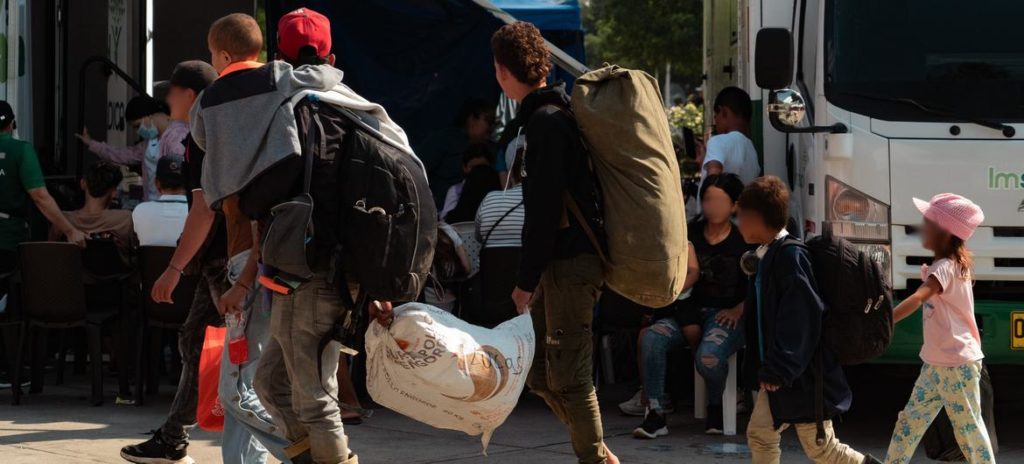
People displaced by violence in the Catatumbo region (archive). UNHCR / Lucas Molet
Ten years after the signing of the peace agreement between the Colombian government and the Revolutionary Armed Forces of Colombia (FARC), the record is paradoxical. On the one hand, the agreement achieved its most ambitious goal: ending a civil war that, for more than half a century, left hundreds of thousands dead and millions displaced. On the other, violence persists in vast areas of the country where armed groups have taken the place of the demobilised guerrillas. For the United Nations, this resurgence reflects not the failure of peace, but the failure of its incomplete implementation.
According to Miroslav Jenča, Special Representative of the United Nations Secretary-General for Colombia, the main problem today is no longer military. It is institutional. Presenting his report to the Security Council, the Slovak diplomat offered an assessment that overturns a widely held view: the violence now shaking Catatumbo, Cauca and parts of the Pacific region is not primarily the result of armed groups’ ability to regroup. Above all, it reveals the persistent inability of the Colombian state to maintain a lasting presence in the territories abandoned by the FARC.
The vacuum left by the war has never been filled
The 2016 peace agreement was not limited to disarming Latin America’s largest guerrilla group. Its ambition ran deeper: to transform the rural regions that had served as a sanctuary for the FARC for several decades. The idea was simple. Where the guerrillas had controlled the population, the state was gradually to take over, bringing roads, schools, health centres, justice, policing, land titles and economic opportunities.,Yet almost ten years on, this handover remains largely unfinished.
In many rural areas, public administration is still absent, infrastructure inadequate and economic prospects limited. This vacuum was swiftly filled by other actors: FARC dissident groups, the National Liberation Army (ELN), criminal organisations and drug-trafficking networks.
The current geography of violence is the most striking illustration of this. As Miroslav Jenča points out, “the areas where violence is most acute today are precisely those where implementation of the agreement and the presence of state institutions have been insufficient”. In other words, today’s conflicts are developing not in spite of the peace agreement, but in the places where it never truly took full effect.
Catatumbo, a testing ground for new wars
The Catatumbo region now embodies all of Colombia’s vulnerabilities. Lying on the border with Venezuela, this strategic region has long been a hub for coca cultivation, drug trafficking and smuggling.
After the FARC’s departure, several armed organisations sought to take control of this area. Clashes intensified in 2025, despite government territorial development initiatives. The conflict itself is changing. Traditional ambushes, anti-personnel mines and kidnappings have now been joined by drones used for military purposes, a sign that even non-state armed groups are adopting technologies once reserved for regular armies.
This modernisation of violence comes even as its causes remain deeply rooted in the past: poverty, isolation, weak institutions and a lack of economic alternatives.
An often-forgotten success: the reintegration of former combatants
This deterioration in security sometimes tends to obscure one of the peace agreement’s major successes. Some 13,000 FARC members laid down their arms in 2016. More than 11,000 are still pursuing their reintegration into society today.
According to the United Nations, few disarmament processes anywhere in the world show such a low rate of return to armed struggle. This outcome is probably the agreement’s main achievement. It demonstrates that a guerrilla movement that fought for more than half a century can lay down its arms without most of its members slipping back underground. But this success remains extremely fragile. Since 2016, more than 500 former combatants have been murdered.
This violence is a reminder that reintegration does not depend solely on the will of former guerrillas. It also requires the state to be able to guarantee their protection, their access to justice and their economic integration. Failing that, armed groups have fertile ground on which to recruit or intimidate former combatants.
Rural reform, the cornerstone of peace
Beyond security, the heart of the peace project remains the transformation of rural Colombia. For decades, the armed conflict was built around particularly stark inequalities in land ownership. The 2016 agreement therefore provided for a sweeping rural reform intended to redistribute land, secure property titles, develop infrastructure and improve access to credit. Territorial development programmes now cover 170 municipalities, while land redistribution is gradually advancing, notably for the benefit of smallholder farmers, rural women and Indigenous communities.
But here again, access to land is not enough. As Miroslav Jenča points out, owning a plot only makes sense if families can live on it in safety, obtain financing, and grow and sell their crops. Recent attacks on several beneficiaries of the reform illustrate the persistence of local power dynamics that continue to challenge the authority of the State.
A political transition under close scrutiny
The political context adds further uncertainty. President-elect Abelardo de la Espriella’s accession to power in August follows a campaign largely dominated by security issues. The new head of state inherits a peace process that has already survived two changes of government, but whose credibility will now depend on his ability to deliver tangible results in the most fragile territories.
For the United Nations, calling the agreement into question would be a strategic mistake. The current difficulties do not prove that it has failed. Above all, they show that its civilian components — rural reform, territorial development, institutional presence — have never been given the same priority as disarmament.
The real test of peace
As the tenth anniversary of the agreement approaches in November, Colombia offers a lesson that extends far beyond its borders. The country has shown that it is possible to persuade a guerrilla movement to lay down its arms and to avert a large-scale return to civil war. Few peace processes anywhere in the world can claim such an outcome. But it is also a reminder of an often underestimated reality: an agreement does not, by itself, bring a conflict to an end.
Peace is not measured solely by the silence of the guns. It is built on the state’s capacity to replace de facto powers, on a lasting basis, with legitimate institutions, public services and economic prospects. Ten years after the FARC, Colombia is no longer a country at civil war. It nonetheless still faces the hardest challenge of any transition out of conflict: turning a diplomatic victory into an effective state presence in territories long governed by violence.
Overcoming the structural causes of the conflict – inequality, exclusion, impunity and mistrust – is not the task of any single government, “but the responsibility of the state”, Colombia’s representative to the United Nations, Leonor Zalabata, said. Consequently, guaranteeing the security of those who have laid down their arms, of communities and of those working to transform the territories remains an absolute priority.
Translated from French. The French original prevails.