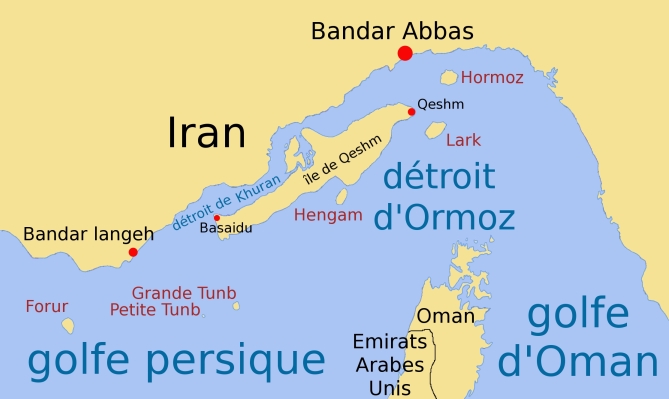
The two ballistic missiles detected by the United Arab Emirates on 18 August did not strike Dubai or Abu Dhabi: according to the assessment of the Emirati Ministry of Defence, they were aimed at shipping and fell into the sea. The episode follows a series of attacks on vessels belonging to the Abu Dhabi National Oil Company (ADNOC) and comes as the future regime of the Strait of Hormuz is being negotiated. Tehran is seeking to retain a say over the passage; Abu Dhabi is demanding a return to the pre-war conditions of free navigation. The Emirati response has, for now, been mainly economic and financial. But behind the exchange of missiles lies a more enduring question: who will set the rules of Hormuz once it reopens?
On 18 August, residents of the United Arab Emirates once again saw a security alert flash up on their phones. The Ministry of Defence announced that it had detected two ballistic missiles launched from Iran. A few hours later, it stated that, according to its assessment, the projectiles had been aimed at “maritime traffic”. Both fell into the sea and there were no casualties. Tehran rejected the Emirati accusation, describing it as baseless.
Taken in isolation, the incident might look like yet another flare-up in the confrontation that has pitted Iran against its Gulf neighbours since the start of the war. Seen in the context of recent weeks, however, it takes on a different dimension. The missiles come after repeated attacks on buildings linked to the Abu Dhabi National Oil Company (ADNOC), after the collapse of traffic through the strait and, above all, at a time when Iran and Oman are negotiating an arrangement that could permanently change the rules of navigation in Hormuz.
This is probably where the key to understanding it lies. At this stage, there is no public evidence to show that Tehran decided to fire on Emirati shipping specifically to force Abu Dhabi to accept the plan under discussion with the Sultanate of Oman. But the timing of events reveals an increasingly clear strategic confrontation: the Emirates refuse to let the crisis allow Iran to turn its capacity for military disruption into a permanent right of control over one of the world’s main energy arteries.
Two missiles aimed less at Abu Dhabi than at shipping
The distinction matters. According to the Emirati assessment, the two missiles of 18 August were not aimed at a district of Dubai, a military base or an onshore oil facility. Their target was reportedly maritime. If that assessment is correct, the incident is part and parcel of the battle for Hormuz rather than a conventional bombardment of Emirati territory.
The maritime backdrop is already fraught. On 7 August, ADNOC said that fifteen of its vessels had been attacked by missiles or drones since the start of the conflict, with at least one seafarer killed and twenty injured. On 13 August, the Emirates accused Iran of attacking two more of the company’s ships in the strait. The following day, another incident struck an ADNOC vessel. Abu Dhabi then condemned acts of “piracy” and the use of the strait as a tool of economic pressure.
Iran has not claimed responsibility for the attacks. However, the Islamic Revolutionary Guard Corps had warned that it could take action against vessels linked to countries it regards as adversaries, or against those failing to comply with Iranian transit directives. The wording is crucial: it ties the physical safety of ships to compliance with a navigation regime that Tehran is precisely seeking to impose.
ADNOC becomes a test of sovereignty
For the Emirates, ADNOC is not merely an oil company. It is one of the federation’s economic pillars and an instrument of its international credibility in energy. The ability to keep exporting despite the crisis has therefore become as much a matter of sovereignty as a commercial issue.
This confrontation touches on a vulnerability that the Emirates have long sought to reduce. As La Tribune des Nations noted in its analysis of 6 July, “The United Arab Emirates: the pursuit of strategic autonomy”, Abu Dhabi has developed Fujairah, on the Gulf of Oman, along with a pipeline that allows part of its crude to be exported without passing through Hormuz. DP World, the Dubai-based ports and logistics giant, is also preparing new port capacity on the eastern coast. The aim remains the same: to reduce the ability of any outside actor to paralyse the Emirati economy by controlling a single chokepoint.
This is precisely what may make the Emirati strategy particularly irksome for Tehran. The more successfully Abu Dhabi bypasses Hormuz and keeps its flows moving, the weaker the coercive effect Tehran is seeking becomes. The attacks on vessels linked to ADNOC can thus be read as an attempt to reintroduce risk precisely where Emirati infrastructure seeks to eliminate it.
The US southern corridor changes the equation
This reading must now take into account a development revealed on 19 August by Axios. According to two US officials, the US military has for several weeks been operating a shipping corridor in the southern part of the strait, along the Omani coast. Between 15 and 20 oil tankers pass in and out through it every night under US military guidance. The United States organises separate time slots for inbound and outbound convoys, helps empty tankers reach Gulf ports to load oil, and then brings them back out through the same channel. US fighter jets provide cover against Iranian drones and cruise missiles.
The officials quoted by Axios estimate that close to 10 million barrels of oil a day now leave the Gulf through this arrangement, roughly half the pre-war level. For the Emirates, the corridor is therefore a vital insurance policy: it keeps open a route in and out for vessels coming to load in the Gulf. But it does not eliminate Iran’s capacity to cause harm. A further hypothesis must therefore be considered, though it cannot be proven at this stage: Tehran may be seeking to show Abu Dhabi that, even under US protection, UAE-linked vessels remain within range of its drones and missiles. The US corridor restores the flow; it does not make the Emirati fleet a sanctuary.
The real battle: the Hormuz regime after the war
Before the war, the strait operated as an international transit route open to shipping without tolls. The plan discussed in early August between Oman and Iran, with regional backing at a time when the Emirates and the other Gulf states were making their own demands known, would change that. According to Reuters, the arrangement under consideration would give Tehran a role over vessels entering the Gulf and Oman a role over the outbound leg. Ships could be required to give notice of their passage, obtain authorisation and pay service fees. Iran is reported to have sought sums equivalent to 5 to 7% of the value of cargoes, with Oman discussing a level of around 3%, while Washington rejects the very principle of such fees. The UAE has not been publicly identified as a formal co-negotiator, but it is directly affected by the arrangement and has set a clear red line: no mandatory tolls and no Iranian political control over passage.
For the shipping industry, this would be no mere technical arrangement. Mandatory payments would amount to a toll, would raise problems with US sanctions and could even lead to the loss of some insurance cover. The International Maritime Organization, for its part, reiterated that passage must remain non-discriminatory, unimpeded and free of transit dues.
It is precisely on this point that the Emirates have drawn their red line. On 22 May, the presidential adviser Anwar Gargash warned that Iranian control would dangerously politicise the strait and place it under Tehran’s influence. He explicitly called for Hormuz to be returned to its pre-war status: an international waterway guaranteeing the free movement of energy, trade and shipping.
The disagreement therefore runs deeper than a quarrel over the amount of any transit fee. It pits two visions against each other. Tehran is seeking recognition, at least de facto, of a supervisory power acquired during the crisis. Abu Dhabi is defending the status quo ante and refuses to let military threats become the source of a new political privilege. It is this tension that the LTDN article of 7 August, “Hormuz: Iran holds the strait, Trump holds the purse strings”, had already highlighted.
Oman in the middle of a negotiation that has become regional
The visit to Abu Dhabi by Haitham bin Tariq, Sultan of Oman, on 17 August comes against this backdrop. The official Omani readout states that the Sultan and Mohammed bin Zayed discussed regional and international developments as well as ways of strengthening security and stability. It makes no specific mention of Hormuz. It would therefore be going too far to claim that the shipping plan was the official subject of the meeting.
But the timing is hard to ignore. Muscat is seeking to bring to fruition a mediation effort that would make the strait navigable and avert a fresh escalation. Abu Dhabi can back that mediation without, for all that, accepting that it should enshrine a permanent Iranian right to screen or tax shipping. Oman’s real challenge, then, is less to reopen a route than to find a formula acceptable to parties who do not give the word “reopening” the same meaning.
Reported seizure of oil tanker: a signal yet to be confirmed
A parallel episode warrants cautious monitoring. The Iranian news agencies Fars and Mehr claimed that a UAE-linked oil tanker had been seized and taken to Bandar Abbas. According to Fars, it was bound for the Emirati port of Jebel Ali. Ship-tracking data showed the Liberian-flagged tanker AMARA making several changes of course before coming to a halt near the Iranian island of Qeshm, in the northern part of the strait used by vessels whose transit has been approved by Iran. However, the available information does not make it possible to confirm independently that the AMARA is indeed the vessel reported to have been seized, nor to establish clearly that it is Emirati-owned. The Jebel Ali destination should therefore likewise remain attributed to Iranian sources until it is confirmed by an independent maritime source.
Caution is all the more warranted given that no official Emirati confirmation has yet been issued. But if the seizure and the reason for it are confirmed, the incident would be particularly telling: Fars presented compliance with a route designated by Iran, the payment of fees and the obtaining of Iranian authorisation as conditions for passage. This would then no longer be merely a threat to shipping, but an attempt to physically enforce the new rules claimed by Tehran.
Abu Dhabi responds first with economic weapons
The Emirati response to the missiles of 18 August was immediate and, for now, non-military. The UAE has suspended all commercial activity, trade and financial transactions with Iran until further notice. The decision carries far more weight than a mere recall of an ambassador or a diplomatic condemnation. For decades, Dubai has been one of the Iranian economy’s main gateways to foreign currency, goods and international networks. There is no reliable public figure that isolates the value of Iranian financial flows passing through the UAE alone. Trade, however, gives an order of magnitude: according to data from Iran’s customs administration for the year ending 20 March 2025, the UAE supplied $21.9 billion of goods to Iran out of $72.4 billion in non-oil imports, or around 30%. It was then the country’s largest supplier, ahead of China. This figure does not include the full range of re-exports, shell companies and parallel financial channels that give Dubai an even broader role in Iran’s access to the global economy.
These customs data, published by IRICA and reported in April 2025, make it possible to gauge the weight of the Emirati trade channel without conflating declared trade with clandestine finance (IRICA data).
The choice of the financial weapon now dovetails with US strategy. The Wall Street Journal notes that the success of renewed US economic pressure on Iran depends largely on the Emirates’ ability to curb Iranian financial networks operating out of Dubai. On 19 August, the Secretary of State, Marco Rubio, held talks with the Emirati National Security Adviser, Sheikh Tahnoon bin Zayed. Washington said the two officials had discussed coordination aimed at holding Iran and its proxies accountable for the ongoing attacks, with Rubio stressing freedom of navigation in the strait.
On the morning of 20 August, Donald Trump toughened this aspect further by threatening economic consequences for countries and entities that continue to support Iran. This US offensive amplifies the impact of the Emirati decision, but it should not obscure Abu Dhabi’s own interest: depriving Tehran of economic leverage at the very moment Iran is seeking to impose maritime leverage.
Why the UAE is holding off on a military response, for now
Abu Dhabi has the means to harden its response, but a direct military strike on Iran would carry a high risk of escalation. The Emirati model rests on the security of its infrastructure, investor confidence, the smooth flow of air and sea transport, and Dubai’s image as a stable hub in an unstable region. Entering a cycle of strikes and counter-strikes would expose precisely these assets.
As long as the attacks do not cause major losses on its territory, the most rational response is therefore to combine several instruments: shutting down Iranian financial channels, diplomatic pressure, strengthened missile defence, greater protection for shipping, intelligence cooperation and coordination with Washington and the other Gulf partners, notably to guarantee commercial vessels routes into and out of the Gulf via the southern corridor protected by the United States. This strategy makes it possible to raise the cost imposed on Iran without immediately offering it the ground for an open military confrontation.
That calculation could, however, change. An attack causing heavy casualties in the UAE, the destruction of a major oil or port facility, a direct strike on Fujairah, Jebel Ali or Abu Dhabi, or a series of seizures of Emirati ships could increase pressure for a tougher response. These are not predictions, but the thresholds to watch in order to understand how Emirati doctrine evolves in the coming weeks.
Can Iran turn coercion into the norm?
Iran does not need to destroy Dubai to put the Emirates under pressure. It need only show that it can make navigation through the strait dangerous and undermine the image of security on which part of the Emirati success rests. Hormuz gives it that capability with an effectiveness that few other instruments afford it.
But Abu Dhabi has levers of its own. Fujairah reduces its geographical dependence. Dubai remains an important economic gateway for Iran. ADNOC carries considerable weight on the energy markets, and the relationship with Washington gives the Emirates access to intelligence and defence capabilities that Tehran must factor into its calculations.
That is why the missiles of 18 August go beyond their purely military dimension. They come at the very moment when it is being decided whether the closure of Hormuz will remain a wartime interlude or give rise to a new system of passage. If Tehran secures a permanent right to screen, authorise or charge ships, it will have turned coercion into the rule. If the Emirates and their partners force a return to the status quo ante, Iran will have demonstrated its capacity to cause harm without managing to convert it into a political gain.
The battle for Hormuz is therefore no longer solely about opening the strait. It is about the right to set the rules once it has reopened.
Further reading from La Tribune des Nations
• Hormuz: Iran holds the strait, Trump holds the purse strings — 7 August 2026
• The United Arab Emirates: the quest for strategic autonomy — 6 July 2026
• Iran–United States: war redraws the strategic architecture of the Middle East — 22 July 2026
Further reading
• Reuters — UAE’s financial embargo on Iran after missile threat puts rivalry back in spotlight — 19 August 2026
• Reuters — UAE says two missiles detected earlier were launched from Iran — 18 August 2026
• Reuters — Proposed Hormuz passage deal not feasible for shipping industry, sources say — 6 August 2026
• Reuters — UAE’s Gargash sees “50-50” odds of US-Iran deal, warns against renewed fighting — 22 May 2026
• Reuters — ADNOC says attacks on vessels, staff significantly impacting operations — 7 August 2026
• Reuters — UAE says Iran attacked two ADNOC vessels in Strait of Hormuz — 13 August 2026
• Reuters — Trump warns of economic consequences for any country that supports Iran — 20 August 2026
• The Wall Street Journal — Trump’s Plan to Squeeze Iran’s Economy Will Live or Die in Dubai — 20 August 2026
• U.S. Department of State — Rubio Talks With UAE’s Sheikh Tahnoon — 19 August 2026 — statement reproduced by Mirage News
• Oman News Agency / Times of Oman — HM the Sultan pays fraternal visit to UAE — 17 August 2026
• Bloomberg — Tanker Stops in Hormuz as Iran Raises Efforts to Control Strait — 18 August 2026 — tracking of the tanker AMARA
• Axios — U.S. conducting stealth operation to transport oil through Hormuz — 19 August 2026
• IRICA / Press TV — Iran posts $14.6bn trade deficit for calendar year to late March — 6 April 2025 — data on Iranian imports from the UAE
• Reuters — Oman proposes Hormuz management system with voluntary fees, source says — 28 July 2026 — a proposal with regional backing
Translated from French. The French original prevails.