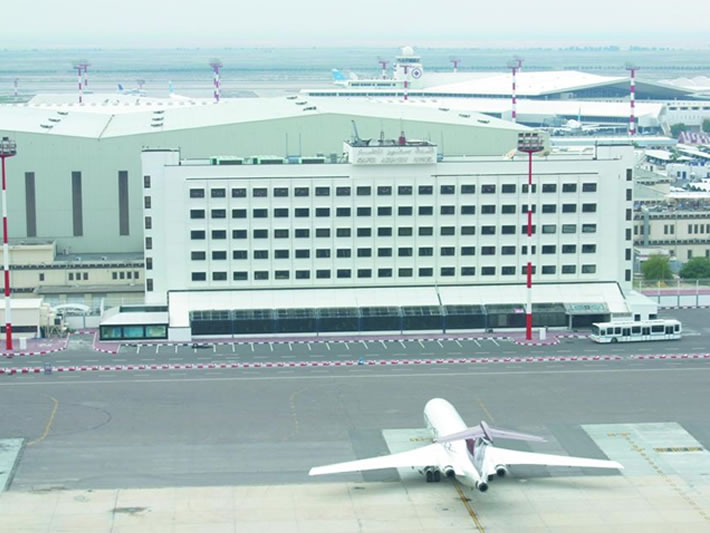
The targeting of Kuwait International Airport and other sites on Kuwaiti territory, as part of the regional escalation at the end of February 2026, is neither an isolated incident nor a sudden development. It is part of a trajectory stretching back four decades, during which Kuwait has been exposed to evolving forms of Iran-linked pressure, ranging from proxy terrorism to maritime warfare and intelligence activity, through to the direct ballistic threat. While Iranian rhetoric during the latest escalation emphasised the targeting of military installations linked to the American presence, striking the international airport and vital infrastructure amounts to an attack on the sovereignty and stability of society, and goes beyond the logic of “military retaliation”.
To understand what happened in 2026, one has to go back to the 1980s, when Kuwait found itself at the heart of the fallout from the Iran-Iraq War. Because of its financial and political support for Iraq, it became the target of a series of bombings and acts of violence attributed to networks linked to Iran. The aim was not strictly military but political and deterrent: to raise the cost of Kuwait’s alignment with Tehran’s adversary. As what became known as the “Tanker War” escalated, the pressure shifted to the maritime domain, where Kuwaiti-linked ships and tankers were targeted, prompting the country to seek US naval protection in 1987. Since then, a structural link has taken hold between Kuwait’s security and the US deterrence posture in the Gulf.
Over forty years, Iran’s instruments of pressure have evolved, but the strategic equation has remained constant
After the end of the Iran-Iraq War, and then Iraq’s invasion of Kuwait in 1990, the region entered a phase in which the balance of power was reshaped. During this period, Kuwait suffered no major attacks directly attributed to Iran, but latent tension persisted. The Kuwaiti-US security partnership deepened, particularly after US forces entered Iraq in 2003 via the port of Umm Qasr. This context made Kuwait, by virtue of its geographical position, part of the regional deterrence equation, even without being a direct party to the conflict.
Tensions returned to the fore in the second decade of the 21st century, with espionage cases and armed cells dismantled by the Kuwaiti authorities, the most notable being the so-called “Al-Abdali cell” affair in 2015. These cases marked a shift from open confrontation to a logic of “latent capability”, consisting of building networks that can be activated in times of escalation. This type of pressure belongs to the “grey zone”, where war is not officially declared but its instruments are quietly prepared.
This trajectory cannot be separated from the political and media escalation seen in recent years on the part of Iran-aligned Iraqi armed groups over the issue of the maritime border in the Khor Abdullah. These groups have recently called into question the maritime agreement between Kuwait and Iraq, adopting increasingly aggressive rhetoric that goes beyond legal and diplomatic frameworks, including implicit threats against Kuwaiti sovereignty. Although the maritime boundary has been settled by international decisions and bilateral agreements, its re-politicisation in mobilising rhetoric illustrates the use of border issues as an instrument of political pressure. In this context, the Khor Abdullah is no longer merely a waterway, but a test of the regional balance, where legal sovereignty intersects with calculations of indirect influence.
It is against this complex historical backdrop that the targeting of Kuwait’s airport and other sites in 2026 must be seen, marking a qualitative shift. Airports are not mere civilian infrastructure; they are a symbol of sovereignty, economic openness and domestic stability. Any threat to civilian airspace, even under the pretext of striking nearby military installations, raises profound legal and security issues relating to the protection of civilians and the safety of air navigation. The line between military and civilian becomes all the more blurred with the use of ballistic missiles and long-range drones, which by their very nature heighten the risk of error or collateral damage.
Over forty years, Iran’s instruments of pressure have evolved, but the strategic equation remains constant: as the confrontation between Iran and its regional or international adversaries intensifies, the likelihood of Kuwait being exposed to external aggression increases because of its alliances and its geographical position. Kuwait is not Iran’s principal strategic enemy, but nor does it lie outside its deterrence calculations. It stands at the intersection of two logics: that of the security alliances that guarantee its protection, and that of geographical proximity, which obliges it to manage its relationship with a major regional power – not to mention the complexities of the Iraqi theatre and their cross-border repercussions.
Kuwait’s challenge today is not confined to strengthening its defensive capabilities. It also lies in managing its position in a regional environment where power politics is making a forceful comeback. The aim is not only to deter any potential aggression, but also to consolidate its border cases legally and diplomatically, to activate international mechanisms where necessary and to strengthen channels for regional de-escalation, so as to prevent Kuwaiti territory or its sea lanes from becoming a stage for messages traded between larger powers.
Ultimately, the targeting of Kuwait’s airport in 2026 and the escalation over Khor Abdullah are not two separate episodes, but two expressions of a continuing test of a small state’s sovereignty in an unstable regional environment. Kuwait, by virtue of its position and its political and economic weight, will remain compelled to manage this delicate balance between deterrence, international law and preventive diplomacy.
Translated from French. The French original prevails.