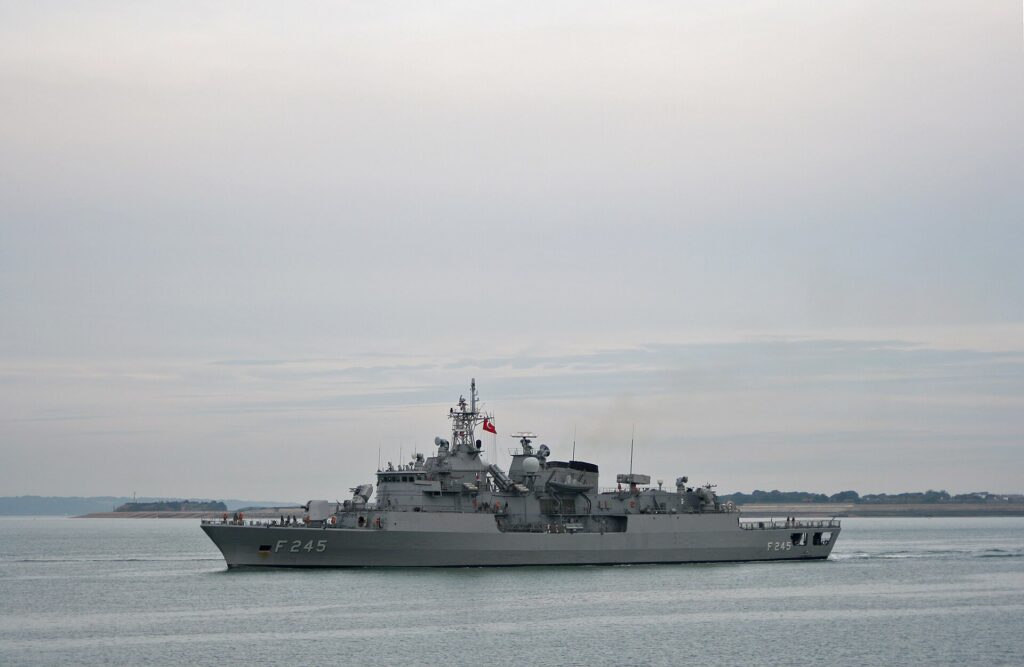
By securing approval of its maritime agreement from the eastern Libyan parliament, Ankara is consolidating its relations with both of the country’s rival authorities. This success goes beyond the delimitation of maritime boundaries. It extends to energy resources, infrastructure and port access. Above all, it highlights the limits of French influence and Italy’s decision to come to terms with Turkish power.
On 20 October 2026, Libya’s House of Representatives, which sits in Tobruk and backs the eastern authorities, rivals of the Tripoli government, approved the maritime memorandum signed with Turkey on 27 November 2019 by Fayez al-Sarraj’s Government of National Accord, then internationally recognised. It also revoked the decisions by which it had rejected the agreements with Ankara and called for the severing of political relations. The shift is considerable: the eastern institution that had opposed Turkey’s intervention now accepts one of its main diplomatic instruments. [1]
This vote does not, on its own, alter the maritime boundaries recognised by other states. Above all, it means that the authorities of both Libyan camps, despite their rivalry, now accept a text that allocates to Turkey and Libya maritime zones contested by Greece, notably in the vicinity of Crete, as well as by Egypt. For Ankara, domestic opposition is easing; international opposition remains. This distinction is essential to understanding the significance of Turkey’s success.
Two governments and several centres of power
Since the fall of Muammar Gaddafi in 2011, Libya has not regained a unified national authority. After his overthrow, various militias that emerged from the uprising kept their weapons and their local control. The political rupture of 2014 installed rival authorities in the west and the east. Yet these are not two states separated by a border: alliances shift, armed groups may cooperate one day and clash the next, and real power does not always coincide with official titles.
In the west, Tripoli, in Tripolitania, is home to the Government of National Unity led by Abdul Hamid Dbeibah, which emerged from the UN-backed political process and is still internationally recognised. In the east, the House of Representatives sits in Tobruk and backs a rival government led by Osama Hammad. In Benghazi, Khalifa Haftar commands the forces grouped under the name “Libyan National Army” (LNA): the title does not mean that he leads a unified national army. A military commander who has built his own power apparatus, he dominates much of Cyrenaica and also wields influence in the south. The parliament, the eastern government and Haftar’s command remain separate centres of decision-making. [2]
This political split is compounded by military and economic fragmentation. Around Tripoli, Dbeibah depends on a balance between armed groups that provide part of the city’s security but also defend their own interests. In the eastern camp, Haftar has units, tribal alliances and family networks that weigh on civilian decision-making. As for oil, it accounts for much of the balance of power: the fields and terminals lie mainly in the east and the south, but export revenues flow through national institutions. Controlling a well therefore does not mean receiving the money from its sale directly.
The Libyan crisis, then, cannot be reduced to a duel between Dbeibah and Haftar. It pits against each other institutions and forces whose alliances keep shifting. The UN’s efforts to bring about elections and reunify the institutions continue to run up against this reality; as recently as 30 August 2026, the mission announced a new preparatory arrangement. The maritime vote marks a rapprochement over one specific interest. It signals neither a general peace nor the country’s reunification. [3]
This chronology sheds light on the current reversal: in 2011, Gaddafi was overthrown; in 2014, the institutions split; in 2019-20, Haftar attacked Tripoli, then retreated in the face of a Turkish-backed coalition; in 2021, Dbeibah’s government was formed as part of a transition that did not lead to national elections. In 2026, the rivalry between Tripoli and Benghazi persists, but external alliances are being reshaped.
Ankara gains a partner in its former adversary
In April 2019, Haftar launched an offensive to capture Tripoli. Turkey, which intervened in support of the authorities in the west, helped to repel his forces in 2020. In November 2019, while the war was under way, Ankara and the government of Fayez al-Sarraj had concluded two memoranda, one on security, the other maritime. Hence the paradox of autumn 2026: the camp that Turkey helped to defeat militarily is endorsing the text signed by its adversaries.
This rapprochement has taken concrete form. The Turkish Ministry of National Defence announced a meeting of military delegations during the port call of the corvette TCG Kınalıada in Benghazi on 20 August 2025, as well as a visit on board by Saddam Haftar. The port call does not prove the existence of a permanent base, but it does attest to direct military exchanges. [4]
For Haftar and his entourage, this rapprochement serves concrete interests: diversifying foreign partners, attracting Turkish companies and avoiding prolonged opposition to a power already influential in Tripoli. For Ankara, reconstruction contracts and security cooperation ease access to the east without abandoning relations with the west. The vote of 20 October reflects this diplomatic shift, not the Haftar camp’s endorsement of every Turkish position. [5]
Turkey therefore does not need to reconcile the whole of Libya in order to make progress. It can negotiate with each centre of power over what that centre actually controls. This flexibility nonetheless carries a weakness: the agreements remain exposed to internal rivalries and changes of succession.
France’s bet on Haftar no longer guarantees Benghazi’s choices
French policy is explained first and foremost by the years spent fighting jihadist organisations, during which Paris regarded Haftar as an important security interlocutor. Emmanuel Macron then hosted Haftar and Fayez al-Sarraj, at the time head of the Government of National Accord in Tripoli, at La Celle-Saint-Cloud on 25 July 2017. The stated aim was to bring the two camps closer together and to support a political way out of the crisis. This mediation did not, however, prevent the offensive against Tripoli in 2019. [6]
The United Arab Emirates and Egypt also backed the eastern camp, pursuing objectives that do not coincide with those of France. None of this support required Haftar to give up seeking other partners. The rapprochement with Ankara illustrates precisely this autonomy: a Libyan actor can benefit from several external relationships, even when their interests diverge.
At the same time, Haftar kept up his contacts with Paris. Haftar met Macron at the Élysée on 26 February 2025, according to an AFP dispatch published the following day. The October vote nevertheless reveals the limits of this relationship: Paris retains access to the eastern leader, without being able to guarantee his strategic choices. [7]
France also retains significant economic interests. On 24 January 2026, TotalEnergies signed the extension of the Waha concessions until the end of 2050. This industrial foothold should not be confused with Paris’s diplomatic influence, but it is a reminder that significant French interests persist. The problem for Paris is turning its presence into a capacity to act. [8]
Italy chooses to work with Turkey
Rome approaches Libya with pressing constraints: energy supply, stability in its southern neighbourhood and migrant departures towards its shores. These priorities favour practical arrangements with whichever authorities are able to act on the ground. Rivalry with Paris exists, but it is not enough to explain this policy.
Eni’s long-standing presence gives this policy a major economic dimension. On 28 January 2023, the Italian group and Libya’s National Oil Corporation (NOC) announced an $8 billion gas project centred on Structures A and E, two installations designed to exploit offshore gas fields linked to Bahr Essalam, off western Libya. The gas is to supply Libya and, in time, contribute to exports. The Greenstream pipeline already links the Libyan coast to Sicily. For Rome, Libyan security is therefore directly tied to its energy needs. [9] [18]
On 16 March 2026, Eni announced two gas discoveries with combined estimated resources of more than one trillion cubic feet, or around 28 billion cubic metres. These resources cannot be exploited immediately, but they explain Rome’s interest in lasting relations with Libya. [10]
Italy also cooperates directly with Ankara. On 1 August 2025, Giorgia Meloni took part in a meeting in Istanbul with Recep Tayyip Erdoğan and Abdelhamid Dbeibah, focused in particular on migration. Rome is thus prepared to deal with Turkey as a power in order to protect its own priorities. This does not amount to endorsing the disputed maritime boundary. [11]
Rome and Paris differ above all in how they handle the balance of power. Italy is seeking sector-by-sector arrangements; France must reconcile its Libyan interests with its strategic closeness to Greece. Ankara can turn these differing priorities to its advantage. An Italian gain does not automatically become a collective European gain.
What the agreement really changes at sea
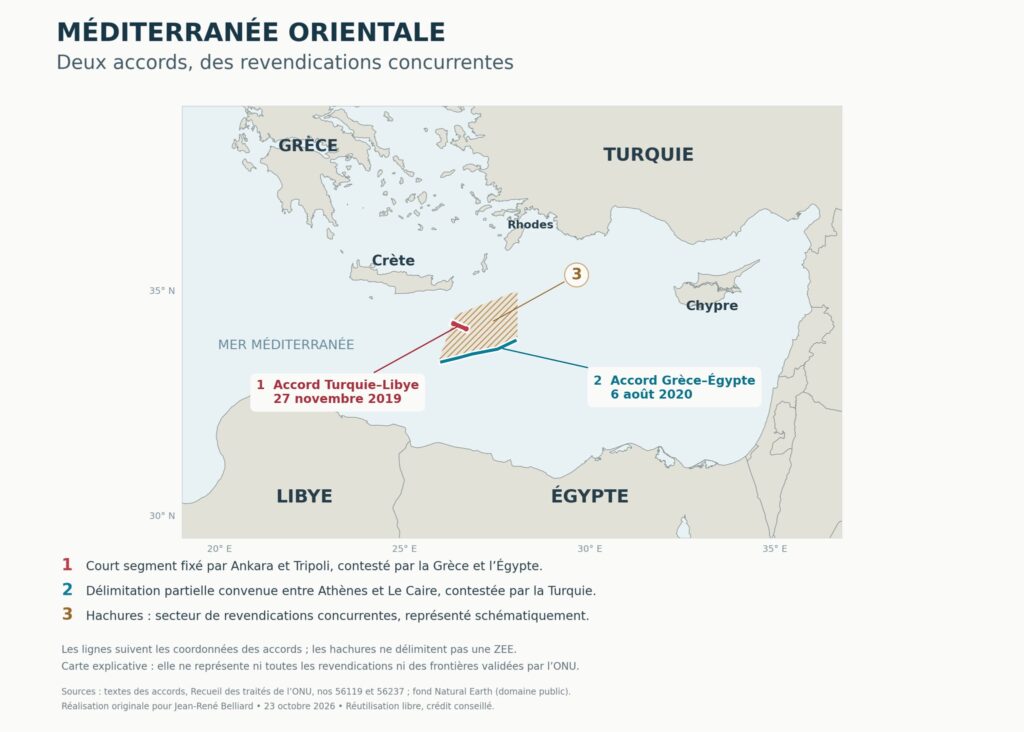
In concrete terms, the 2019 memorandum draws a maritime boundary between Turkey and Libya that drastically reduces the weight given to the Greek islands lying between their coasts, Crete in particular. Greece and Egypt oppose the agreement. Athens maintains that these islands also generate entitlements to the surrounding maritime zones. Two conflicting interpretations of the law of the sea are thus superimposed on the map. The European Union likewise considers that the boundary infringes the rights of third states and does not comply with the law of the sea; Ankara defends a delimitation it regards as equitable. The Libyan vote strengthens Turkey’s position politically, but does not make the Greek and Egyptian legal objections go away. [12]
A legal clarification is essential. The territorial sea, which may extend up to 12 nautical miles from the coast, falls under the sovereignty of the coastal state. The exclusive economic zone (EEZ), which may reach 200 nautical miles subject to the rights of other states, grants it preferential rights to exploit the resources of the water and the seabed: it does not give it ownership of the entire sea. The continental shelf concerns the seabed and its subsoil, notably for the exploitation of hydrocarbons. When the coasts or islands of several countries face each other at a short distance, their claims overlap and must be delimited. This is precisely what divides Ankara, Athens and Cairo. [13]
The economic stakes are nonetheless tangible. On 25 June 2025, the NOC signed a memorandum with the Turkish company TPAO providing for geological and geophysical surveys of four offshore areas. The agreement concerns exploration and does not prove the existence of new exploitable deposits. It shows how maritime diplomacy can open up industrial prospects. [14]
From the seabed to European ports
Power cables broaden the stakes of this dispute. The Great Sea Interconnector is intended to link the European grid to Cyprus and then to Israel. On 15 October 2026, Reuters reported a request to resume seabed surveys and recalled Turkey’s opposition to the project. The question is whether a European-backed project can go ahead despite Ankara’s claims. [15]
A distinction must nonetheless be drawn between operational pressure and recognised rights. The Convention on the Law of the Sea protects the laying of submarine cables, subject to the rules applicable to the various maritime zones; pipelines are governed in part by other conditions. Turkey is not a party to the convention, and disagreements over boundary delimitation persist. But a continental shelf claim does not, in itself, create a general veto over all cables. [13]
Ports also form part of this strategy. They allow for ship maintenance, the delivery of equipment, trade and, depending on the agreements concluded, military support. Shipping lanes then link these facilities to markets. Resources, undersea infrastructure and logistical access can reinforce one another, without falling under a single legal regime or under Turkish control that has already been secured.
Turkey’s strategy combines several levers: military protection for a partner in Tripoli, dialogue with its former adversary in Benghazi, economic opening and the consolidation of its maritime claims. Libya thus becomes a foothold from which to influence decisions in the Mediterranean. What is at stake is not a Turkish “corridor” that would automatically bar navigation, but Ankara’s ability to complicate or negotiate rival projects.
Egypt, Greece and Cyprus reject Turkish-Libyan agreement
On 21 October 2026, the Egyptian Ministry of Foreign Affairs rejected Libya’s approval of the 2019 memorandum. Cairo regards it as null and void and without legal effect for Egypt, particularly with regard to its rights over its exclusive economic zone and continental shelf. The protest is politically significant: Egypt, a traditional backer of the Haftar camp, is contesting an agreement now accepted by Libya’s eastern authorities. The disagreement shows that their interests do not always coincide, though it does not signal a rupture. [19]
Greece also rejected Tobruk’s decision, while Cyprus has opposed the Turkish-Libyan delimitation from the outset. On 22 October, Athens announced talks with Cairo on extending eastwards, towards Cyprus, their partial maritime delimitation agreement signed in 2020. No new agreement had been concluded at that point: the two capitals are seeking to mount a diplomatic and legal response to Ankara’s strategy. Israel, too, condemned the Libyan vote. [20] [21]
Europe forced to choose its response
By securing the eastern authorities’ assent to an agreement originally concluded with Tripoli, Ankara has scored a decisive point. Its influence is not exclusive, however. Haftar retains other interlocutors: his reception by the Egyptian President, Abdel Fattah al-Sisi, on 19 August 2026 is a reminder that his rapprochement with Ankara is part of a diversification of relations, not an automatic abandonment of his former backers. [16]
Europeans can therefore still carry weight. Their difficulty lies in reconciling the defence of Greek and Cypriot rights, energy needs and relations with the Libyan authorities. A French policy without operational levers risks exhausting itself in protests; Italian arrangements without European coordination may strengthen Ankara’s bargaining power.
Turkey cannot set the rules governing the Mediterranean seabed on its own. It is, however, working to make its exclusion politically and materially costly. It is in this sense that it is seeking to force Europe into dialogue. For Paris as for Rome, the question becomes one of the substance of the negotiation: defending specific interests together, or letting Ankara deal with each of them separately.
Keywords
Turkey, Libya, Mediterranean, France, Italy, Haftar, Tripoli, Benghazi, gas, oil, submarine cables, ports, law of the sea
Sources and reference links
[1] Libyan news agency LANA — parliamentary approval, 20 October 2026
[2] Associated Press — the Libyan authorities and the vote of 20 October
[3] UNSMIL — agreement on the next electoral steps, 30 August 2026
[4] Turkish Ministry of National Defence — port call in Benghazi, 20 August 2025
[5] Reuters — Ankara–Benghazi rapprochement and ratification, 20 October 2026
[6] Élysée — La Celle-Saint-Cloud meeting, July 2017
[7] AFP in L’Orient-Le Jour — Haftar received by Macron, 27 February 2025
[8] TotalEnergies — extension of the Waha concessions, January 2026
[9] Eni — $8 billion gas project, 28 January 2023
[10] Eni — two gas discoveries, 16 March 2026
[11] Embassy of Italy — Italy–Turkey–Libya summit of 1 August 2025
[12] European Union — statement on the memorandum, 21 October 2026
[13] United Nations — Convention on the Law of the Sea, in particular articles 56, 58, 79 and 121
[14] LANA — NOC-TPAO agreement on four offshore areas, 25 June 2025
[15] Reuters — Great Sea Interconnector project, 15 October 2026
[16] Egyptian Presidency — Sisi-Haftar meeting, 19 August 2026
[17] Reuters in La Tribune — French military personnel in Libya, 20 July 2016
[18] Eni — operations in Libya and the Greenstream gas pipeline
[19] Egyptian Ministry of Foreign Affairs, statement of 21 October 2026 — https://sis.gov.eg/en/media-center/news/egypt-rejects-libyan-parliaments-ratification-of-maritime-mou-with-turkey/
[20] Reuters, 22 October 2026 — Greece-Egypt talks on extending the EEZ — https://www.reuters.com/world/greece-egypt-talks-extend-maritime-zone-further-east-2026-10-22/
[21] Reuters, 21 October 2026 — reactions from Egypt and Israel — https://theprint.in/world/egypt-rejects-libyan-approval-of-maritime-deal-with-turkey/3078106/
Follow Seals Consulting on X : @Consulting4502
Further reading in La Tribune des Nations
Egypt’s port of Damietta: the energy war reaches the Mediterranean
After Hormuz, Bab el-Mandeb: the new front in the energy war
The oil crisis: from the straits to the streets
Translated from French. The French original prevails.